Schema Versioning Strategy: A Practical Guide for Engineers
Schema Versioning Strategy: A Practical Guide for Engineers

A resilient schema versioning strategy combines compatibility-first rules (additive by default), semantic or date-based versioning for major breaks, a published deprecation runway, and explicit migration patterns matched to each schema type. Start this week, publish your version policy, add a schemaVersion sentinel to documents and messages, wire contract tests into CI, and post your deprecation policy where consumers can find it.
Every strategy needs five core elements:
- A compatibility contract (backward, forward, or full) declared for each schema surface
- A registry or version marker so producers and consumers agree on which schema is active
- A migration plan (lazy, batch, or dual-write) for each breaking change
- CI checks that fail the build before a breaking change ships
- A deprecation window with a published removal date and usage monitoring
Pro Tip: For regulated systems, bind every deprecation event to automated compliance tests and write the result to an audit log. That single habit converts a governance risk into a documented control.
Key Takeaways
A sound schema versioning strategy requires compatibility contracts, version markers, migration plans, CI enforcement, and a published deprecation window to evolve schemas without breaking consumers.
| Point | Details |
|---|---|
| Compatibility contract first | Declare backward, forward, or full compatibility per schema surface before writing any migration code. |
| Embed version markers in data | Add a schemaVersion field to documents and messages so consumers can apply the correct migration path. |
| CI must block breaking changes | Run lint, registry compatibility checks, and consumer-driven contract tests on every pull request. |
| Deprecation needs a 12-month runway | Announce removals at least 12 months out for external consumers; use the Sunset header for HTTP APIs. |
| Jundago governs the full lifecycle | Jundago automates schema generation, compatibility checks, RBAC enforcement, and audit trails in one platform. |
Table of Contents
- What schema versioning is and why it matters
- How to classify schema changes before you version them
- Backward, forward, and full compatibility: which model fits your system
- Concrete techniques and tools for managing schema evolution
- Operational best practices for deprecating schemas safely
- Migration workflow patterns you can use today
- Common anti-patterns that will cost you later
- How to integrate schema checks into CI/CD and governance
- Schema versioning as a compliance posture, not just an engineering practice
- Jundago accelerates schema governance for regulated teams
- Authoritative specs and guides to read next
- Sources
What schema versioning is and why it matters
Schema versioning is the practice of tracking, communicating, and managing changes to the structure of data contracts over time. It applies across every surface where a producer and consumer share a structural agreement: relational database tables, JSON and NoSQL documents, Apache Avro and Protobuf message formats, OpenAPI/REST contracts, and GraphQL schemas.
Ignore it and the failure modes are concrete. A renamed column breaks an ORM query silently. A removed field in a Kafka message causes a consumer to throw a null-pointer exception at 2 AM. A tightened validation rule in a JSON document rejects records that were valid yesterday. In regulated environments, those failures carry an extra cost: a HIPAA audit trail that could be impacted if fields change without proper tracking, or a PCI DSS report referencing an outdated schema version that was replaced without clear communication.
The scope decision matters too. When data lives in an event store or a message bus, you need version markers in the data itself, not just at the API layer. A REST API can carry its version in the URI and leave the payload schema implicit, but a Kafka topic that replays three years of events must embed a schemaVersion field so consumers know which migration path to apply. Both layers together are required for event-sourced systems.
How to classify schema changes before you version them
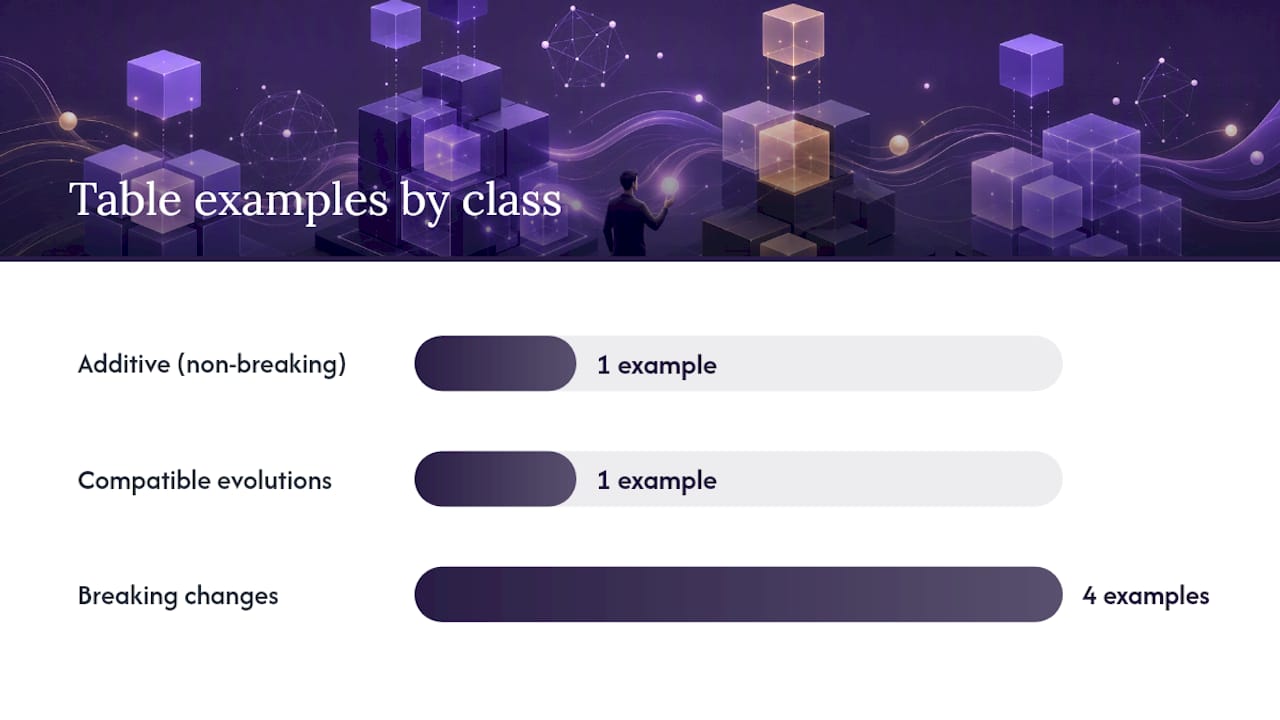
Not every change is a breaking change, and treating them all the same wastes migration budget. The taxonomy below covers the most common cases.
Additive (non-breaking): adding an optional field, adding a new type or enum value, adding a new endpoint or query field. No version bump required for consumers that ignore unknown fields.
Compatible evolutions: widening a type (int32 to int64), making a required field optional, relaxing a validation constraint. These are technically backward-compatible but require coordination with consumers that depend on the old constraint.
Breaking changes: renaming a field, removing a field, changing a field’s type in a narrowing direction, tightening validation, changing the semantic meaning of an enum value, reordering positional fields (critical in Avro without named fields).
Format-specific notes matter here. Apache Avro enforces compatibility modes at the registry level: backward compatibility means a new schema can read data written by the old one; forward means the old schema can read data written by the new one. GraphQL’s model is additive by design: add fields and types freely, then use @deprecated to signal obsolescence so clients migrate at their own pace. For SQL schemas, adding a nullable column is safe; dropping a column or changing a NOT NULL constraint is a major-version event.
| Change Type | Example | Recommended Response |
|---|---|---|
| Add optional field | New metadata object in JSON |
No version bump |
| Widen numeric type | int32 → int64 |
Minor bump, verify consumers |
| Remove field | Drop legacy_id column |
Major bump + migration plan |
| Rename field | user_name → username |
Major bump + dual-write period |
| Change enum meaning | status: "active" reused for new state |
Major bump + consumer coordination |
| Tighten validation | Add NOT NULL to existing column | Major bump + data backfill |
Watch the edge cases. A field whose meaning changes without a type change looks non-breaking to a linter but breaks consumer logic. Default-value changes are similarly invisible to schema diff tools but can alter downstream calculations. These require explicit coordination, not just a version bump.
Backward, forward, and full compatibility: which model fits your system
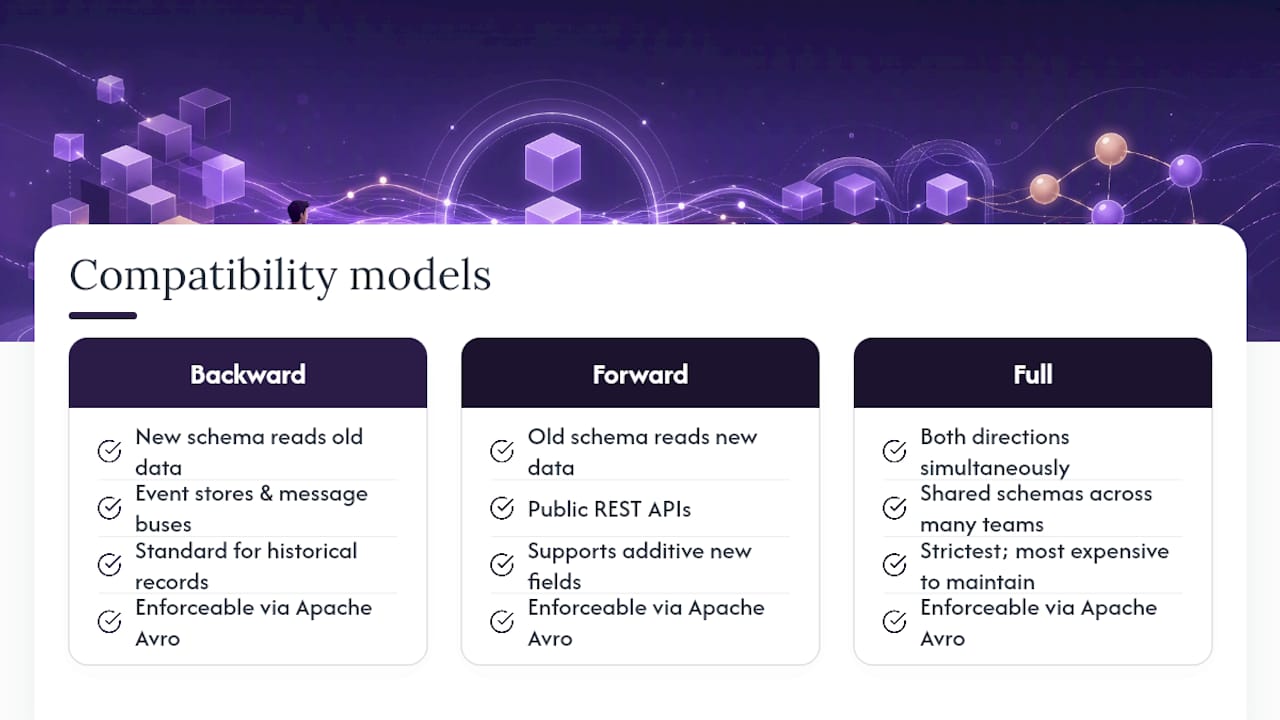
Backward compatibility means new schema reads old data. A consumer upgraded to schema v2 can still process messages written under v1. This is the standard for event stores and message buses where you cannot retroactively rewrite historical records.
Forward compatibility means old schema reads new data. A consumer still running v1 can process messages written by a v2 producer. This is the model public REST APIs often need: you ship a new field, and old clients must not break when they encounter it.
Full compatibility requires both directions simultaneously. It is the strictest contract and the most expensive to maintain, but it is the right choice for shared schemas consumed by many independent teams on different release cycles.
Apache Avro documents all three modes and lets you enforce them at the registry level, so a producer cannot register a schema that violates the declared compatibility contract. Semantic Versioning maps cleanly onto this: patch for bug fixes, minor for backward-compatible additions, major for any breaking change.
When you need a temporary relaxation, parallel fields are the standard tool. Add the new field alongside the old one, migrate producers to write both, wait for consumers to adopt the new field, then remove the old one. Union types in Avro serve the same purpose for type changes.
Pro Tip: Don’t gate field removal on an arbitrary date. Instrument usage of deprecated fields and remove them only after observed access drops below a defined threshold, say, zero hits over a 30-day window in production. That threshold is defensible in a post-incident review; a calendar date is not.
Concrete techniques and tools for managing schema evolution
Version numbering
Semantic Versioning is the accepted convention for API-level contracts: MAJOR.MINOR.PATCH. Major bumps signal breaking changes; minor bumps signal backward-compatible additions. For high-scale mutable contracts where many consumers pin to a specific version, date-based versioning (e.g., 2024-11-01) offers strong per-account pinning but requires transformer chains to convert between versions, which carries real operational cost. URI versioning (/v1/, /v2/) remains the pragmatic default for most REST teams because it is visible in logs, debuggable with curl, and integrates cleanly with CDNs.
Schema registries
A schema registry is the enforcement layer. Producers register a schema before publishing; the registry validates compatibility against the declared mode and rejects violations before a bad schema reaches consumers. Confluent Schema Registry is the reference implementation for Avro and Protobuf on Kafka. For JSON Schema, a similar pattern applies: embed a numeric schemaVersion in each document and maintain an ordered registry of up/down migration functions.
Format-specific tooling
- Apache Avro: use named fields and set compatibility mode to
BACKWARDorFULLat the subject level in your registry - Protobuf: never reuse field numbers; use
reservedto tombstone removed fields - JSON Schema: embed
schemaVersionin every document; maintain a migration function registry with idempotent up/down transforms - GraphQL: add fields freely, mark obsolete fields with
@deprecated(reason: "..."), and track deprecated-field usage before removal - REST/OpenAPI: choose URI versioning for simplicity or header-based versioning for clean URLs, knowing header versioning is harder to debug and cache
CI checks to run on every PR
Operational best practices for deprecating schemas safely
A deprecation policy is not a courtesy. It is a contract with your consumers, and in regulated environments it is evidence of due process.
- Announce early. Publish the deprecation notice at least 12 months before removal for external consumers; 6 months is a reasonable floor for internal services with clear ownership.
- Add the
Sunsetheader. For HTTP APIs, RFC 8594 defines aSunsetheader that communicates the removal date in a machine-readable way. Clients can parse it and alert their teams automatically. - Pin SDKs to a version. Publish a versioned OpenAPI spec or SDK for each major version so consumers can pin and migrate on their own schedule.
- Require contract tests in CI. A consumer that breaks when you remove a field should fail their CI pipeline, not yours. Consumer-driven contract testing makes that happen.
- Track deprecated-field access. Instrument every deprecated field. If a consumer is still hitting it the week before removal, you have a coordination problem, not a technical one.
Deprecation policy template:
- Announcement date: [date]
- Deprecation date (field/version marked deprecated): [date]
- Sunset date (removal): [date, minimum 12 months after announcement for external consumers]
- Migration guide URL: [link]
- Owner: [team or individual]
Pro Tip: For regulated environments, tie every deprecation event to an automated test run and write the result to an immutable changelog. Healthcare teams managing HIPAA-adjacent data flows can use that log as evidence of controlled schema transitions during audits.
Migration workflow patterns you can use today
The expand-contract pattern is the safest path for most breaking changes.
- Expand: add the new field alongside the old one. Both fields coexist in the schema.
- Migrate producers: update all writers to populate both fields.
- Migrate consumers: update all readers to use the new field.
- Verify: confirm no consumer reads the old field (check your instrumentation).
- Contract: remove the old field in a follow-up release.
This pattern works for column renames in SQL, field renames in JSON, and type changes in Avro. The key discipline is step 4: do not skip the verification.
Lazy vs. batch migration applies when existing data must be transformed. Lazy migration (migrate-on-read) converts a record the first time it is read after a schema change. It requires no downtime and spreads load over time, but it means your system must handle both old and new formats simultaneously until all records are touched. Batch migration converts all records in a background job before the new schema goes live. It is faster to complete but requires a maintenance window or careful dual-read logic during the backfill.
Both approaches require idempotency: running the migration twice must produce the same result. Track progress with a migrated_at timestamp or a migration-state flag per record.
Monitor during migration: track error rate on the new schema path, deprecated-field hit count, and migration throughput (records/second). A spike in errors after a canary deploy is your signal to roll back before the change reaches full traffic.
Common anti-patterns that will cost you later
Version tags without governance. Bumping to v2 without a written compatibility contract, a migration guide, or a deprecation timeline is theater. Consumers see a new version number and assume safety; then they discover the payload changed in ways the changelog never mentioned.
Tight coupling between services. When Service A’s database schema is imported directly by Service B (shared ORM models, shared migration files), a schema change in A breaks B at compile time. The mitigation is an explicit API contract between them, versioned independently of the underlying storage.
Ad-hoc breaking changes. Removing a field because “nobody uses it” without checking instrumentation data is one of the most common causes of production incidents. Always verify with metrics before removing.
Mixing versioning schemes across teams. One team uses URI versioning, another uses custom headers, a third embeds version in the payload. Consumers that talk to multiple services now need to learn three different version-discovery mechanisms. Standardize on one approach per public surface type.
Regulatory warning: In HIPAA and PCI DSS environments, a poorly communicated deprecation is not just a technical failure. If a downstream system continues to send data to a deprecated endpoint that no longer enforces the expected validation rules, you may be transmitting protected health information or cardholder data through an unvalidated path. That is a compliance event, not an integration bug. Document every deprecation with a removal date, a migration guide, and evidence of consumer notification.
How to integrate schema checks into CI/CD and governance
A schema change that breaks a consumer should never reach production. The CI pipeline is where you catch it.
- Lint the schema on every PR. Tools like
spectral(OpenAPI),buf lint(Protobuf), andajv(JSON Schema) catch structural errors before a human reviews the diff. - Run a compatibility check against the registry.
buf breakingcompares the proposed schema against the registered baseline and fails the build on any breaking change that violates the declared compatibility mode. - Execute contract tests. Consumer-driven contract testing (CDC) inverts the usual test direction: consumers publish their expectations as contracts, and the provider’s CI runs those contracts against every build. Pact is the reference implementation. A provider that breaks a consumer contract fails its own pipeline before the change ships.
- Run smoke tests against a staging environment seeded with production-representative data in both old and new schema formats.
- Post-deploy monitoring: after merge, watch deprecated-field access rates, consumer error spikes, and schema drift alerts for at least 24 hours.
Governance artifacts to maintain: a versioned changelog per schema surface, a deprecation registry (field name, deprecation date, removal date, owner), a schema catalog with ownership metadata, and automated test run records for audit purposes. For regulated contexts, the iTwin BIS schema governance model offers a useful reference for managing backward compatibility across many independent consumers over long product lifetimes.
Schema versioning as a compliance posture, not just an engineering practice
The teams that treat schema versioning as a pure engineering concern tend to discover its compliance dimension the hard way, usually during an audit or an incident.
For any system touching HIPAA-regulated data or PCI DSS cardholder data, a schema change is a data-handling change. Removing a field that was part of a minimum necessary data assessment, or adding one that was not, can alter the compliance posture of the entire data flow. That means schema changes in regulated systems need the same change-control rigor as code changes: documented approval, a tested rollback path, and an auditable record of what changed and when.
The organizational changes that matter most are not technical. Cross-team migration SLAs (a written agreement that a consumer team will complete migration within N weeks of a deprecation notice) turn a social contract into an accountable one. A documented deprecation policy with a named schema owner converts an informal practice into a governance artifact. For healthtech teams, linking clinical data schema changes to compliance review cycles is the difference between a controlled evolution and an audit finding.
RBAC and ABAC controls on who can register or promote a schema are the enforcement layer. Without them, any developer can push a breaking schema change to a shared registry, and the governance policy is effectively advisory.
Jundago accelerates schema governance for regulated teams
Regulated enterprises need more than a checklist. They need a platform where schema generation, compatibility enforcement, and compliance governance happen in the same workflow.
Jundago’s AI-native API lifecycle platform generates REST, GraphQL, gRPC, and SOAP APIs from intent, runs automated compatibility checks, and enforces RBAC and ABAC controls on every schema promotion. Built-in audit trails capture every schema change with timestamps and approver identity, giving compliance teams the evidence they need without manual documentation. For teams operating under HIPAA, PCI DSS, or Open Banking requirements, governance is not a bolt-on; it ships with the platform. Explore Jundago to see how schema versioning, testing, and compliance automation work together in a single governed environment.
Authoritative specs and guides to read next
The sources below are organized by use case so you can go straight to what you need.
For standards and numbering conventions:
- Semver — the canonical reference for MAJOR.MINOR.PATCH conventions; start here for API versioning numbering
- Graphql — official guidance on additive evolution and the
@deprecateddirective - W3C XML Schema 1.1 — reference for teams managing XSD-based integrations
For format-specific implementation:
- Avro — backward/forward/full compatibility modes and registry integration
- JSON Schema migration patterns (jsonic.io) — practical guide to
schemaVersionembedding and migration function registries
For REST and API versioning trade-offs:
- REST API versioning patterns (restfulapi.net) — URI, header, and query versioning with operational trade-offs
- API versioning at scale (Cadence blog) — date-based and URI versioning compared with real operational context
For governance and multi-consumer ecosystems:
- iTwin BIS schema versioning and generations — a detailed model for maintaining backward compatibility across many product consumers over time