REST vs GraphQL: Which One Should You Build On?
REST vs GraphQL: Which One Should You Build On?

REST wins for public APIs, CDN-heavy caching, and stable resource contracts. GraphQL wins when clients need flexible, composed data from many sources with minimal round trips. Most production systems don’t pick one forever. They pick per surface.
- Pick REST when you’re shipping a public or partner-facing API that needs aggressive HTTP caching and predictable contracts.
- Pick GraphQL when your frontend teams need to shape queries themselves, especially with multiple client types (web, mobile, IoT) hitting overlapping data.
- Consider both when you have an external partner ecosystem and an internal product surface with different consumers and different velocity needs.
Pro Tip: For a new project, start with REST for anything crossing an organizational boundary, and reserve GraphQL for the surfaces your own frontend team fully controls.
Key Takeaways
REST and GraphQL solve different problems, and the right architecture usually runs both rather than picking one forever.
| Point | Details |
|---|---|
| Default to REST for public APIs | Stable contracts and native HTTP caching make REST the safer choice for external and partner-facing surfaces. |
| Reserve GraphQL for internal composition | Use GraphQL where one team owns the schema and clients need flexible, nested data in one request. |
| Batch resolvers before scaling | Add DataLoader-style batching early to avoid N+1 query storms in production GraphQL services. |
| Migrate incrementally, not all at once | Wrap REST endpoints with a GraphQL facade or use a BFF before attempting a full rewrite. |
| Choose a governed platform for regulated APIs | Jundago generates and governs both REST and GraphQL APIs with built-in RBAC, ABAC, and compliance modules for regulated industries. |
Table of Contents
- REST vs GraphQL at a Glance
- What Is REST, Exactly?
- What Is GraphQL, Exactly?
- The Real Trade-offs, Dimension by Dimension
- When Should You Pick REST vs GraphQL?
- How Do You Migrate From REST to GraphQL Without a Rewrite?
- How Does an API Platform Handle REST and GraphQL for Regulated Enterprises?
- Running REST and GraphQL Together Without the Governance Headache
- Frequently Asked Questions
- Sources
REST vs GraphQL at a Glance
The dimensions below are what actually show up in architecture reviews and RFCs, not marketing bullet points.
| Dimension | REST | GraphQL |
|---|---|---|
| Structure / endpoints | Multiple resource endpoints, one per entity type | Single /graphql endpoint for all operations |
| Data fetching | Fixed response shape per endpoint; risk of over/underfetching | Client specifies exact fields; fewer round trips for nested data |
| Schema / typing | Optional, external (OpenAPI, JSON:API) | Mandatory, server-enforced, introspectable |
| Versioning & evolution | URL or header versioning (/v2/users) |
Additive fields plus deprecation directives, no version bump |
| Caching | Native HTTP/CDN caching via URLs, ETags, Cache-Control | Requires persisted queries or app-layer caching; POST breaks CDN caching |
| Error handling | HTTP status codes plus response body | Always returns 200, with an errors array describing failures |
| Performance & N+1 | Cost is predictable per endpoint | N+1 resolver calls common without batching (DataLoader) |
| Security surface | Per-route authorization, easier to audit | Per-field authorization, plus query cost/depth attacks to guard against |
| Tooling & learning curve | Mature ecosystem (Postman, Swagger, curl) | Steeper curve; needs codegen, schema governance, resolver tooling |
| Typical use cases | Public APIs, partner integrations, simple CRUD | Multi-client apps, dashboards, BFFs, complex relational UIs |
The practical takeaway: REST optimizes for infrastructure simplicity, GraphQL optimizes for client flexibility. Neither is a strict upgrade over the other, and the AWS comparison of GraphQL and REST frames the split the same way: REST uses multiple endpoints and HTTP verbs, GraphQL runs on a single endpoint with a required schema.
What Is REST, Exactly?
REST (Representational State Transfer) is an architectural style, not a protocol. It maps resources to endpoints and uses HTTP verbs to act on them: GET /orders/123, POST /orders, DELETE /orders/123/items/4. There’s no REST specification the way there’s a GraphQL spec. It’s a set of constraints that most HTTP APIs follow to some degree.
Three principles do the heavy lifting:
- Statelessness — each request carries everything the server needs, with no session state stored server-side between calls.
- Resource orientation — nouns (users, orders, invoices) get URLs; verbs (HTTP methods) act on them.
- HTTP semantics — status codes, headers, and caching directives (
Cache-Control,ETag) do real work instead of being decorative.
A typical GET request looks like this:
GET /api/v1/orders/123
Accept: application/json
The server responds with a JSON body and a 200 OK, and can attach an ETag so future requests can validate a cached copy instead of re-downloading it. That caching behavior is arguably REST’s biggest operational advantage, and it’s baked into every CDN on the internet.
REST’s real strength isn’t the JSON payload. It’s that any HTTP-aware piece of infrastructure, from browsers to CDNs to load balancers, already knows how to cache, retry, and route it correctly.
What Is GraphQL, Exactly?
GraphQL is a typed query language and a runtime that executes those queries against a schema you define. Instead of many endpoints, there’s usually one: /graphql. Clients send a query describing exactly which fields they want, and the server returns exactly that shape, nothing more.
GraphQL has three operation types: queries (read), mutations (write), and subscriptions (real-time updates over WebSockets or similar transports). Every field in the schema resolves through a function called a resolver, and the whole schema is introspectable, which is why tools like GraphiQL can autogenerate documentation and autocomplete queries.
A typical query looks like this:
query {
  order(id: "123") {
    total
    customer { name }
    items { sku quantity }
  }
}
Note what’s absent: no HTTP status code communicates the result. GraphQL nearly always returns 200 OK even on failure, with problems reported in a separate errors array alongside any partial data. According to AWS’s breakdown of API design architectures, this single-endpoint, schema-first model is the defining structural difference from REST.
A GraphQL schema is a contract the client can query at runtime. That’s powerful for flexibility, but it also means governance has to happen inside the schema itself, not at the network layer.
Where REST and GraphQL Actually Agree
Before splitting hairs over trade-offs, it’s worth naming the overlap. Both are client-server, stateless over HTTP, and both typically move JSON. Both support full CRUD operations and can be secured with tokens, OAuth, or API keys, just through different enforcement points. Both can be documented and typed, whether that’s an OpenAPI spec bolted onto REST or a schema built into GraphQL from day one, a point the IBM comparison of GraphQL and REST makes explicitly. Neither cares what database or backend language sits behind it.
The Real Trade-offs, Dimension by Dimension
This is where the decision actually gets made, and it’s rarely as simple as “GraphQL is more efficient.”
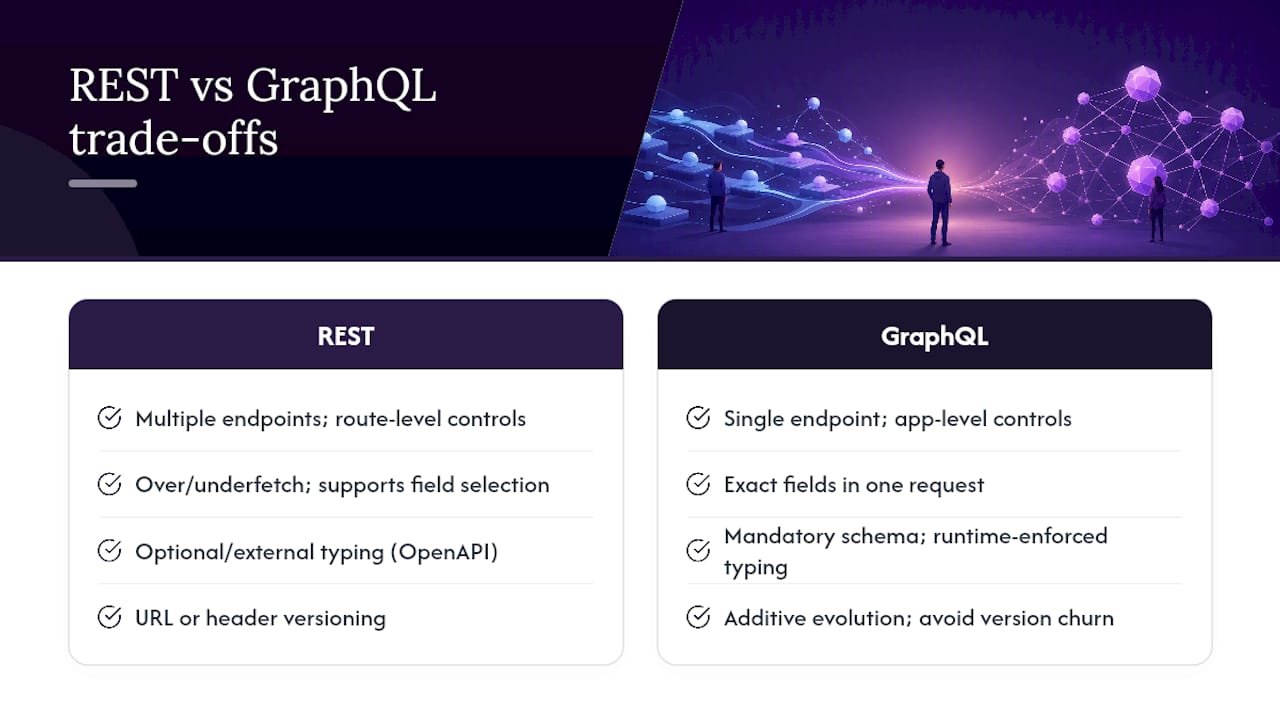
Structure and endpoints. REST’s multiple endpoints map cleanly to rate limiting, CDN rules, and per-resource access logs. GraphQL’s single endpoint means all traffic looks identical at the network layer, so rate limiting and monitoring have to happen inside the application.
Data fetching. The classic complaint about REST is overfetching (getting fields you don’t need) and underfetching (needing five calls to assemble one screen). GraphQL solves both by letting clients ask for exact fields in one request. But modern REST conventions like JSON:API and OData support field selection and includes, which Strapi’s comparison of GraphQL and REST points out narrows this gap considerably.
Schema and typing. REST’s typing is optional and external (OpenAPI). GraphQL’s schema is mandatory and enforced at runtime, which means better codegen but also a schema you must actively govern.
Versioning. REST typically bumps a version number in the URL or header. GraphQL prefers additive changes with @deprecated directives on old fields, avoiding version sprawl entirely.
Caching. This is REST’s home turf: native HTTP caching, CDN-friendly GET requests, ETags. GraphQL usually POSTs to one endpoint, which breaks that caching model unless you add persisted queries or normalized client-side caches, as Vercel’s guide to REST and GraphQL explains.
Errors. REST uses HTTP status codes. GraphQL returns 200 with an errors array, which means your monitoring dashboards need GraphQL-aware parsing, not just status-code alerts.
Performance and N+1. GraphQL’s flexibility can trigger N+1 queries at the resolver level, where fetching a list of orders then triggers a separate database call per order’s customer. Batching tools like DataLoader fix this, but only if someone remembers to add them.
Security surface. REST secures at the route level. GraphQL needs per-field authorization and defenses against deeply nested or expensive queries, since a single request can hide unbounded backend work.
Pro Tip: If your team is adopting GraphQL for the first time, budget for DataLoader and query-cost limiting in the first sprint, not as a fix after the first production incident.
When Should You Pick REST vs GraphQL?
The right answer depends on who’s consuming the API and how many of them there are.
Reach for REST when:
- You’re publishing a public or partner-facing API where predictable, cacheable contracts matter more than flexibility.
- Your data model is simple CRUD without deep relational nesting.
- CDN caching is a meaningful part of your performance and cost strategy.
Reach for GraphQL when:
- Multiple client types (web, iOS, Android, embedded devices) need different slices of the same data.
- Your UI is composed from many related resources on one screen, and round-trip count actually matters.
- One team owns both the frontend and the GraphQL layer, so schema changes don’t require cross-team coordination.
Run both when you’re serving external partners through REST while your own product team builds an internal GraphQL layer or BFF on top of the same services. This is common enough that Vercel’s REST and GraphQL guide treats it as a standard pattern rather than an edge case.
Quick decision checklist before you commit:
- How many distinct client types will consume this API in the next 18 months?
- Does caching infrastructure (CDN, edge caching) carry meaningful cost or latency weight for you?
- Does your team have the platform maturity to govern a schema, add resolver tracing, and limit query cost?
- Are you serving external partners who need a stable, documented contract more than flexibility?
Two or more “yes” answers pointing toward flexibility and internal control push you toward GraphQL. Answers weighted toward external consumers and caching push you toward REST.
How Do You Migrate From REST to GraphQL Without a Rewrite?
Nobody should rip out a working REST API to bolt on GraphQL overnight. The safer path is incremental.
- Backend-for-frontend (BFF): Add a thin service that composes calls to existing REST services, optionally exposing a GraphQL facade to the client while REST stays untouched underneath.
- Gateway and federation: Centralize schemas behind a gateway once you have more than a couple of GraphQL services; keep per-service schemas until that complexity actually shows up.
- Wrap REST with GraphQL: Derive a schema from your existing REST JSON responses, write resolvers that call those REST endpoints, and batch aggressively to avoid N+1 at the wrapper layer. Prisma’s tutorial on wrapping a REST API with GraphQL walks through exactly this three-step process.
- Apollo Link Rest: For client-side prototyping, Apollo Link Rest lets you query existing REST endpoints through a GraphQL client without standing up a GraphQL server at all.
Pro Tip: Roll GraphQL out to internal surfaces first, add persisted queries and cost limiting before opening it to external clients, and monitor resolver latency from day one.
Where Teams Get Burned in Production
The failures are predictable, and they’re almost always operational, not architectural.
- N+1 queries creep in silently until a dashboard that used to load in 200ms takes four seconds; batch resolvers with DataLoader before this becomes a fire drill.
- Forgetting caching entirely — GraphQL teams skip persisted queries and normalized caching, while REST teams ship endpoints with no
Cache-Controlheader at all. - Schema drift happens when nobody lints schema changes in CI/CD, leading to breaking changes that slip past code review on both GraphQL schemas and REST’s OpenAPI specs.
- Observability gaps show up when GraphQL’s single endpoint masks per-resolver cost; without resolver-level tracing, an SLO breach looks like a mystery instead of a known bottleneck.
GraphQL’s operational model, because a single /graphql POST can represent dozens of logical operations, makes resolver-level tracing a requirement rather than a nice-to-have for meaningful observability at scale.
How Does an API Platform Handle REST and GraphQL for Regulated Enterprises?
Regulated enterprises don’t get to pick REST or GraphQL based on developer preference alone. Every API surface needs an audit trail, and every field access needs to map back to a policy someone can defend to an auditor.
That’s why platforms serving healthcare, finance, and manufacturing customers typically expose both REST and GraphQL rather than forcing a single choice. REST fits media-heavy flows and file uploads cleanly, partly because GraphQL’s community patterns for uploads remain awkward and complicate compliance workflows around auditability. GraphQL fits internal product surfaces where per-field authorization and schema governance matter more than CDN caching.

What actually matters operationally: policy-as-code enforcement, RBAC and ABAC controls applied consistently whether the request hits a REST endpoint or a GraphQL resolver, and automated compliance checks baked into the deployment pipeline rather than bolted on after the fact. Schema governance and type-safe codegen aren’t optional extras once multiple teams touch the same graph.
What I’d Tell a Team Starting From Scratch
Start with REST for anything crossing a trust boundary, and layer GraphQL in only where one team owns the full stack. Before scaling GraphQL past a handful of resolvers, invest in resolver tracing, schema linting in CI, and query cost limits. Skipping that groundwork is how a flexible API architecture turns into an unmonitored liability.
Running REST and GraphQL Together Without the Governance Headache
Most teams don’t struggle with picking REST or GraphQL. They struggle with running both consistently once compliance, auditability, and multiple clouds enter the picture. Jundago is built for exactly that gap: a platform where API Studio generates REST, GraphQL, gRPC, or SOAP APIs from plain-language intent, and GraphQL Studio handles schema design with AI-assisted resolvers instead of hand-wiring every field.
Every API generated through the platform inherits RBAC and ABAC controls, automated testing, and compliance modules for domains like HIPAA, PCI DSS, and IEC 62443, all managed centrally from Command Center across AWS, Azure, GCP, and Oracle Cloud. That means the schema governance and resolver tracing this article just walked through aren’t a separate project your team bolts on later. If you’re weighing a REST-to-GraphQL migration or standing up both surfaces for a regulated system, take a look at the Jundago platform and see what a governed starting point actually looks like.
Frequently Asked Questions
Is GraphQL faster than REST? Not universally. GraphQL reduces round trips when a screen needs many related resources, but performance depends heavily on query shape and whether resolvers are batched. REST wins on raw per-request predictability and CDN caching.
Can REST and GraphQL coexist in the same system? Yes, and it’s common. Many production systems run REST for public, cacheable surfaces and GraphQL for internal, product-facing composition, treating the choice as per-surface rather than all-or-nothing.
Does GraphQL replace the need for API versioning? Mostly. GraphQL favors additive schema changes with deprecation directives over version bumps, though teams still need governance to track which fields are deprecated and when to remove them.
What’s the biggest operational risk with GraphQL?
Unmonitored resolver cost. A single /graphql request can hide N+1 queries or expensive nested lookups that never show up in standard HTTP-level monitoring.
Should a new project start with REST or GraphQL? For most new projects, start with REST for anything crossing team or organizational boundaries, and introduce GraphQL only for surfaces one team fully owns and can govern.
Sources
For deeper technical grounding, the GraphQL vs REST comparison from AWS covers the core architectural distinctions, while Strapi’s REST vs GraphQL guide is the sharpest resource on modern REST field selection.
Consult the GraphQL spec and OpenAPI documentation before finalizing a schema; consult Prisma’s wrapping tutorial specifically when migrating an existing REST service.
- GraphQL vs REST API - Difference Between API Design Architectures
- REST vs GraphQL: The complete guide for full-stack teams - Vercel
- REST or GraphQL in Strapi v5: When to Pick Each
- apollographql/apollo-link-rest