RBAC vs ABAC: Hybrid Access Control for Enterprises
RBAC vs ABAC: Hybrid Access Control for Enterprises

Most regulated enterprises should run RBAC as the coarse-grained baseline and layer ABAC policies on top for context-aware, fine-grained decisions. That combination, not a pure choice between the two, is what NIST’s access control research and production deployments across HIPAA- and PCI DSS-regulated environments consistently support.
- Pure RBAC is enough when your permission patterns are stable, your user population is relatively homogeneous, and you have fewer than roughly 50 distinct permission combinations to manage.
- ABAC is required when you need record-level access decisions, time- or location-based constraints, or per-request audit justification for regulators.
- The hybrid is the default enterprise answer because RBAC handles broad job-function boundaries cheaply while ABAC handles the edge cases that would otherwise force role explosion.
Start with roles, map the one or two policies that keep forcing new role creation, and pilot ABAC for exactly those cases. Jundago’s platform ships both models with compliance modules for HIPAA and PCI DSS, so you can validate the hybrid architecture without building a policy engine from scratch.
Table of Contents
- What is RBAC, and why do architects still rely on it?
- What is ABAC, and when does it become necessary?
- How do RBAC and ABAC compare across the dimensions that matter?
- When should you pick RBAC, ABAC, or a hybrid?
- What do production-ready hybrid architectures actually look like?
- What do engineers need to get right during implementation?
- How do you migrate from RBAC to a hybrid without breaking production?
- What do sample RBAC, ABAC, and hybrid policies look like?
- How does Jundago implement RBAC and ABAC for regulated enterprises?
- Key Takeaways
- The hybrid-first stance is not a compromise. It is the architecture.
- Jundago gives regulated enterprises RBAC and ABAC without the infrastructure build
- Authoritative sources and further reading
What is RBAC, and why do architects still rely on it?
Role-Based Access Control grants permissions to roles, then assigns roles to users. A user gets access to a resource because they hold a role that carries the relevant permission, not because of anything specific about that user or that resource instance. NIST’s foundational RBAC model formalized this as a three-tier structure: users are assigned to roles, roles are assigned permissions, and permissions map to operations on objects.
The architectural primitives you reason about during design and audits:
- Role assignment: a user holds zero or more roles; access is the union of all permissions those roles carry.
- Role inheritance (hierarchical RBAC): senior roles inherit the permissions of junior ones, so a
Senior Analystrole can extendAnalystwithout duplicating every permission. - Separation of duty (SoD): static or dynamic constraints that prevent a single user from holding two roles that together create a conflict of interest, such as
Payment InitiatorandPayment Approversimultaneously. Separation of duties is a core internal-control principle that RBAC enforces structurally. - Role provisioning lifecycle: roles are created, assigned, reviewed, and revoked through a defined workflow, which is what makes RBAC auditable.
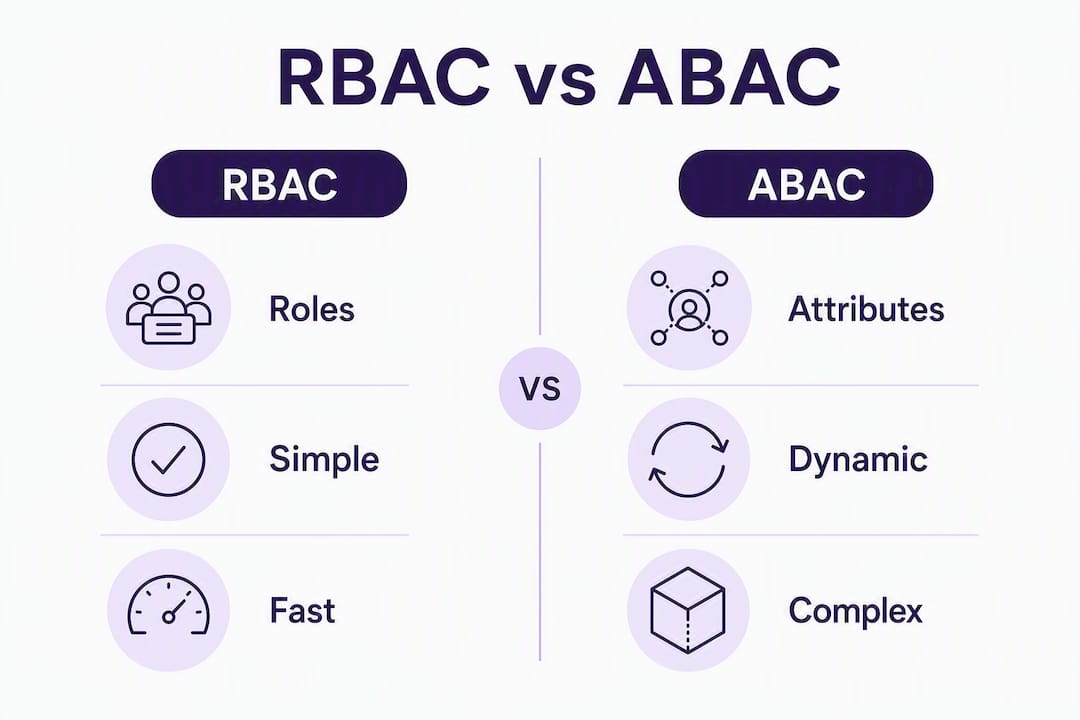
Operationally, RBAC decisions are fast. An authorization check is essentially a join between a user’s role set and a permission table. That lookup is cheap, cacheable, and easy to explain to an auditor. The failure mode is equally well understood: role explosion. When teams try to encode conditional logic (“only their own department’s records,” “only during business hours”) as distinct roles, the role count grows combinatorially and the model collapses under its own weight.
What is ABAC, and when does it become necessary?
Attribute-Based Access Control evaluates a policy against a set of attributes at runtime to produce an allow or deny decision. NIST SP 800-162 formalizes ABAC as an authorization approach that evaluates subject, object, operation, and environmental attributes, making it the natural policy model for context-aware, per-request decisions.
Attributes fall into four categories:
- Subject attributes: user role, department, clearance level, employment status, team membership.
- Object (resource) attributes: data classification, owner, sensitivity label, project tag, record-level metadata.
- Action attributes: read, write, delete, export, approve.
- Environment attributes: time of day, IP address, geolocation, device posture, session risk score.
A policy engine evaluates these at request time. The three components architects need to place in their architecture are the Policy Decision Point (PDP), which evaluates the policy; the Policy Administration Point (PAP), where policies are authored and stored; and the Policy Information Point (PIP), which fetches attribute values the PDP needs to evaluate a rule. The enforcement point that intercepts the request and calls the PDP is the Policy Enforcement Point (PEP), typically sitting at the API gateway, service mesh sidecar, or middleware layer.
The trade-offs are real. ABAC gives you fine-grained, dynamic control that RBAC cannot match. The cost is complexity: you need authoritative attribute sources, a reliable PDP, and a policy language (OPA/Rego, Google’s CEL, or Amazon’s Cedar are the common choices). Attribute fetch latency is a primary operational concern in high-concurrency API environments, which is why caching and PDP placement matter as much as the policy logic itself.

How do RBAC and ABAC compare across the dimensions that matter?
| Dimension | RBAC | ABAC |
|---|---|---|
| Policy expressiveness / granularity | Coarse-grained; permission tied to role, not resource instance | Fine-grained; any combination of subject, object, action, and environment attributes |
| Administration complexity | Low to moderate; role lifecycle is well-understood | High; requires attribute governance, policy authoring, and PIP maintenance |
| Scalability | Hits role explosion when conditional rules proliferate | Scales in expressiveness; PDP must scale horizontally for throughput |
| Performance & latency | Fast; lookup is a set membership check | Adds latency from attribute fetch and policy evaluation; mitigated by caching |
| Auditability / compliance readiness | Good for role-level audits; weak for per-request justification | Strong; each decision carries a full attribute trace for regulators |
| Implementation cost & time | Low; most identity platforms support RBAC natively | Higher; requires PDP, PAP, PIP, and attribute pipeline investment |
| Best-fit use cases | Internal admin consoles, stable org structures, SaaS tenant isolation | Healthcare record access, financial transaction controls, API data-level filtering, zero-trust |
A few trade-offs worth calling out directly:
- Role explosion is not a theoretical risk. It is the most common signal that RBAC has reached its practical limit in a given system.
- ABAC’s runtime evaluation model is what makes it the right fit for zero-trust architectures, where trust is never assumed and every request must be independently justified.
- Auditability flips in ABAC’s favor the moment regulators ask for per-request evidence. RBAC tells you what a user could access; ABAC tells you exactly why a specific request was allowed or denied.
- The performance gap between the two models is largely an engineering problem, not an inherent architectural constraint. A well-placed, cached PDP closes most of it.
When should you pick RBAC, ABAC, or a hybrid?
The decision is not philosophical. It follows from your actual permission patterns, your regulatory obligations, and the signals your current system is already sending you.
Use pure RBAC when:
- You have fewer than roughly 50 stable permission patterns across your user population.
- Access decisions do not depend on resource-instance attributes (who owns the record, what classification it carries).
- Your compliance obligations are satisfied by role-level audit reports.
- Your team has no existing PDP infrastructure and cannot absorb the operational overhead yet.
Move to ABAC (or add it as a layer) when:
- You need record-level access control (a nurse sees only their assigned patients; a financial analyst sees only their region’s data).
- Time, location, or device posture must influence access decisions.
- HIPAA, PCI DSS, or GDPR data minimization require per-request justification and fine-grained scoping at the record level.
- You are building or securing an API platform where different consumers need different views of the same resource.
- Regulators or auditors have asked for evidence of why a specific access event occurred.
Signals that RBAC is already breaking in your environment:
- Your role count has grown faster than your headcount over the past 12 months.
- Engineers are creating “emergency roles” to handle one-off access requests.
- Role reviews during audits take days because no one can explain why a role exists.
- A single conditional rule (“only their own department”) has spawned five or more role variants.
The hybrid is the right default for any organization that is already past the early-growth phase. Industry practice consistently points to designing for hybrid from day one: RBAC for coarse boundaries, ABAC for the exceptions. Retrofitting ABAC into a pure-RBAC system that has already exploded is far more expensive than building the seam in early.
What do production-ready hybrid architectures actually look like?
Mature enterprise environments adopt a hybrid where RBAC sets broad access boundaries and ABAC layers fine-grained constraints on top. Four patterns cover most production cases:
- RBAC base + ABAC guardrails: the identity provider (IdP) issues a role claim; the PDP evaluates additional attribute conditions before allowing the request. The role gates entry; the attributes gate the specific operation. Auditability is strong because both the role and the attribute trace are logged.
- Derived roles + attribute filters: roles are dynamically derived from attributes at session time (a user with
department=financeandclearance=L3gets a derivedFinanceL3role). This keeps the downstream authorization logic simple while the complexity lives in the derivation layer. The trade-off is that derived-role logic must be tested and versioned like any other policy. - Session-level role assumption + policy evaluation: a user assumes a role for a session (similar to AWS IAM role assumption), and ABAC policies evaluate against that session context plus resource tags. Databricks uses exactly this pattern: RBAC sets the active identity for the session while ABAC evaluates data-level row filters attached to resource tags.
- Data-tag-driven row filtering: resource records carry sensitivity or ownership tags; the query layer applies filters based on those tags and the requestor’s attributes. This pushes the enforcement down to the database, which is the most efficient place for it when you are filtering large datasets.
Enforcement point placement matters. The PEP sits at the API gateway or service mesh sidecar. The PDP should be a stateless, horizontally scalable service, not embedded in application code. The PIP fetches attributes from authoritative sources (your identity directory, HR system, resource metadata store) and caches them with appropriate TTLs. Embedding PDP logic in application code is the single most common architectural mistake in hybrid deployments: it makes policy updates require code deploys.
Pro Tip: If PDP latency is a concern, push list-filtering decisions into the database query layer rather than calling the PDP once per record. A single PDP call that returns a filter predicate, which the database then applies, scales orders of magnitude better than per-row PDP calls.

What do engineers need to get right during implementation?
The policy model is the easy part. The operational infrastructure around it is where implementations succeed or fail.
Attribute sourcing and governance
Every attribute the PDP evaluates must come from an authoritative source with a defined owner, a freshness TTL, and a change-control process. Stale or inconsistent attributes cause authorization errors that are hard to debug and harder to explain to auditors. Map each attribute to its source (LDAP/Active Directory for user attributes, your CMDB or resource metadata API for object attributes, your MDM for device posture) before you write a single policy.
Policy engine placement
Run the PDP as a dedicated, stateless service. OPA with Rego, Google’s CEL, and Amazon’s Cedar are the three policy languages with the widest production adoption. OPA is the most flexible; Cedar is purpose-built for authorization with formal verification properties; CEL is the right choice if you are already deep in the Google Cloud or Kubernetes ecosystem. Cache attribute bundles at the PDP level and set TTLs that match the sensitivity of the attribute (session-scoped for device posture, longer for department membership).
Performance checklist
- Fetch attributes in batch at session start where possible, not per-request.
- Cache PDP decisions for identical (subject, resource, action, environment) tuples with short TTLs.
- Push row-level filters into the database query rather than calling the PDP per record.
- Profile PDP latency under your peak API concurrency before going to production.
- Use asynchronous policy evaluation for non-blocking operations where a slight delay is acceptable.
Testing and validation
Policy unit tests should cover every branch of every rule. Integration tests should replay real traffic patterns against the policy engine. Shadow mode evaluation is the safest way to validate ABAC accuracy before cutover: run ABAC decisions in parallel with RBAC enforcement, log the deltas, and investigate every divergence before flipping the switch.
Auditability
Each PDP decision should emit a structured log entry containing the subject attributes, resource attributes, policy version, and the decision outcome. That trace is what satisfies a HIPAA or PCI DSS auditor asking why a specific record was accessed at a specific time. RBAC alone cannot produce that evidence.
Pro Tip: Pre-compute derived roles or attribute bundles during session establishment rather than at each request. A session-scoped attribute cache that is populated once at login and refreshed on a defined TTL eliminates the most common source of ABAC latency in high-throughput API environments.
How do you migrate from RBAC to a hybrid without breaking production?
The risk in migration is not the policy model. It is the gap between what your current roles actually enforce and what your policies intend to enforce. Audit that gap before you touch anything.
Phase 1: Discovery (weeks 1–4)
- Export your full role and permission inventory. Every role, every permission assignment, every user-to-role mapping.
- Identify the top 5–10 roles by assignment count and the top 5–10 by “exception request” frequency (these are your role explosion candidates).
- Map each role to the business rule it encodes. If you cannot articulate the rule in one sentence, the role is already a problem.
- Identify the one or two policies that are forcing new role creation. These become your ABAC pilot candidates.
Phase 2: Pilot (weeks 5–10)
- Select the single policy causing the most role proliferation. Express it as an ABAC condition (for example,
subject.department == resource.owner_department). - Deploy the PDP in shadow mode: RBAC enforces, ABAC evaluates and logs.
- Run shadow mode for two to four weeks. Investigate every divergence between RBAC and ABAC decisions.
- Performance-test the PDP under production-representative load.
Phase 3: Expand (weeks 11–20)
- Flip the pilot policy to enforcement mode with a documented backout plan (re-enable RBAC enforcement within 15 minutes if needed).
- Introduce derived roles for the next tier of conditional policies.
- Expand attribute sourcing to cover the new policies: confirm TTLs, ownership, and change-control for each new attribute.
- Run automated policy compliance checks against your HIPAA or PCI DSS control mappings.
Phase 4: Cutover and steady state (weeks 21+)
- Retire the roles that the ABAC policies have replaced. Do not leave zombie roles in the system.
- Establish a policy CI pipeline: every policy change goes through a pull request, automated unit tests, and a compliance gate before deployment.
- Schedule quarterly role and policy reviews. Automated drift detection (comparing current assignments against approved baselines) should run continuously.
Risk mitigation: dual-evaluation shadow mode is your primary safety net. Keep it running for at least two weeks per policy before enforcement cutover. For large organizations, budget 6–9 months for a full hybrid migration; mid-size teams with a focused scope can complete it in 3–4 months.
What do sample RBAC, ABAC, and hybrid policies look like?
Concrete examples make the architecture tangible. These are pseudocode representations, not tied to a specific policy language, but they map directly to OPA/Rego, Cedar, or CEL implementations.
RBAC: role definition and permission mapping
roles:
  finance_analyst:
    permissions:
      - resource: financial_report
        actions: [read, export]
      - resource: budget_dashboard
        actions: [read]

user_role_assignments:
  - user: alice@example.com
    roles: [finance_analyst]
Alice can read and export financial reports because she holds finance_analyst. The check is a set membership lookup. Fast, auditable, and easy to explain.
ABAC: context-aware policy
ALLOW if:
  subject.department == resource.owner_department
  AND subject.clearance >= resource.sensitivity_level
  AND environment.time_of_day BETWEEN 08:00 AND 18:00
  AND environment.device_posture == "compliant"
This policy evaluates four attributes at runtime. It does not care what role Alice holds. It cares whether her department matches the resource’s owning department, whether her clearance is sufficient, whether the request is within business hours, and whether her device is compliant. No role encodes this combination.
Hybrid: role-based allow with attribute conditions
ALLOW if:
  subject.roles CONTAINS "finance_manager"
  AND subject.region == resource.region
  AND environment.time_of_day BETWEEN 06:00 AND 20:00
The hybrid pattern is the production default: the role gates the broad permission class, and the attributes enforce the contextual constraints that would otherwise require dozens of role variants. This is the architecture that eliminates role explosion without abandoning the administrative simplicity of RBAC.
Testing these policies:
- Write unit tests for every branch: a compliant device in-hours should pass; a non-compliant device should fail; a mismatched department should fail.
- Replay a sample of real production requests against the policy in shadow mode before enforcement.
- Test policy changes in a staging environment with synthetic traffic that covers edge cases (boundary times, cross-region requests, elevated clearance levels).
How does Jundago implement RBAC and ABAC for regulated enterprises?
Jundago ships both RBAC and ABAC as native security controls across its full API lifecycle platform, which means you are not bolting a policy engine onto an existing API stack. The authorization model is built into the platform from generation through deployment.
Relevant capabilities for access control architecture:
- RBAC support: role definitions and permission mappings are managed through Jundago’s Command Center, with full role lifecycle governance across AWS, Azure, GCP, and Oracle Cloud deployments.
- ABAC and policy engine integration: attribute-driven policies evaluate subject, resource, and environment attributes at the API gateway layer, with PDP placement configurable per deployment target.
- Decision tracing for audits: every authorization decision is logged with its full attribute context, giving compliance teams the per-request evidence that HIPAA and PCI DSS auditors require.
- Compliance modules: industry-specific modules for healthcare (HIPAA, HL7 FHIR), finance (PCI DSS, KYC/AML, Open Banking), and manufacturing (IEC 62443) ship with pre-built policy templates that map directly to regulatory control requirements.
- Multi-cloud governance: Command Center provides a single governance plane across all four major cloud providers, so role and policy changes propagate consistently rather than drifting per-environment.
For API-centric deployments, Jundago’s architecture places the PEP at the API gateway and the PDP as a managed service within the platform, which eliminates the most common implementation risk: embedding policy logic in application code. The ETL/ELT integration studio also supports attribute sourcing pipelines, so you can feed authoritative HR, CMDB, and device posture data into the PIP without building custom connectors.
Enterprise pilots typically start with the compliance module for the team’s primary regulatory domain and expand from there. Contact Jundago’s team through the platform landing page to scope a pilot for your environment.
Key Takeaways
For most regulated enterprises, the right answer to RBAC vs ABAC is neither one alone: start with RBAC for coarse-grained role boundaries, identify the policies forcing role explosion, and layer ABAC for exactly those cases.
| Point | Details |
|---|---|
| Hybrid is the default | RBAC sets broad access boundaries; ABAC handles context-aware, record-level constraints that RBAC cannot express without role explosion. |
| Role explosion is the trigger | When roles proliferate to encode conditional rules, that is the signal to pilot ABAC for the offending policy. |
| Auditability favors ABAC | ABAC decision traces provide per-request justification that HIPAA, PCI DSS, and GDPR auditors require; RBAC alone cannot produce this evidence. |
| Migration is staged, not a cutover | Shadow mode evaluation, phased policy rollout, and automated drift detection reduce migration risk for both mid-size and large organizations. |
| Jundago ships both models | Jundago’s platform provides native RBAC and ABAC controls, decision tracing, and compliance modules for HIPAA and PCI DSS across multi-cloud deployments. |
The hybrid-first stance is not a compromise. It is the architecture.
The framing of RBAC vs ABAC as a binary choice is one of the most persistent misconceptions in enterprise authorization design. Security architects spend time debating which model to adopt when the real question is where to draw the line between them.
RBAC is not a legacy model waiting to be replaced. It is the right tool for stable, job-function-aligned permissions, and it will always be cheaper to administer than a pure-ABAC system for those cases. The mistake is treating it as the only tool. When a team reaches for a new role to encode a conditional rule, that is not a failure of RBAC. It is a signal that the rule belongs in a policy, not a role.
The deeper problem is that most organizations adopt ABAC reactively, after role explosion has already made the system unmanageable. By that point, the migration is expensive because the role inventory is large, undocumented, and politically entrenched. The architects who avoid that pain are the ones who design the RBAC/ABAC seam into the system from the start, even if the ABAC side is empty at launch.
Attribute governance deserves more attention than it usually gets. A policy engine is only as good as the attributes it evaluates. Stale department data, inconsistent clearance levels, or missing device posture signals produce authorization errors that are genuinely hard to debug. The policy CI pipeline and the attribute governance process are not optional operational niceties. They are the difference between a hybrid system that works reliably and one that erodes trust in the authorization layer over time.
One practical recommendation: form a small policy review board with representation from security, engineering, and compliance. Not to approve every policy change, but to own the policy language standards, the attribute governance rules, and the quarterly drift review. That governance structure is what keeps the hybrid architecture maintainable at scale.
Jundago gives regulated enterprises RBAC and ABAC without the infrastructure build
Regulated enterprises building API-centric systems face a specific problem: they need fine-grained, auditable access control across multi-cloud deployments, and they need it to satisfy HIPAA, PCI DSS, or IEC 62443 out of the box, not after months of custom policy engine work.
Jundago’s AI-native API platform ships RBAC and ABAC as native security controls, with decision tracing built into every authorization event. You get a managed PDP, pre-built compliance modules for healthcare and finance, and a governance layer that spans AWS, Azure, GCP, and Oracle Cloud from a single Command Center. The ETL/ELT integration studio handles attribute sourcing pipelines so your PIP stays current without custom connectors.
For enterprises that need to move from a pure-RBAC system to a hybrid architecture without rebuilding their API stack, Jundago is the platform to evaluate first. Request a demo or scope an enterprise pilot directly through jundago.com.
Authoritative sources and further reading
- NIST SP 800-162: Guide to Attribute Based Access Control (ABAC) — the canonical ABAC definition; use this for policy-centric and zero-trust framing.
- Kuhn, Coyne, Weil — Adding Attributes to Role-Based Access Control (NIST/CSRC) — the foundational paper on RBAC-to-ABAC migration rationale and role explosion; cited throughout this article.
- NIST RBAC Glossary (CSRC) — authoritative RBAC term definitions for standards-aligned documentation.
- Sandhu, Ferraiolo, Kuhn — The NIST Model for Role-Based Access Control (CSRC) — the original NIST RBAC model paper; foundational for RBAC architecture.
- Splunk Blog — RBAC vs ABAC Compared — compliance-focused comparison covering HIPAA, PCI DSS, and GDPR implications.
- Policy language references: OPA/Rego for flexible general-purpose policies; Amazon Cedar for authorization-specific formal verification; Google CEL for Kubernetes and GCP-native deployments.
- Jundago — AI-Native API Platform — platform-specific evaluation for enterprises needing native RBAC/ABAC controls, compliance modules, and multi-cloud governance.