OAuth 2.0 Security Best Practices for Modern APIs
OAuth 2.0 Security Best Practices for Modern APIs

The short answer: use Authorization Code with PKCE for every client type, sender-constrain your tokens with mTLS (RFC 8705) or DPoP (RFC 9449), rotate refresh tokens on every use, restrict access token audience to the intended resource server, authenticate clients with asymmetric keys, and enforce exact redirect URI matching. RFC 9700 codifies these as the current security baseline; the OWASP OAuth 2.0 Cheat Sheet translates them into operational checks you can run today.
- Authorization Code + PKCE for all clients (RFC 9700 requires PKCE for public clients, recommends it for confidential clients; deprecates the implicit grant entirely)
- Sender-constrained tokens or refresh token rotation to detect and block token replay before it causes damage
- Audience-restricted, least-privilege scopes so a stolen token cannot be replayed against an unintended resource server
- Asymmetric client authentication (private_key_jwt or mTLS) instead of shared secrets wherever possible
- Strict redirect URI matching and CSRF protections (state/nonce plus PKCE) to close the authorization code interception window
Start your audit by grepping logs for response_type=token (implicit grant) and checking whether your authorization server’s discovery document lists code_challenge_methods_supported. Missing either is a high-severity gap.
Key Takeaways
Authorization Code with PKCE, sender-constrained tokens, asymmetric client authentication, exact redirect URI matching, and least-privilege scopes are the five controls that close the most critical OAuth 2.0 attack surfaces, as codified in RFC 9700 and the OWASP OAuth 2.0 Cheat Sheet.
| Point | Details |
|---|---|
| PKCE is now universal | RFC 9700 requires PKCE for public clients and recommends it for confidential clients; enforce it server-side or it provides no protection. |
| Sender-constrain high-value tokens | Use mTLS (RFC 8705) for server-to-server APIs and DPoP (RFC 9449) for SPAs and mobile apps to block token replay at the resource server. |
| Rotate refresh tokens on every use | Revoke the entire token family on duplicate refresh token presentation; this is the primary signal of refresh token theft. |
| Scopes are coarse boundaries | Use domain-oriented read/write scopes for API surface control; push per-object authorization into claims and ABAC/RBAC policies to prevent scope explosion. |
| Governance must be continuous | Automate client inventory, scope audits, and credential rotation; stale clients and over-privileged scopes are persistent exposures that periodic audits miss. |
Table of Contents
- What are the highest-priority OAuth 2.0 best practices you can act on today?
- Why do the RFC 9700 and OWASP controls actually matter?
- Which grants should you use, and how do you migrate away from the unsafe ones?
- How do you protect access tokens, refresh tokens, and ID tokens?
- How should you authenticate OAuth clients securely?
- How do you handle redirect URIs and CSRF protections correctly?
- How should you design OAuth scopes for APIs?
- Which OAuth grants are deprecated and how do you migrate away from them?
- What does an OAuth implementation audit checklist look like?
- How do you monitor OAuth flows and respond to token compromise?
- Which libraries and reference implementations should you use?
- How does Jundago operationalize these OAuth controls for regulated enterprises?
- The gap between what OAuth guides promise and what actually breaks production
- Sources
What are the highest-priority OAuth 2.0 best practices you can act on today?
Think of this as your sprint-zero remediation list, ordered by blast radius.
High priority
- Migrate implicit grant to Authorization Code + PKCE. Any client still using
response_type=tokenexposes access tokens in the browser history, referrer headers, and server logs. RFC 9700 deprecates the implicit grant with no exceptions. - Enable refresh token rotation. Configure your authorization server to issue a new refresh token on every use and immediately invalidate the previous one. Replay of a stolen refresh token then produces a detectable collision.
- Enforce PKCE on the server side. Client-side PKCE is meaningless if the server accepts requests without a
code_challenge. Verifycode_challenge_methods_supportedin your AS metadata and reject authorization requests that omit it. - Audit redirect URI registrations. Pull the full list of registered redirect URIs and flag any that use wildcards, contain open redirectors, or point to
http://(except loopback addresses for native apps).
Medium priority
- Restrict token audience. Every access token should carry an
audclaim scoped to the specific resource server it targets. Resource servers must reject tokens whoseauddoes not match. - Switch client authentication to asymmetric methods. Replace
client_secret_postandclient_secret_basicwithprivate_key_jwtor mTLS for confidential clients. - Publish Authorization Server metadata per RFC 8414 so clients can discover supported PKCE methods, token endpoint auth methods, and revocation endpoints programmatically.
- Implement token revocation and introspection endpoints and call them on logout, credential rotation, and suspected compromise.
Lower priority (but do not skip)
- Deprecate Resource Owner Password Credentials (ROPC). Replace with Authorization Code flow or Device Authorization Grant for constrained devices.
- Set short access token lifetimes. Fifteen minutes is a reasonable ceiling for most APIs; pair with refresh token rotation rather than extending the access token TTL.
- Automate client inventory. Track every registered client, its redirect URIs, scopes, and credential expiry. Stale clients with over-privileged scopes are a persistent exposure.
Pro Tip: To detect implicit grant usage without reading every log line, query your authorization server’s token issuance events for grant_type values and filter for implicit. In AWS Cognito, this surfaces in CloudTrail under InitiateAuth; in Azure AD, look for oauth2/authorize requests where response_type contains token without code. Flag any hit as a P1 remediation item.
Why do the RFC 9700 and OWASP controls actually matter?
Security controls without a threat model are just compliance theater. Here is what you are actually defending against and which control closes each gap.
Authorization code interception
When a browser-based or native app exchanges an authorization code, an attacker who intercepts the code (via a malicious redirect, a compromised browser extension, or a log-scraping attack) can redeem it before the legitimate client does. PKCE closes this window by binding the authorization request to a secret verifier that only the originating client holds. Without PKCE, code interception is a straightforward attack requiring no cryptographic capability.
Token replay and injection
A bearer token stolen from a network log, a misconfigured CORS response, or a compromised resource server can be replayed against any resource server that accepts it. Sender-constraining (mTLS or DPoP) binds the token to the client’s key material, so possession of the token string alone is not enough. The OWASP OAuth 2.0 Cheat Sheet explicitly recommends sender-constraining as the preferred defense against replay, with refresh token rotation as the fallback when sender-constraining is not yet deployable.
Open redirector exfiltration
An authorization server that performs partial redirect URI matching (prefix or suffix) can be tricked into redirecting the authorization code to an attacker-controlled URI that shares a registered prefix. RFC 9700 requires exact string matching. The attack is trivially exploitable: register https://app.example.com/callback and craft a request to https://app.example.com/callback.attacker.com.
Client credential theft
Symmetric client secrets stored in environment variables, mobile app binaries, or CI/CD pipelines are routinely exfiltrated. Asymmetric client authentication (private_key_jwt or mTLS) means the private key never leaves the client’s secure storage; the authorization server only holds the public key or certificate. Compromising the AS does not expose the client’s private key.

Which grants should you use, and how do you migrate away from the unsafe ones?
The answer is almost always Authorization Code with PKCE. Here is the prescriptive breakdown.
-
Use Authorization Code + PKCE for all client types. RFC 9700 makes PKCE mandatory for public clients (SPAs, native apps) and recommends it for confidential clients. There is no client type for which PKCE is a downgrade. Configure your authorization server to require
code_challenge_method=S256and rejectplainas a fallback. -
Generate PKCE correctly on the client side. The
code_verifiermust be a cryptographically random string of 43–128 characters. Thecode_challengeisBASE64URL(SHA256(ASCII(code_verifier))). Never useplainin production; it provides no protection against an attacker who can observe the authorization request. -
Verify PKCE on the server side. The token endpoint must recompute the challenge from the submitted verifier and reject the request if it does not match. Publish
code_challenge_methods_supported: ["S256"]in your AS discovery document (RFC 8414) so clients can confirm support without trial and error. -
Migrate implicit grant clients in three steps. First, register a new redirect URI for the Authorization Code flow. Second, update the client to use
response_type=codewith PKCE. Third, disableresponse_type=tokenat the AS level once all clients have migrated. Give internal clients a two-sprint window; third-party clients may need a deprecation notice period. -
Migrate ROPC to Authorization Code or Device Authorization Grant. ROPC exposes user credentials to the client application, which is the exact trust boundary OAuth was designed to eliminate. For headless or constrained devices (IoT, CLI tools), use the Device Authorization Grant (RFC 8628) instead. For standard web and mobile flows, Authorization Code with PKCE handles every use case ROPC was solving.
-
Hybrid response types (
code id_token) are acceptable for OIDC. When you need an ID token at the authorization endpoint for session establishment, the hybrid flow is a reasonable choice. Restrict it toresponse_type=code id_tokenand never includetokenin the hybrid response to avoid exposing access tokens in the front channel. -
Read RFC 9700 alongside your existing RFC 6749 deployment. RFC 6749 defines the original grant model; RFC 9700 supersedes its security assumptions. Treat RFC 9700 as the operative document for any security decision and RFC 6749 as the protocol grammar reference.
How do you protect access tokens, refresh tokens, and ID tokens?
Token security has three layers: how tokens are bound to their legitimate holder, how long they live, and what they are allowed to do.
Sender-constraining: mTLS vs. DPoP
Sender-constraining ties a token to a cryptographic key the client controls, so the token is useless without the corresponding private key.
| Method | Protection mechanism | Deployment complexity | Best fit |
|---|---|---|---|
| mTLS (RFC 8705) | Token bound to client TLS certificate; AS and RS verify certificate thumbprint in cnf claim |
Requires PKI infrastructure; simpler for server-to-server | Confidential server clients, microservices, regulated B2B APIs |
| DPoP (RFC 9449) | Token bound to a per-request proof-of-possession JWT signed with an ephemeral key | No PKI required; client generates key pair at runtime | SPAs, mobile apps, public clients where mTLS is impractical |
| Refresh token rotation | Detects replay by invalidating the previous token on use; no cryptographic binding | Low; supported by most AS implementations | Any deployment as a baseline; combine with sender-constraining for defense-in-depth |
For server-to-server APIs in regulated environments (healthcare, finance), mTLS is the stronger choice because the certificate is managed by your PKI and the binding survives token reuse across multiple requests. For SPAs and mobile apps, DPoP is the practical path: no certificate infrastructure, and the proof-of-possession JWT is generated fresh for each request.
Refresh token rotation and replay detection
Configure your AS to rotate refresh tokens on every use. When a rotated (invalidated) refresh token arrives at the token endpoint, the AS should revoke the entire token family, not just the replayed token. This forces the attacker and the legitimate client into a collision that surfaces in your logs as a duplicate refresh token attempt.
Pro Tip: Combine refresh token rotation with sender-constraining for defense-in-depth. Rotation catches replay at the token endpoint; sender-constraining catches replay at the resource server. An attacker who steals a DPoP-bound refresh token cannot use it without the private key, and if they somehow obtain both, rotation ensures the window is a single use.
Token lifetimes and audience restriction
Short access token lifetimes (15 minutes is a common ceiling) limit the damage window from a stolen token. Pair short lifetimes with refresh token rotation rather than extending the access token TTL. Every access token should carry an aud claim that names the specific resource server it targets; resource servers must validate aud on every request and reject tokens intended for a different audience. This prevents a token issued for api.payments.example.com from being replayed against api.records.example.com.
How should you authenticate OAuth clients securely?
Client authentication is where many deployments quietly fail. A client_secret stored in a .env file, a mobile app binary, or a CI/CD secret manager is a shared symmetric credential that can be exfiltrated without the client ever knowing.
Prefer asymmetric client authentication:
private_key_jwt: The client signs a JWT with its private key and sends it to the token endpoint. The AS verifies the signature against the registered public key. The private key never leaves the client’s secure storage.- mTLS client authentication (RFC 8705): The client presents a TLS certificate during the handshake. The AS validates the certificate against a registered thumbprint or a trusted CA. Works well when you already have PKI infrastructure.
client_secret_jwt: A step up from basic secret transmission but still symmetric. Use only when asymmetric methods are not yet deployable.client_secret_basic/client_secret_post: Acceptable only for low-risk internal clients with short-lived secrets and automated rotation. Never use for production confidential clients handling sensitive data.
Key lifecycle checklist:
- Store private keys in an HSM or cloud KMS (AWS KMS, Azure Key Vault, GCP Cloud HSM). Never store them in environment variables or source control.
- Rotate keys on a defined cadence (90 days is a common baseline for regulated sectors) and support key rollover without service interruption by registering the new public key before retiring the old one.
- Bind each key to a specific client registration. A key that authenticates multiple clients creates a blast radius that spans all of them.
- Automate revocation: when a client is decommissioned or a key is suspected compromised, revoke the registration and the associated tokens immediately, not at the next scheduled rotation.
For public clients (SPAs, native apps), client authentication is not possible by definition. PKCE and sender-constraining are the compensating controls.
How do you handle redirect URIs and CSRF protections correctly?
Redirect URI validation is one of the most frequently misconfigured controls in OAuth deployments, and the consequences range from authorization code theft to full account takeover.
Exact string matching rules:
- Register the complete, canonical redirect URI including scheme, host, path, and any fixed query parameters.
- The AS must perform exact string comparison, not prefix matching, suffix matching, or regex. RFC 9700 is explicit on this.
- For native apps using loopback (localhost) redirects, RFC 8252 permits port variations on loopback addresses (
127.0.0.1) because the OS assigns ports dynamically. This is the only sanctioned exception to exact matching. http://redirect URIs are permitted only for loopback addresses. All other redirect URIs must usehttps://.
What not to do:
- Do not register wildcard redirect URIs (
https://*.example.com/callback). A subdomain takeover instantly becomes an OAuth token exfiltration. - Do not allow query parameter redirects (
https://app.example.com/callback?redirect=https://attacker.com). This is an open redirector by construction. - Do not accept redirect URIs that were not registered at the time of the authorization request, even if they look plausible.
CSRF protections:
- PKCE provides strong CSRF protection for the authorization code flow because the
code_verifierbinds the token request to the authorization request. When PKCE is enforced server-side, a CSRF attack that injects a foreign authorization code will fail the verifier check. - Still bind a
stateparameter to the session for authorization code injection and mix-up attack detection. The AS should return thestatevalue unchanged; the client must verify it matches before processing the response. - For OIDC flows, include a
noncein the authorization request and verify it in the ID token. This closes the token substitution window in hybrid flows. - Audit your client registry quarterly: pull all registered redirect URIs, check for
http://(non-loopback), wildcards, and URIs pointing to domains you no longer control.
How should you design OAuth scopes for APIs?
Scopes are a coarse-grained security perimeter, not a fine-grained authorization system. Treating them as the latter is the root cause of scope explosion, the anti-pattern where every resource and action gets its own scope name until the consent screen is unreadable and the policy is unmanageable.
The right model, as scope design guidance from the identity security community makes clear: scopes define which API surface a token can touch; claims, roles, and ABAC/RBAC policies decide what the token holder can do within that surface.
Scope design guidelines:
- Use domain-oriented, hierarchical prefixes:
payments:read,payments:write,records:read. The prefix groups related scopes and makes consent UX legible. - Prefer
read/writesuffixes over per-action names (payments:list,payments:create,payments:update). Per-action scopes multiply faster than you can manage them. - Keep high-privilege scopes short-lived. A scope like
admin:writeshould appear only on tokens with a 5-minute TTL and require step-up authentication. - Expose scopes in your AS discovery document so clients can request only what they need and consent UX can display human-readable descriptions.
Operational patterns:
- Use token exchange (RFC 8693) to downscope tokens at the resource server boundary. A gateway token with
api:read api:writecan be exchanged for a narrowerrecords:readtoken before passing it to a downstream microservice. - Push per-object authorization into claims (
tenant_id,resource_id,role) or an external policy engine (OPA, Cedar). A scope ofdocuments:readplus atenant_idclaim in the token is far more maintainable thandocuments:read:tenant123. - Audit scope assignments in client registrations regularly. Operational governance guidance recommends detecting unused or over-privileged scopes as part of lifecycle management.
Pro Tip: Prevent scope explosion by establishing a scope registry as a governed artifact, not a developer convenience. Every new scope requires a name, a human-readable description, a data classification, and an owner. Treat a scope addition the same way you treat a schema migration: reviewed, versioned, and reversible.
Which OAuth grants are deprecated and how do you migrate away from them?
Two grants must be removed from production deployments. Both are deprecated in RFC 9700 and flagged by the OWASP cheat sheet.
Implicit grant (response_type=token)
- Exposes access tokens directly in the redirect URI fragment, which appears in browser history, referrer headers, and server logs.
- No mechanism exists to bind the token to the client that requested it.
- Migration: replace with Authorization Code + PKCE. For SPAs, this is a configuration change in most modern OIDC client libraries (Auth.js, oidc-client-ts, AppAuth).
- Disable
response_type=tokenat the AS level once all clients have migrated. Do not leave it enabled “for compatibility.”
Resource Owner Password Credentials (ROPC)
- Requires the client application to handle the user’s raw credentials, eliminating the trust boundary that OAuth was designed to create.
- Incompatible with MFA, phishing-resistant authentication, and modern identity provider features.
- Migration for web/mobile: Authorization Code + PKCE with a standard login UX.
- Migration for constrained/headless devices: Device Authorization Grant (RFC 8628), which keeps credentials out of the client entirely.
- Migration for machine-to-machine: Client Credentials grant with asymmetric client authentication.
When hybrid responses are acceptable
The hybrid flow (response_type=code id_token) is acceptable for OIDC session establishment when you need an ID token at the authorization endpoint. Never include token in the hybrid response type. Validate the c_hash claim in the ID token to bind it to the authorization code and prevent substitution attacks.
What does an OAuth implementation audit checklist look like?
Run this against every OAuth deployment before it ships and on a quarterly cadence thereafter.
- Registration hygiene: every client has a registered name, owner, and expiry date. No orphaned clients with active credentials.
- PKCE support: AS discovery document lists
code_challenge_methods_supported: ["S256"]. Token endpoint rejects requests withoutcode_challenge. - Redirect URI matching: all registered URIs use
https://(except loopback). No wildcards. No open redirectors. Exact string matching enforced. - Client authentication method: confidential clients use
private_key_jwtormTLS. Noclient_secret_postfor production APIs handling sensitive data. - Token lifetimes: access tokens expire within 15 minutes. Refresh tokens have a defined maximum lifetime and rotate on use.
- Revocation endpoints: AS exposes a revocation endpoint (RFC 7009). Clients call it on logout and credential rotation.
- Audience restriction: every access token carries an
audclaim. Resource servers validateaudon every request. - Scope minimization: client registrations request only the scopes they actively use. No
*or catch-all scopes.
Common mistakes and quick fixes:
- Scope explosion: dozens of per-action scope names. Fix: consolidate to domain-oriented
read/writepairs and push fine-grained decisions into claims. - Long-lived tokens in browsers: SPAs storing access tokens in
localStorage. Fix: use in-memory storage with a refresh token in anHttpOnlycookie, or use a BFF (Backend for Frontend) pattern. - Client secrets in mobile binaries: reverse-engineering a mobile app takes minutes. Fix: treat all mobile clients as public clients; use PKCE and DPoP instead of a client secret.
- Missing sender-constraints on high-value APIs: bearer tokens for financial or health data APIs. Fix: require DPoP or mTLS at the resource server and reject plain bearer tokens.
- No revocation on logout: tokens remain valid until expiry even after the user logs out. Fix: call the revocation endpoint on logout and implement short access token TTLs.
How do you monitor OAuth flows and respond to token compromise?
Logging and monitoring are where OAuth security either holds or collapses under real-world conditions.
Logging design:
- Log every authorization event with: client ID, user ID (or subject), requested scopes, granted scopes, redirect URI, IP address, and timestamp.
- Log every token issuance, refresh, and revocation event with the same correlation fields. Use a consistent
jti(JWT ID) to trace a token across its lifecycle. - Never log the token value itself. Log the
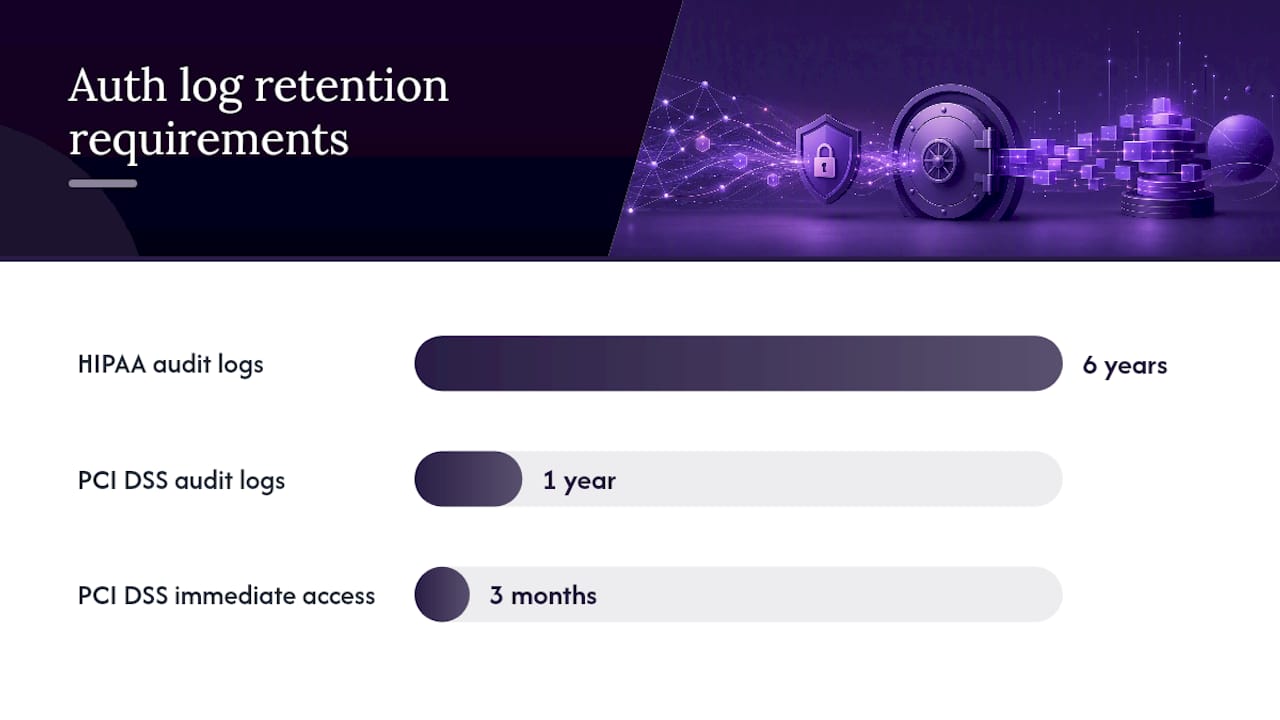
jtiand thesub/client_idpair. This gives you traceability without creating a log-based token exfiltration risk. - For U.S. regulated sectors (HIPAA, PCI DSS), retain auth event logs for the period required by the applicable regulation. HIPAA requires a minimum of six years for audit logs; PCI DSS requires one year with three months immediately available.
Introspection vs. local JWT verification:
- Use local JWT verification (signature +
exp+aud+isschecks) for high-throughput resource servers where the latency of an introspection call is unacceptable. - Use token introspection (RFC 7662) when you need real-time revocation awareness, particularly for long-lived tokens or high-risk operations. Introspection adds a network round-trip but reflects revocation immediately.
- Combine both: verify the JWT locally for basic validity, then call introspection for tokens above a risk threshold (admin scopes, financial operations, first use after a long idle period).
Alerting rules:
- Alert on duplicate refresh token use (same token presented twice). This is the canonical signal of refresh token theft.
- Alert on authorization codes presented more than once. A replayed code means either a client bug or an active attack.
- Alert on tokens used from a new IP or geography within a short window of the original issuance.
- Alert on mass token revocation events, which may indicate a credential rotation following a compromise or an automated attack.
Incident response steps:
- Revoke the token family (all tokens issued to the affected client or user session) immediately.
- Rotate the client credential if client compromise is suspected.
- Notify affected users if their session was active during the suspected compromise window.
- Review logs for the 24-hour window before the alert to identify what the attacker accessed.
- Patch the misconfiguration that enabled the attack before re-enabling the affected client.
PII in logs requires care: log subject identifiers (sub) rather than raw usernames or email addresses where possible, and apply log access controls consistent with your data classification policy.
Which libraries and reference implementations should you use?
The library you choose matters as much as the configuration. An unmaintained library with a known CVE in its PKCE implementation undoes every control in this guide.
Server-side OAuth/OIDC frameworks:
- Keycloak (Java): full-featured AS with PKCE, DPoP, mTLS, and RFC 8414 metadata support. Widely used in regulated U.S. environments.
- Ory Hydra (Go): lightweight, headless AS designed for cloud-native deployments. Strong PKCE and token introspection support.
- Spring Authorization Server (Java): the reference implementation for Spring-based confidential clients and AS deployments.
- node-oidc-provider (Node.js): the most complete OIDC-certified provider for Node.js; supports DPoP and all current grant types.
Client-side libraries:
- oidc-client-ts (TypeScript/browser): handles Authorization Code + PKCE, silent renewal, and DPoP for SPAs. Actively maintained.
- AppAuth (iOS, Android, Java): the reference implementation for native app OAuth flows per RFC 8252. Handles loopback redirect and PKCE correctly.
- Auth.js (Next.js/Node.js): abstracts OIDC flows for server-rendered and edge-deployed apps; supports multiple providers.
DPoP and mTLS tooling:
- For DPoP proof generation, use the
dpopnpm package or thejoselibrary (JavaScript/TypeScript), which provides the JWT signing primitives needed to construct DPoP proofs per RFC 9449. - For mTLS in Node.js, configure the
httpsmodule oraxioswith apfx/cert/keyoption pointing to your client certificate. In Java, configureSSLContextwith your client keystore.
Validation logic for resource servers:
When validating a sender-constrained token, the resource server must:
- Verify the JWT signature against the AS’s JWKS endpoint.
- Validate
exp,iss, andaudclaims. - For DPoP: verify the DPoP proof JWT in the request header, confirm the
htu(HTTP URI) andhtm(HTTP method) match the current request, and check that thejktthumbprint in the token matches the DPoP key. - For mTLS: extract the client certificate thumbprint from the TLS session and compare it to the
cnf.x5t#S256claim in the token.
Consult Microsoft’s identity platform documentation for practical examples of token types, app registration fields, and endpoint configuration that map directly to these validation steps.
How does Jundago operationalize these OAuth controls for regulated enterprises?
Knowing the controls is one thing. Enforcing them consistently across dozens of APIs, multiple cloud environments, and rotating engineering teams is where most organizations fall short. Jundago’s API governance platform is built specifically for this gap.
Feature-to-control mapping:
- Automated client inventory: Jundago’s Command Center maintains a live registry of every OAuth client, its registered redirect URIs, scopes, credential type, and expiry. Stale clients surface automatically rather than accumulating silently.
- Scope governance: the platform enforces a scope registry as a governed artifact. New scopes require approval, carry a data classification, and are versioned. This directly prevents scope explosion.
- Token policy enforcement: RBAC and ABAC controls built into Jundago’s API Studio enforce audience restriction and scope minimization at the API definition layer, before a token is ever issued.
- Policy-as-code for aud/scope checks: resource server validation logic (aud, scope, sender-constraint verification) can be expressed as policy-as-code and applied uniformly across AWS, Azure, GCP, and Oracle Cloud deployments from a single Command Center.
- Automated rotation workflows: credential rotation for client keys and refresh token policies can be triggered by lifecycle events (client decommission, scheduled rotation, incident response) without manual intervention.
- Compliance alignment: industry modules for healthcare (HIPAA, HL7 FHIR) and finance (PCI DSS, Open Banking) ship with OAuth policy templates pre-mapped to the applicable regulatory requirements.
For regulated U.S. enterprises, the API gateway security patterns that Jundago enforces include token validation middleware, scope-based routing, and anomaly detection hooks that feed directly into your SIEM.
Pro Tip: Integrate OAuth audits into your CI/CD pipeline using Jundago’s policy gates. A pull request that registers a new OAuth client or adds a scope triggers an automated policy check: does the client use asymmetric auth? Are the redirect URIs exact-match? Is the scope in the governed registry? Catching misconfigurations at merge time costs a fraction of what a post-deployment audit costs.
Regulated enterprises building APIs at scale need OAuth security that is continuous, not periodic. Jundago’s platform enforces RFC 9700 and OWASP-aligned controls across the full API lifecycle, from generation to production governance. See how Jundago works.
The gap between what OAuth guides promise and what actually breaks production
Most OAuth 2.0 security guides read like a checklist of RFCs. Implement PKCE, rotate refresh tokens, use mTLS. Check, check, check. The problem is that the checklist treats each control as independent, when the real attack surface is the gaps between them.
Here is what the conventional advice consistently underweights: client credential hygiene is the most exploited gap in production OAuth deployments, and it is almost never the first thing teams fix. Teams migrate to PKCE, add refresh token rotation, and then leave a client_secret hardcoded in a Kubernetes secret that three teams have read access to. The attacker does not need to break PKCE. They just need the secret.
The second underweighted issue is scope governance. Scope explosion is not just an aesthetic problem. When a client has 40 scopes and no one knows which ones it actually uses, you cannot safely revoke any of them without risking a production outage. That paralysis is exactly what keeps over-privileged clients alive for years. The fix is not a better naming convention; it is treating scopes as governed artifacts from day one, with ownership, data classification, and automated usage tracking.
The third thing most guides get wrong: they treat OAuth security as a deployment-time concern. You configure PKCE, you ship, you move on. But token lifetimes drift upward under operational pressure (“the refresh is causing latency”), client registrations accumulate without cleanup, and scope assignments expand without review. The organizations that actually maintain a strong OAuth posture treat it as a continuous governance process, not a one-time configuration.
If you are prioritizing, fix client authentication first. Asymmetric keys are not significantly harder to implement than rotating secrets, and they eliminate an entire class of credential exfiltration attacks. Then fix scope governance. Then add sender-constraining for your highest-value APIs. PKCE is table stakes at this point; most modern libraries handle it correctly by default. The hard work is the operational discipline that keeps the controls effective after the initial deployment.
Sources
The normative documents below are the primary sources for every control in this guide. Read the RFC text directly for MUST/SHOULD/RECOMMENDED language when writing policy documents or audit criteria.
- RFC 9700: OAuth 2.0 Security Best Current Practice | RFC Editor
- OAuth2 - OWASP Cheat Sheet Series
- Scope Best Practices in OAuth 2.0 - DEV Community
- OpenID Connect on the Microsoft identity platform | Microsoft Learn
- OAuth scopes & permissions best practices | Obsidian Security
When using RFC text in policy documents, cite the specific section and the normative keyword (MUST, SHOULD, RECOMMENDED, MAY). RFC 9700 uses “MUST” for PKCE on public clients and “RECOMMENDED” for sender-constraining; knowing the distinction matters when writing compliance requirements.