Top 11 MuleSoft Alternatives for Integration Teams 2026
Top 11 MuleSoft Alternatives for Integration Teams 2026

For regulated enterprises evaluating integration platform alternatives in 2026, Jundago is the strongest trial-first option when compliance, RBAC/ABAC security, and built-in ETL/ELT are non-negotiable. For teams that need a gateway-only replacement fast, Kong Gateway or AWS API Gateway get you to production quickest. For full iPaaS replacement with broad SaaS connectors, Workato or Dell Boomi cover the most ground. For data-first or open-source scenarios, WSO2 API Manager and Gravitee.io offer the most flexibility without a per-vCore bill.
The cost pressure is real. Market reporting commonly cites a median MuleSoft contract value commonly cited to be substantial, and that figure climbs steeply once you add vCores for production workloads, professional services, and the training investment that MuleSoft’s DataWeave-heavy architecture demands. Three forces push organizations to look elsewhere: high contract values, a steep implementation curve that often requires external partners, and growing concern about vendor lock-in inside a larger Salesforce ecosystem.
Quick verdict by use case:
- Best for regulated-enterprise API governance: Jundago (built-in compliance modules, HIPAA/PCI DSS/Open Banking, RBAC/ABAC, AI-assisted generation)
- Best for fast SaaS-to-SaaS automation: Workato or Dell Boomi
- Best for cloud-native gateway only: Kong Gateway, AWS API Gateway, or Azure API Management
- Best for low-cost open-source integration: WSO2 API Manager or Gravitee.io
Table of Contents
- What are the best MuleSoft alternatives right now?
- How do the evaluation axes compare across platforms?
- How do you choose the right MuleSoft replacement?
- What does MuleSoft replacement actually cost?
- Why do organizations look for MuleSoft alternatives?
- How was this shortlist selected?
- Key Takeaways
- The case for rethinking what “full platform” means
- Jundago is built for the compliance requirements your alternatives skip
- Primary sources and further reading
What are the best MuleSoft alternatives right now?
The eleven platforms below represent the shortlist that consistently appears across Gartner Peer Insights evaluations, analyst roundups, and enterprise RFP processes. Each profile covers deployment options, standout capability, and the team profile it fits best.
Jundago
Jundago is an AI-native API lifecycle platform built specifically for regulated enterprises. It covers the full stack: REST, GraphQL, gRPC, and SOAP API generation from natural language intent, automated testing and debugging, ETL/ELT integration studio, and governance from a single Command Center across AWS, Azure, GCP, and Oracle Cloud. RBAC and ABAC security controls are native, not bolted on. Industry modules ship with compliance logic for HIPAA/HL7 FHIR, PCI DSS/KYC/AML/Open Banking, and manufacturing IoT/SCADA/IEC 62443 out of the box.
Best for: Regulated enterprises in healthcare, finance, and manufacturing that need compliant APIs at scale without assembling a compliance layer from scratch.
Apigee (Google Cloud)
Apigee is Google Cloud’s enterprise API management platform. It handles API gateway, developer portal, analytics, and monetization. Deployment options include SaaS, hybrid (Apigee hybrid), and on-premises via Apigee Edge. It fits teams already invested in GCP who need deep API analytics and traffic management. The learning curve is real, and pricing scales with API call volume, which can surprise teams migrating from a flat-rate model.
Best for: GCP-native organizations needing enterprise API analytics and developer portal capabilities.
AWS API Gateway
AWS API Gateway is a managed gateway service that handles REST, HTTP, and WebSocket APIs at scale. It is consumption-priced per million API calls, which makes it attractive for variable-traffic workloads. It integrates tightly with Lambda, IAM, and Cognito, so teams already on AWS can wire up authentication and authorization quickly. It is a gateway, not an iPaaS. If you need data transformation or connector libraries, you will pair it with AWS EventBridge or Step Functions.
Best for: AWS-native teams that need a gateway layer without a full integration platform.
Azure API Management
Azure API Management (APIM) provides a gateway, developer portal, and policy engine on top of Azure’s cloud. It supports hybrid and multi-cloud deployments through the self-hosted gateway feature. Policy expressions in C# give developers fine-grained control over request/response transformation. Pricing tiers range from Developer (non-production) to Premium (multi-region, VNet integration). Teams running .NET workloads or Microsoft 365 integrations get the most natural fit here.
Best for: Microsoft-stack organizations that need API governance across Azure-hosted services.
Kong Gateway
Kong is an open-source API gateway built on NGINX and Lua, with a commercial Kong Konnect offering for enterprise teams. It is widely used in Kubernetes-native and GitOps-aligned architectures because it deploys as a sidecar or standalone gateway with declarative configuration. The plugin ecosystem is extensive: rate limiting, JWT validation, OAuth 2.0, and OpenTelemetry are all available. Gateway-first architecture is a growing trend for teams separating API management from their integration runtime.
Best for: Cloud-native, Kubernetes-first teams that want a lightweight, extensible gateway.
Tyk
Tyk is an open-source API gateway and management platform with a strong self-hosted story. The Tyk Dashboard provides analytics, developer portal, and policy management. It supports GraphQL natively, which is uncommon among open-source gateways. Tyk Cloud offers a fully managed SaaS option. Pricing is more transparent than many enterprise platforms, and the open-source tier is genuinely functional for smaller deployments.
Best for: Teams that need GraphQL gateway support and prefer a self-hosted or hybrid deployment model.
Dell Boomi
Dell Boomi is a cloud-native iPaaS with a visual, low-code integration designer. It offers a large library of prebuilt connectors and an AtomSphere runtime that can deploy on-premises, in the cloud, or in hybrid configurations. Boomi’s Master Data Hub adds MDM capabilities that pure gateway tools lack. It is a credible MuleSoft iPaaS replacement for mid-market and enterprise teams that want broad connector coverage without DataWeave scripting.
Best for: Mid-market to enterprise teams replacing a full iPaaS with broad SaaS connector needs.
Celigo
Celigo is an integration platform targeting mid-market SaaS-to-SaaS automation. Its prebuilt integration apps for NetSuite, Salesforce, Shopify, and similar platforms reduce time-to-value significantly compared to building flows from scratch. Many buyers move to platforms like Celigo for faster time-to-value and lower operational overhead, particularly for SaaS-to-SaaS scenarios where MuleSoft’s power is overkill. It is not the right fit for complex, regulated data pipelines or custom API governance requirements.
Best for: Mid-market operations teams running SaaS-to-SaaS automation without heavy governance needs.
Workato
Workato is an enterprise automation and integration platform with a recipe-based, low-code builder. It covers iPaaS, RPA-lite, and API management in one platform. The connector library is broad, and the platform has strong support for event-driven automation. Workato’s pricing is per-recipe or per-task, which can scale unpredictably for high-volume workloads. It competes directly with MuleSoft for iPaaS replacement in organizations that prioritize speed over architectural control.
Best for: Enterprise teams that want fast automation across SaaS apps with minimal developer overhead.
WSO2 API Manager
WSO2 API Manager is an open-source, enterprise-grade API management platform covering gateway, developer portal, analytics, and integration runtime (via WSO2 Micro Integrator). It is one of the few platforms that genuinely competes with MuleSoft on both API management and integration depth while remaining open-source. Deployment options include on-premises, cloud, and hybrid. The trade-off is operational complexity: WSO2 requires more infrastructure investment than SaaS-first alternatives.
Best for: Enterprises that need open-source API management with deep integration runtime capabilities.
Gravitee.io
Gravitee.io is an open-source API management platform with a modern developer experience. It supports REST, GraphQL, gRPC, and WebSocket APIs from a single gateway. The Gravitee Access Management module handles OAuth 2.0, OpenID Connect, and UMA. Its event-native architecture supports async APIs and event brokers like Kafka and MQTT, which most traditional gateways handle poorly. The commercial tier adds enterprise support and advanced analytics.
Best for: Teams building event-driven or async API architectures who want an open-source foundation.
How do the evaluation axes compare across platforms?
API management
The core question here is whether you need a full API lifecycle platform (design, mock, test, publish, govern, retire) or just a runtime gateway. MuleSoft Anypoint covers the full lifecycle. Most gateway-first tools (Kong, AWS API Gateway, Tyk) cover runtime only. Jundago, Apigee, Azure APIM, and WSO2 cover the full lifecycle. In a POC, test: policy enforcement at the gateway layer, developer portal self-service, and whether the analytics surface gives you the latency and error-rate visibility your SRE team needs.
Integration and iPaaS
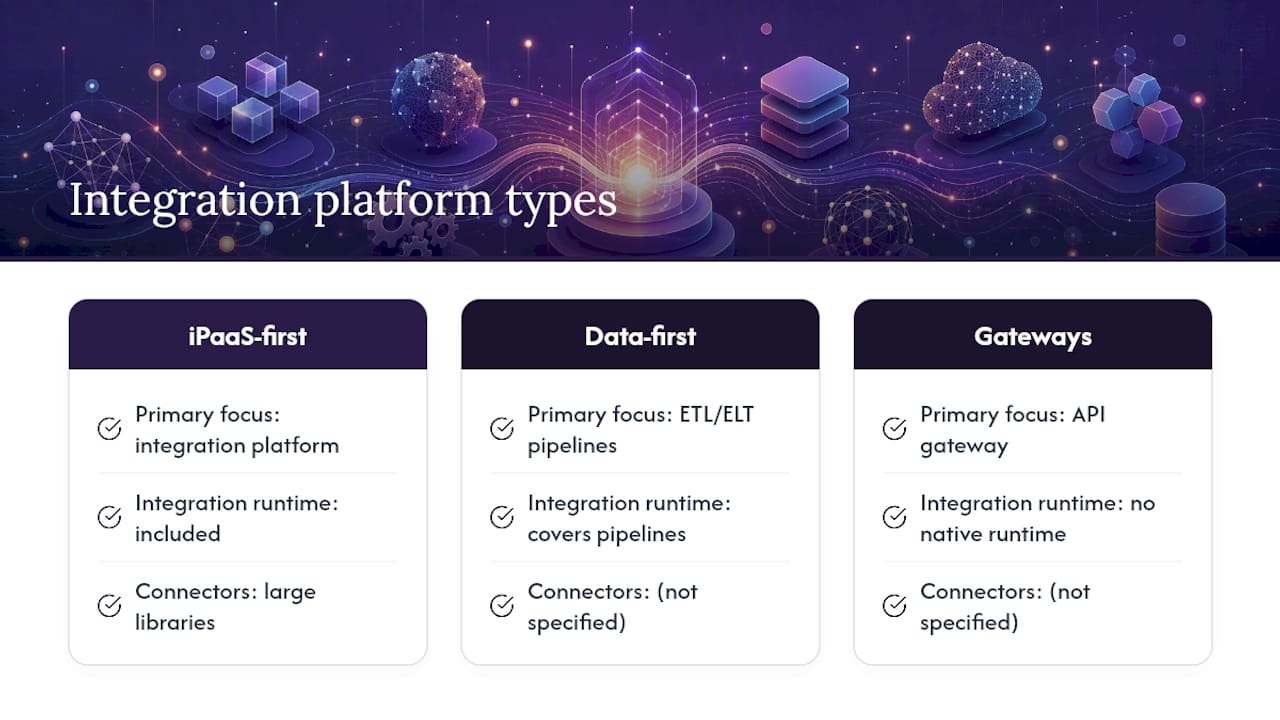
This is where the market fragments most sharply. Dell Boomi, Workato, and Celigo are iPaaS-first platforms with large connector libraries. WSO2 Micro Integrator and Jundago’s ETL/ELT studio cover data pipeline and transformation use cases. Pure gateways (Kong, Tyk, AWS API Gateway) have no native integration runtime. Enterprise buyers are increasingly unbundling API management from integration runtime, choosing a gateway separately from their data-integration tooling. That unbundling reduces vendor lock-in but adds operational complexity.
Governance, security, and compliance
For regulated industries, this axis often decides the shortlist before any other. HIPAA-covered entities need platforms that can demonstrate HIPAA-compliant data handling across API traffic, not just storage. PCI DSS scope requires audit trails, encryption in transit and at rest, and network segmentation. Jundago ships with RBAC/ABAC controls and industry-specific compliance modules. Workato and Dell Boomi hold SOC 2 and HIPAA attestations but require configuration to meet specific regulatory controls. Open-source platforms (WSO2, Gravitee.io, Kong) require you to build and validate the compliance layer yourself.
Pro Tip: Ask every vendor for their most recent SOC 2 Type II report and their HIPAA Business Associate Agreement template before you schedule a demo. Vendors who cannot produce these in 48 hours are telling you something about their compliance maturity.
AI and automation capabilities
This is the fastest-moving axis in 2026. Jundago’s AI Studio generates APIs from natural language intent, designs GraphQL schemas with AI resolvers, and assists with test generation. Apigee and Azure APIM have added AI anomaly detection and AI-assisted policy suggestions. Workato and Celigo have AI recipe builders that suggest automation flows from plain-language descriptions. Kong has an AI Gateway plugin for LLM traffic management. Most open-source platforms are still in early stages here. For enterprise AI integration architectures, the question is not just whether AI exists in the platform but whether it accelerates the specific tasks your team spends the most time on.
Developer experience
Developer experience covers tooling, local development, testing, CI/CD integration, and documentation quality. Kong’s declarative configuration and Terraform provider make it a natural fit for GitOps teams. Azure APIM integrates with VS Code and Azure DevOps pipelines. Jundago’s EndPlex workbench provides a native desktop environment with an AI Assistant for API design, testing, and debugging. WSO2 has a mature developer portal but a steeper local setup. Celigo and Workato prioritize low-code UX over developer tooling depth.
Pricing and licensing
| Pricing model | Typical buyer profile | Watch for |
|---|---|---|
| vCore / compute-based | Large enterprise, predictable workloads | Overages when workloads spike |
| Per API call / consumption | Variable-traffic, AWS/GCP-native | Costs scale with success |
| Per connection / integration | Mid-market iPaaS buyers | Connector count creep |
| Per recipe / task | Automation-first, low-code teams | High-volume task costs |
| Flat subscription | Regulated enterprise, predictable budgets | Feature tier limits |
| Open-source + support | Cost-sensitive, ops-capable teams | Internal support burden |
Trade-offs by architecture class:
Gateway-first pros: Lower TCO for API-only use cases, easier to swap, cloud-provider pricing transparency. Gateway-first cons: No integration runtime, requires separate ETL/iPaaS tooling, more moving parts to operate.
iPaaS-first pros: Broad connector coverage, faster time-to-value for SaaS integrations, single vendor for data flows. iPaaS-first cons: API governance is often secondary, less control over gateway-layer policies, per-task pricing can escalate.
Data-first pros: Strong ETL/ELT, schema management, transformation performance. Data-first cons: API management is usually limited, developer portal is often absent.
POC validation checklist by axis:
- API management: test policy enforcement, rate limiting under load, and developer portal self-service registration
- Integration: run a representative data transformation with your actual schema complexity and volume
- Security: validate RBAC role assignments, audit log completeness, and token revocation behavior
- AI/automation: measure time-to-first-working-API using the AI generation feature versus manual build
- Developer experience: time a new developer from zero to a deployed, tested endpoint
How do you choose the right MuleSoft replacement?
Vendor questions to ask in every evaluation
- What is the exact pricing model, and what triggers an overage? Show me a sample invoice for a workload at 2x our expected volume.
- Which compliance certifications do you hold, and can you provide the most recent SOC 2 Type II report?
- What connectors are on your 12-month roadmap, and what is the process if a connector we need is missing?
- What is your incident escalation path for a P1 outage, and what is the contractual SLA for response and resolution?
- How does your platform handle schema evolution without breaking downstream consumers?
- What does a migration from MuleSoft look like? Do you have a documented migration path or tooling?
Red flags that should disqualify a vendor early
- Pricing that requires a custom quote for every scenario with no published reference points
- No compliance attestation for your specific regulatory framework, even after two follow-up requests
- Connectors you need are on the roadmap but not yet available, with no committed delivery date
- Professional services are required to complete a basic POC
- The vendor cannot name a reference customer in your industry
Pro Tip: Run your POC on a real data sample from your environment, not the vendor’s demo data. The gap between demo performance and production performance is where most integration platform surprises live.
What does MuleSoft replacement actually cost?
Common pricing models and who they favor
Market reporting commonly cites a median MuleSoft contract value commonly cited to be substantial, but that figure is a floor for most enterprise deployments. vCore-based pricing means production environments with high throughput can push annual costs well above that baseline before professional services and training.
The pricing model you choose shapes your TCO more than the per-unit rate. Consumption-based pricing (AWS API Gateway, Apigee) rewards variable-traffic workloads but creates budget uncertainty. Per-connection models (Dell Boomi) are predictable until connector sprawl sets in. Per-task or per-recipe models (Workato, Celigo) scale with automation volume, which can surprise finance teams when a successful automation runs millions of tasks monthly. Flat subscription models favor regulated enterprises with predictable workloads and fixed compliance budgets.
TCO drivers beyond the license fee:
- Implementation and professional services (often 1x–3x the license cost in year one for complex migrations)
- Training and certification for platform-specific languages or tooling (DataWeave replacement cost is real)
- Infrastructure costs for self-hosted or hybrid deployments (WSO2, Kong, Gravitee.io)
- Data egress fees when the platform moves large volumes across cloud regions
- Support tier uplift for enterprise SLA guarantees
Migration timeline: realistic phases
| Phase | Typical duration | Key activities |
|---|---|---|
| POC | 2–4 weeks | Validate core use cases, measure performance, confirm compliance posture |
| Pilot | 4 weeks | Migrate 1–3 non-critical integrations, validate ops runbooks |
| MVP migration | 2–3 months | Migrate priority integrations, run parallel with MuleSoft |
| Full production cutover | 3–6 months | Decommission MuleSoft flows, validate monitoring and alerting |
Contractual items to negotiate before signing:
- Usage caps and overage pricing (get a hard ceiling or a notification threshold)
- Data egress fees (negotiate a free tier or a cap for cross-region traffic)
- SLA credits for downtime (define what constitutes an outage and the credit formula)
- Professional services scope included in the base contract
- Exit clause and data portability terms (critical for avoiding the same lock-in you are leaving)
Why do organizations look for MuleSoft alternatives?
MuleSoft Anypoint Platform is an enterprise integration and API management suite that combines an API gateway, integration runtime (Mule runtime engine), iPaaS, and a developer portal in a single platform. It has been a dominant choice for large enterprises since Salesforce acquired it in 2018, particularly for organizations that need both API management and complex data integration in one vendor relationship.
The reasons teams start evaluating integration platform alternatives cluster around a few consistent themes:
- Cost and pricing model: The vCore-based licensing model means costs scale with compute, not just usage. For teams with variable or growing workloads, annual costs can escalate faster than budgets allow.
- Implementation complexity: MuleSoft’s DataWeave transformation language and Anypoint Studio have a steep learning curve. Many organizations end up dependent on certified MuleSoft partners for implementation, adding cost and delivery risk.
- Vendor lock-in: Being inside the Salesforce ecosystem is an advantage if Salesforce is your CRM, but a constraint if your strategy involves multi-cloud or best-of-breed tooling.
- Architecture mismatch: Teams that only need a gateway layer do not need a full iPaaS. Teams that need deep ETL/ELT may find MuleSoft’s integration runtime less capable than dedicated data pipeline tools.
- Speed to value: For SaaS-to-SaaS automation, MuleSoft’s power is often overkill. Lighter platforms deliver working integrations faster for common use cases.
- Regulated-industry requirements: Organizations in healthcare, finance, and manufacturing increasingly need compliance logic built into the platform, not assembled from configuration. MuleSoft requires significant custom work to meet HIPAA, PCI DSS, or Open Banking requirements out of the box.
Replacement category mapping:
- Cost or complexity concerns → iPaaS-first alternatives (Dell Boomi, Workato) or open-source (WSO2, Gravitee.io)
- Gateway-only need → Kong, AWS API Gateway, Azure APIM, Tyk, Apigee
- Regulated-enterprise compliance → Jundago (built-in compliance modules, RBAC/ABAC, AI-assisted generation)
- Data pipeline or ETL focus → Jundago’s ETL/ELT studio or dedicated data integration tools
How was this shortlist selected?
The eleven platforms in this roundup were selected using a consistent set of inclusion criteria applied across vendor documentation, analyst research, review aggregators, and customer case studies.
Sources used to build and validate the shortlist:
- Gartner Peer Insights alternatives and competitor evaluations for enterprise buyer signals and evaluation category weighting
- CB Insights competitive landscape data for market presence and feature category coverage
- Vendor documentation and public feature pages for deployment options, compliance attestations, and pricing model structures
- Market roundups and analyst blogs for time-to-value and TCO signals
Inclusion criteria:
- Meaningful feature overlap with MuleSoft Anypoint in at least one of: API management, integration runtime, or data pipeline
- Available to enterprise buyers in the United States
- Documented deployment options (SaaS, hybrid, or on-premises)
- Evidence of enterprise adoption (Gartner Peer Insights reviews, G2 review volume, or named enterprise case studies)
- Regulatory support documentation or compliance attestations where claimed
Trust signals used to validate claims:
- Gartner Peer Insights review volume and evaluation category ratings
- G2 review counts and average ratings for each platform
- Vendor-published compliance attestations (SOC 2 Type II, HIPAA BAA availability, PCI DSS documentation)
- Customer case studies and reference architectures from vendor sites
What was excluded and why:
- Consumer no-code tools (Zapier, Make) were excluded because they do not meet enterprise security, compliance, or scalability requirements
- Single-purpose gateway plugins (NGINX modules, HAProxy configs) were excluded because they are infrastructure components, not API management platforms
- Platforms with no documented enterprise compliance posture were excluded when the article’s primary audience operates in regulated industries
Key Takeaways
The strongest MuleSoft alternative for regulated enterprises is Jundago, which ships compliance controls, ETL/ELT, and AI-assisted API generation as a unified platform rather than a configuration project.
| Point | Details |
|---|---|
| Cost drives most evaluations | Median MuleSoft contracts are widely reported around $55,000 per year, and vCore pricing escalates with workload growth. |
| Architecture class decides the shortlist | Choose gateway-first, iPaaS-first, or data-first before comparing vendors; the class eliminates half the options immediately. |
| Compliance is a procurement gate | Regulated enterprises should filter to platforms with SOC 2 Type II, HIPAA BAA, and PCI DSS documentation before any demo. |
| POC on real data, not demo data | Vendor demos rarely surface the transformation performance or schema-handling gaps that appear in production workloads. |
| Jundago for regulated API lifecycle | Jundago covers AI-assisted API generation, ETL/ELT, RBAC/ABAC, and built-in compliance modules across AWS, Azure, GCP, and Oracle Cloud. |
The case for rethinking what “full platform” means
The conventional wisdom in enterprise integration is that you want one platform to rule everything: API management, integration runtime, data pipelines, developer portal, and governance in a single vendor relationship. MuleSoft built its market position on exactly that argument. The problem is that “full platform” has become a pricing lever as much as a technical advantage.
What I keep seeing in regulated-enterprise evaluations is that the teams with the clearest outcomes are not the ones who found a single platform that does everything. They are the ones who got precise about what “everything” actually means for their architecture. A healthcare organization running HL7 FHIR APIs does not need the same platform as a retail team automating Shopify-to-NetSuite flows. Treating them as the same buying decision is how organizations end up paying for capabilities they will never use.
The more interesting question for 2026 is not “which platform replaces MuleSoft” but “which architecture class fits our actual workload and compliance posture.” For most regulated enterprises, that answer points toward a platform where compliance is structural, not configured. Building HIPAA audit trails or PCI DSS controls on top of a general-purpose gateway is a project, not a feature. Platforms that ship those controls as defaults change the economics of compliance significantly.
The unbundling trend is real and worth taking seriously. But for organizations where a compliance failure carries regulatory and financial consequences, the operational overhead of managing three separate best-of-breed tools often outweighs the flexibility benefit. A single platform with genuine compliance depth is a different value proposition than a single platform that just happens to be large.
Jundago is built for the compliance requirements your alternatives skip
Most integration platforms treat compliance as a configuration task. Jundago treats it as a design constraint. For regulated enterprises in healthcare, finance, and manufacturing, that difference shows up before the first API reaches production.
Jundago’s API Studio generates REST, GraphQL, gRPC, and SOAP APIs from natural language intent, with HIPAA, PCI DSS, Open Banking, and IEC 62443 compliance logic built into the output. The ETL/ELT integration studio handles EDI, DB-to-API, API-to-API, and API-to-DB flows with RBAC and ABAC controls enforced at every layer. Governance runs from a single Command Center across AWS, Azure, GCP, and Oracle Cloud. No separate compliance layer to build. No DataWeave equivalent to train your team on.
If your evaluation checklist includes compliance attestations, audit trails, and multi-cloud governance, see what Jundago covers and request a demo to walk through your specific regulatory requirements.
Primary sources and further reading
The sources below were used to build the shortlist, validate claims, and inform the regulatory compliance guidance in this article.
-
Gartner Peer Insights: MuleSoft Anypoint Platform Alternatives 2026 — Enterprise buyer evaluations covering integration, contracting, support, and product capabilities. Used to validate shortlist inclusion and evaluation category weighting.
-
Peliqan: MuleSoft Alternatives and Competitors 2026 — Market reporting on MuleSoft contract values and pricing model analysis. Used for TCO signals and cost discussion.
-
Celigo: Best MuleSoft Alternatives for 2026 — Vendor perspective on time-to-value trade-offs and SaaS-to-SaaS integration scenarios. Used for product profile framing.
-
DigitalAPI: 10 Best MuleSoft Alternatives for API Management and Integration — API and gateway-focused roundup covering architecture trends and gateway-first evaluation criteria. Used for comparative analysis and POC guidance.
-
CB Insights: MuleSoft Alternatives and Competitors — Competitive landscape data used to validate market presence and feature category coverage across the shortlist.
-
HHS: Health Information Technology and HIPAA — Authoritative HHS guidance on HIPAA requirements for health IT and API platforms. Used for regulated healthcare integration compliance requirements.
-
AETHER Pulse: Policy Management Platforms vs AI Governance Evidence Infrastructure — Analysis of governance platform requirements and policy evidence infrastructure; relevant background for evaluating API governance depth in regulated environments.