Healthcare API Integration: A Technical Playbook for U.S. Teams
Healthcare API Integration: A Technical Playbook for U.S. Teams

Healthcare API integration connects EHRs, payer systems, medical devices, and analytics platforms using standards like HL7 FHIR, OAuth 2.0, and HIPAA-aligned security controls. The goal is interoperability: getting the right clinical and administrative data to the right system at the right time, without building brittle point-to-point connections that collapse when a vendor updates their schema. Before writing a single line of code, your engineering lead should do five things:
- Scope your data — identify which PHI flows across which systems and classify sensitivity.
- Pick a standards profile — FHIR R4 with US Core is the baseline for most new U.S. integrations.
- Set your auth model — SMART on FHIR with OAuth 2.0 and PKCE for patient-facing apps; client credentials for backend services.
- Choose a sandbox — register against a vendor dev sandbox or a public FHIR test server before touching production.
- Define success metrics — latency SLOs, data completeness rates, and audit log coverage before go-live.
Involve your security and compliance team from day one, not after the prototype. At minimum, confirm which Business Associate Agreements are required and verify TLS 1.2+ is enforced on every endpoint.
Key Takeaways
FHIR R4 with US Core profiles, SMART on FHIR OAuth 2.0, and HIPAA-aligned security controls form the non-negotiable foundation of any production healthcare API integration in the United States.
| Point | Details |
|---|---|
| Start with FHIR R4 and US Core | Patient, Encounter, Observation, Condition, and MedicationRequest cover most clinical use cases and are US Core required. |
| SMART on FHIR plus PKCE for auth | Use PKCE for every mobile or public client; client credentials for backend service-to-service flows. |
| HIPAA controls from day one | TLS 1.2+, RBAC/ABAC, audit logging, BAAs, and synthetic data in pre-production are non-negotiable before any PHI flows. |
| Match architecture to data pattern | Use API gateway plus façade for legacy EHRs, streaming for device telemetry, and bulk FHIR export for analytics pipelines. |
| Jundago for regulated API lifecycle | Jundago covers API generation, FHIR-aligned contract testing, RBAC/ABAC, and governance automation across AWS, Azure, GCP, and Oracle Cloud. |
Table of Contents
- What healthcare API integration looks like for your IT team
- Which standards and data formats to implement first
- How teams typically connect systems: architectures and patterns
- Security, privacy, and U.S. compliance controls you need to implement
- From prototype to production: implementation steps and best practices
- Developer tools, sandboxes, and testing resources
- Common use cases and real integration examples
- Common challenges and how to mitigate them
- How Jundago maps to regulated healthcare API integration needs
- Jundago: built for regulated healthcare API work
- Sources
What healthcare API integration looks like for your IT team
In practical terms, healthcare API integration means writing and operating the code, configurations, and governance policies that let distinct clinical systems exchange data reliably. You are not just connecting two databases. You are connecting systems with different data models, different identity schemes, different update cadences, and different regulatory obligations.
The systems you will typically connect:
- EHRs (Epic, Cerner, Veradigm/Allscripts): patient demographics, clinical notes, lab results, medication lists, encounter records. Expect FHIR R4 endpoints alongside legacy HL7 v2 feeds and, in some cases, proprietary APIs.
- Payer systems: claims, eligibility, prior authorization, and patient access data. Major payers now expose FHIR-based Patient Access APIs under CMS mandates.
- Medical devices and remote monitoring: telemetry streams (vitals, glucose, waveforms) that arrive at high frequency and require ingestion pipelines rather than request-response patterns.
- Analytics and AI platforms: data warehouses, ML pipelines, and population health tools that consume normalized FHIR bundles or flat extracts.
Stakeholder responsibilities tend to break down this way:
- Integration engineers own the mapping, transformation, and transport layer.
- Clinical informaticists validate that code sets, terminologies, and clinical logic are correct after transformation.
- Security and compliance review auth flows, audit logging, and BAA coverage.
- Product owners define the data scope and prioritize which resources to expose first.
- Developers build client apps, write contract tests, and manage API versioning.
Nobody owns this alone. The teams that struggle most are the ones where compliance reviews the integration only after it is built.
Which standards and data formats to implement first
Not every standard deserves equal attention at the start of a project. Here is the priority order that works for most U.S. healthcare API integration projects, along with notes on when each standard earns its place.
| Standard | Primary purpose | When to prioritize | Key pitfall |
|---|---|---|---|
| FHIR R4 / US Core | Clinical data exchange (REST) | Any new patient-facing or EHR-connected integration | Ignoring US Core profiles; raw FHIR without profiles is too permissive |
| HL7 v2.x | Legacy ADT, lab, and order feeds | Connecting to older EHRs or hospital systems that have not migrated | Segment variations across vendors; no single canonical v2 dialect |
| DICOM | Medical imaging (radiology, pathology) | Any integration touching imaging workflows or PACS systems | Large payload sizes; requires dedicated image management infrastructure |
| SMART on FHIR / OAuth 2.0 | App authorization and launch | Every patient-facing or provider-facing app launch | Skipping PKCE for mobile/public clients; token scope creep |
| OpenID Connect | Identity federation | Multi-tenant or cross-organization identity scenarios | Conflating authentication (OIDC) with authorization (OAuth 2.0) |
| GraphQL | Flexible, client-driven queries | Analytics dashboards or apps needing partial resource fetches | Over-fetching prevention; N+1 query risk on FHIR-backed resolvers |
| gRPC | Low-latency, high-throughput internal services | Device telemetry pipelines or microservice-to-microservice calls | Limited browser support; requires Protobuf schema discipline |
For FHIR specifically, the Allscripts FHIR R4 API illustrates how a production EHR server publishes a capability statement, supports SMART app launch profiles, and handles both patient and standalone OAuth2 flows. Read a vendor’s capability statement before writing any client code — it tells you exactly which resources and interactions the server actually supports, not what the marketing page claims.
SMART on FHIR is the standard pairing for both provider and patient app launches, and PKCE is the right choice for any mobile or public client. Skipping PKCE is the most common auth mistake in patient-facing integrations.
Pro Tip: Start with five FHIR resources and get them right: Patient, Encounter, Observation, Condition, and MedicationRequest. These five cover the majority of clinical use cases and are required by US Core. Expanding from a solid foundation is far easier than retrofitting profiles onto a poorly mapped initial set.
How teams typically connect systems: architectures and patterns
Architecture choice determines how much operational pain you will carry for the next several years. There is no universal right answer, but there are clear signals that point toward each pattern.
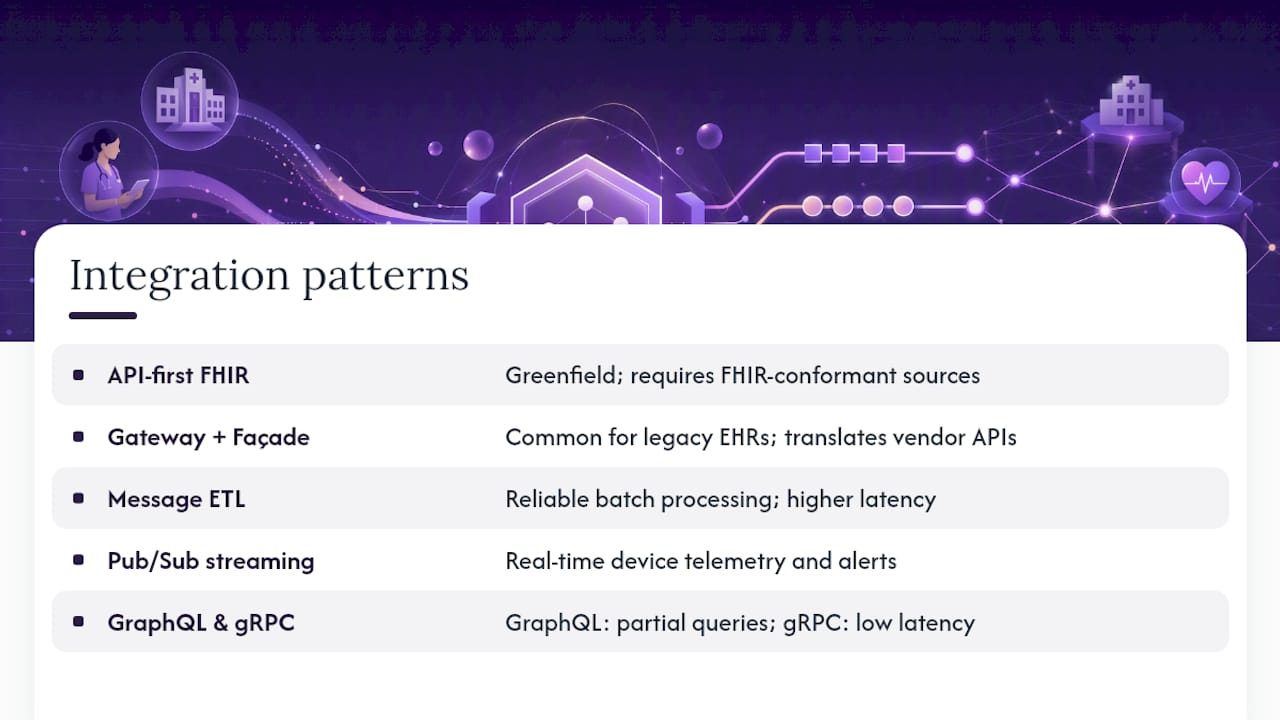
API-first with a FHIR server is the cleanest approach for greenfield integrations. You stand up a FHIR server (HAPI FHIR, Azure Health Data Services, Google Cloud Healthcare API), expose standard endpoints, and let clients query against it. The server handles resource validation, search parameters, and versioning. The tradeoff: your upstream data sources must be able to write conformant FHIR, which is rarely true of legacy systems without a transformation layer in between.
API gateway plus façade is what most teams actually build when connecting to existing EHRs. The gateway handles auth, rate limiting, routing, and observability. The façade translates proprietary vendor APIs or HL7 v2 feeds into FHIR-shaped responses. Greenway Health’s developer platform is a good example of why this matters: it exposes both FHIR R4 endpoints and a proprietary API (GAPI), so any integration must handle both surfaces. A façade layer absorbs that complexity and presents a single FHIR interface to downstream consumers.
Message-based ETL fits batch workflows: nightly claims extracts, scheduled lab result pulls, or bulk FHIR exports for population health. You get reliability and retry logic at the cost of latency. This is the right choice for analytics pipelines that do not need real-time data.
Pub/sub and streaming handle device telemetry and real-time clinical alerts. A patient monitor pushing vitals every 30 seconds cannot wait for a polling cycle. Kafka, AWS Kinesis, or Azure Event Hubs sit between the device and the FHIR server, buffering and normalizing the stream before persistence.
GraphQL and gRPC are specialized tools. GraphQL works well when a client needs partial resource fetches across multiple FHIR resource types in a single round trip — common in analytics dashboards. gRPC is the right choice for internal microservice communication where you need strict schema contracts and low latency, particularly in device telemetry pipelines.
A production architecture almost always combines patterns: an API gateway at the perimeter, a FHIR server for standards-compliant storage and query, a façade for legacy EHR adapters, and a streaming layer for device data. The mistake is trying to force one pattern to cover all scenarios.
Security, privacy, and U.S. compliance controls you need to implement
HIPAA compliance is not a checkbox. It is a set of technical controls that must be designed into the integration from the start, not retrofitted after a security review flags gaps.
The minimum technical controls for any integration handling PHI:
- Encryption in transit: TLS 1.2 minimum, TLS 1.3 preferred, on every API endpoint and message queue. No exceptions for internal services.
- Encryption at rest: AES-256 for stored PHI, including database fields, object storage, and backup snapshots.
- Authentication: OAuth 2.0 with OIDC for user-facing flows; client credentials for service-to-service. PKCE required for mobile and browser clients.
- Authorization: RBAC for role-based access (clinician vs. admin vs. patient); ABAC for attribute-based policies (e.g., only treating providers can access a specific patient’s record).
- Audit logging: every PHI access event logged with timestamp, user/service identity, resource accessed, and action taken. Logs retained per your organization’s retention policy and HIPAA minimum standards.
- Data minimization: return only the FHIR resources and fields the client actually needs. Avoid returning full patient bundles when a single Observation is all that is required.
- BAAs: executed with every vendor, cloud provider, and third-party service that touches PHI before any data flows.
Mapping those controls to HIPAA safeguard categories:
- Technical safeguards: encryption, access control (RBAC/ABAC), audit controls, automatic logoff, and integrity controls.
- Administrative safeguards: BAAs, workforce training, incident response procedures, and risk analysis documentation.
- Physical safeguards: covered by your cloud provider’s data center controls, but you must verify and document them.
For incident response, set alerting thresholds on unusual access patterns (bulk record pulls, off-hours access, repeated auth failures) and define a tabletop exercise cadence of at least twice per year. Log retention of 6 years aligns with HIPAA’s documentation requirements.
Pro Tip: Reduce your BAA surface area during development by using synthetic or de-identified data in every pre-production environment. Never use real PHI in a sandbox or CI pipeline. Tools like Synthea generate realistic synthetic patient data that passes FHIR validation without exposing a single real patient record.
From prototype to production: implementation steps and best practices
Moving a healthcare integration from a working prototype to a production system that meets clinical and compliance standards requires a structured roadmap. Here is the sequence that reduces rework:
- Discovery and data scope: document every data element, source system, and consumer. Identify PHI, classify sensitivity, and map to FHIR resources.
- Standards and profile selection: choose FHIR R4 with US Core profiles as the baseline. Identify any Da Vinci implementation guides relevant to your use case (e.g., Prior Authorization Support for utilization management).
- Sandbox registration and client setup: register your app in the vendor’s developer portal. Test against a public FHIR sandbox before requesting production credentials.
- Auth flow implementation: implement SMART on FHIR launch sequences, token acquisition, and refresh logic. Cache tokens and check
expires_inbefore each request to avoid unnecessary re-authentication. - Mapping and transformation: write FHIR profile-conformant mappings. Use a terminology service (SNOMED CT, LOINC, RxNorm) for code set normalization. Validate every resource against the target profile before writing to the FHIR server.
- CI/CD and automated testing: treat your OpenAPI or FHIR CapabilityStatement as the source of truth. Run contract tests on every build. Automate FHIR profile validation in the pipeline.
- Canary deployment: route a small percentage of traffic to the new integration before full cutover. Monitor error rates, latency, and data completeness against your SLOs.
- Monitoring and SLOs: define latency targets (e.g., p95 under 500ms for synchronous FHIR queries), data completeness rates, and audit log coverage. Alert on deviation.
- Governance and versioning: use semantic versioning for your API. Communicate breaking changes with a migration window of at least 90 days. Maintain a changelog.
Testing matrix for a production-grade integration:
| Test type | What it covers | Recommended tooling |
|---|---|---|
| Unit tests | Individual mapping functions, transformations | Jest, pytest, JUnit |
| Contract tests | FHIR profile conformance, resource shape | FHIR validator, Touchstone |
| End-to-end tests | Full auth and data flow from client to FHIR server | Postman, Newman, custom scripts |
| Performance / load tests | Throughput, latency under realistic concurrency | k6, Gatling, JMeter |
| Security tests | Pen testing, static code analysis, dependency scanning | OWASP ZAP, Snyk, Semgrep |
Developer tools, sandboxes, and testing resources
The right toolset cuts weeks off a healthcare API integration project. Here is what to reach for at each stage:
- FHIR sandboxes: HAPI FHIR’s public test server (
hapi.fhir.org) and Logica Health’s sandbox are solid starting points for resource validation and query testing. Most major EHR vendors (Epic, Cerner, Veradigm) also provide developer sandboxes with realistic data models. - FHIR validator: the official HL7 FHIR validator (
validator.fhir.org) checks resources against US Core and other profiles. Run it in CI to catch conformance failures before they reach production. - Postman collections: the Query Connector API docs include OAuth 2.0 client credentials examples, token management guidance, and Postman collections that illustrate production-grade FHIR query flows. These are worth adapting for your own test suite.
- Synthea: generates synthetic FHIR-compliant patient data. Use it to populate your test environment without touching real PHI.
- SDKs: FHIR client libraries exist for most major languages (fhir.js for JavaScript, firely-net-sdk for .NET, fhirclient for Python). They handle resource parsing, search parameter encoding, and token injection.
- CI plugins: integrate the FHIR validator and OpenAPI linters (Spectral) into your CI pipeline so conformance failures block merges rather than reaching staging.
For token management specifically: cache tokens, check expires_in on every cached token before use, and refresh proactively rather than waiting for a 401. This single practice eliminates a large category of intermittent auth failures in automated pipelines.
Pro Tip: Register your app against the Cigna Developer Portal’s Patient Access API early in your project if you are building a payer-connected integration. The PKCE flow and scope documentation there reflect the patterns CMS-mandated payer APIs use across the industry, so the patterns transfer directly.
Common use cases and real integration examples
The use cases below represent the majority of production healthcare API integration work in the U.S. today.
EHR read/write for patient apps: a patient-facing mobile app uses SMART on FHIR to launch from the EHR, acquires an access token scoped to the patient’s record, and reads Patient, Condition, MedicationRequest, and Observation resources. Writes (e.g., patient-reported outcomes) go back as QuestionnaireResponse or Observation resources. The central challenge is scope negotiation and handling partial data when the EHR does not populate all expected fields.
Patient Access APIs (payer-side): under CMS interoperability rules, major payers expose FHIR-based Patient Access APIs. Cigna’s Patient Access API is built on FHIR 4.0.1 with SMART/OAuth flows and PKCE, exposing claims, clinical data, and formulary information. The data flow: app registers with the payer, patient authorizes via OAuth, app reads ExplanationOfBenefit, Coverage, and Patient resources.
Prior authorization automation: the Da Vinci Prior Authorization Support (PAS) implementation guide, documented in Epic’s FHIR interface catalog, replaces legacy ANSI X12 278 EDI transactions with FHIR-based Claim and ClaimResponse resources. This cuts turnaround time and eliminates the translation layer between clinical and administrative systems.
Telehealth session data exchange: a telehealth platform writes Encounter and Observation resources back to the EHR after a visit. The key resources are Encounter (session metadata), Observation (vitals or assessment scores), and DocumentReference (clinical notes). Consent recording is critical here — the patient must have authorized the data flow.
Device telemetry ingestion: a remote patient monitoring platform streams vitals via a pub/sub pipeline into a FHIR server as Observation resources. High-frequency data (every 30 seconds) requires batching and backpressure handling before FHIR persistence. The FHIR server is not a time-series database; aggregate and downsample before writing.

Analytics and AI pipelines: bulk FHIR export ($export operation) pulls normalized patient data into a data lake. Downstream ML models consume de-identified FHIR bundles. The integration challenge is maintaining referential integrity across resources during de-identification and ensuring the export cadence matches the analytics refresh cycle.
Common challenges and how to mitigate them
Every healthcare integration project hits the same walls. Knowing them in advance is the difference between a delayed project and a failed one.
-
Legacy EHRs with custom HL7 v2 feeds: no two HL7 v2 implementations are identical. Use a façade layer that normalizes vendor-specific segment variations into a canonical internal model before exposing a FHIR interface. Document every deviation from the base standard in your integration spec.
-
Inconsistent code sets: a lab result coded in one system’s local codes will not match LOINC codes expected by the consumer. Implement a terminology service (e.g., NLM’s VSAC for value sets, RxNorm for medications) and run code normalization as part of your transformation pipeline, not as an afterthought.
-
Identity and consent management: patient matching across systems is notoriously unreliable. Use a Master Patient Index (MPI) or probabilistic matching service. For consent, record patient authorization as a FHIR Consent resource and enforce it at the API gateway before any data is returned.
-
Testing with PHI: pre-production environments that contain real patient data are a compliance liability. Use Synthea-generated data or de-identified extracts from production, and enforce environment-level controls that prevent real PHI from entering non-production systems.
-
Scalability and resilience: FHIR servers under heavy read load can degrade quickly without caching. Implement a read-through cache for frequently accessed resources (Patient demographics, ValueSets). Use circuit breakers on upstream EHR connections to prevent cascade failures when a vendor system is slow. Apply rate limiting at the API gateway to protect downstream systems from burst traffic.
-
Cold starts and throughput: serverless FHIR deployments suffer from cold start latency on the first request after idle periods. For latency-sensitive clinical workflows, use provisioned concurrency or a warm-pool strategy. For bulk operations, prefer asynchronous $export patterns over synchronous large-bundle reads.
-
Versioning and breaking changes: FHIR R4 and FHIR R5 are not wire-compatible. Pin your client to a specific FHIR version and communicate version migration timelines with at least 90 days’ notice. Use content negotiation headers to signal version preference.
How Jundago maps to regulated healthcare API integration needs
The requirements described throughout this article — FHIR conformance, HIPAA-aligned security, automated testing, multi-cloud deployment, and governance — are exactly the operational surface that an AI-native API lifecycle platform needs to cover. Jundago is built for this environment.
Here is how the platform’s capabilities map to the integration requirements your team faces:
- API generation from intent: API Studio generates REST, GraphQL, gRPC, and SOAP APIs from natural language descriptions, cutting the time from data model to deployable endpoint. For FHIR-aligned integrations, this means generating resource-shaped APIs without hand-coding every CRUD operation.
- GraphQL Studio with AI resolvers: when your analytics layer needs flexible, partial-fetch queries across FHIR resource types, GraphQL Studio designs the graph and generates AI-backed resolvers, reducing the N+1 query risk that plagues naive FHIR-over-GraphQL implementations.
- Automated testing and load testing: the platform’s built-in testing covers unit, contract, and load testing in a single workflow. For healthcare integrations, contract testing against FHIR profiles is the highest-value test type — catching conformance failures before they reach a clinical system.
- RBAC and ABAC security controls: Jundago ships with both role-based and attribute-based access control, which maps directly to the HIPAA technical safeguard requirements for access control and audit logging described earlier.
- Governance via Command Center: policy enforcement, versioning rules, and compliance checks run centrally across AWS, Azure, GCP, and Oracle Cloud deployments. Automated policy checks in CI catch HIPAA-related control gaps before code merges, not after a security audit.
- ETL and ELT integration studio: the full integration studio handles the batch and streaming patterns described in the architecture section, including EDI-to-FHIR transformations for legacy payer flows.
Pro Tip: Use Jundago’s governance layer to enforce API versioning policies and breaking-change windows automatically. For regulated healthcare workloads, having policy-as-code in CI is far more reliable than relying on manual review processes to catch compliance gaps.
For teams evaluating a compliance-focused proof-of-concept, Jundago’s platform supports the full lifecycle from generation through production governance. For AI-driven compliance risk assessment alongside your integration work, AITHEA’s compliance consulting offers a complementary perspective on regulatory risk in regulated enterprise environments.
What healthcare integrations actually teach you
The technical standards are the easy part. FHIR R4 is well-documented, the US Core profiles are clear, and the auth flows are standardized. What actually determines whether a healthcare API integration succeeds is cross-functional coordination — specifically, whether clinical, legal, and security teams are in the room during architecture decisions, not reviewing a finished design.
The most expensive mistakes I have seen are not technical. They are organizational: a team that built a beautiful FHIR integration and then discovered, three weeks before go-live, that the BAA with the EHR vendor did not cover the specific data flow they had designed. Or a team that used real patient data in their staging environment for six months before anyone flagged it.
Prioritize ruthlessly. Five FHIR resources done correctly beat twenty resources done sloppily. Measure integration success by data completeness rates and audit log coverage, not by the number of endpoints you have deployed. And treat your OpenAPI or FHIR CapabilityStatement as a living contract, not a document you write once and forget.
The teams that ship reliable healthcare integrations are the ones that treat compliance as an engineering discipline, not a legal formality.
Jundago: built for regulated healthcare API work
Most API platforms treat compliance as a configuration option. Jundago treats it as the starting point. For healthcare IT teams that need to ship FHIR-aligned, HIPAA-ready APIs without building a custom governance layer from scratch, Jundago’s AI-native platform covers the full lifecycle: generation, testing, security, and multi-cloud deployment, all with compliance controls built in rather than bolted on.
API Studio generates REST, GraphQL, gRPC, and SOAP APIs from intent. The ETL and ELT integration studio handles the legacy EDI and HL7 v2 transformations that every real-world healthcare integration requires. RBAC and ABAC are native, not add-ons. And Command Center enforces governance policies across AWS, Azure, GCP, and Oracle Cloud from a single control plane, so your compliance posture does not fragment as you scale across environments.
If your team is planning a FHIR implementation, a payer integration, or a device telemetry pipeline and needs a platform that meets healthcare’s regulatory requirements out of the box, explore Jundago’s platform and request a compliance-focused proof-of-concept with your specific use case.
This article is general information, not a substitute for advice from a qualified lawyer. Consult a qualified legal professional about your own circumstances before acting on anything here.
Sources
The resources below are the primary references for any U.S. healthcare API integration project. Each one is worth bookmarking before you start a new integration.