gRPC vs. REST: The Architect's Decision Guide
gRPC vs. REST: The Architect’s Decision Guide

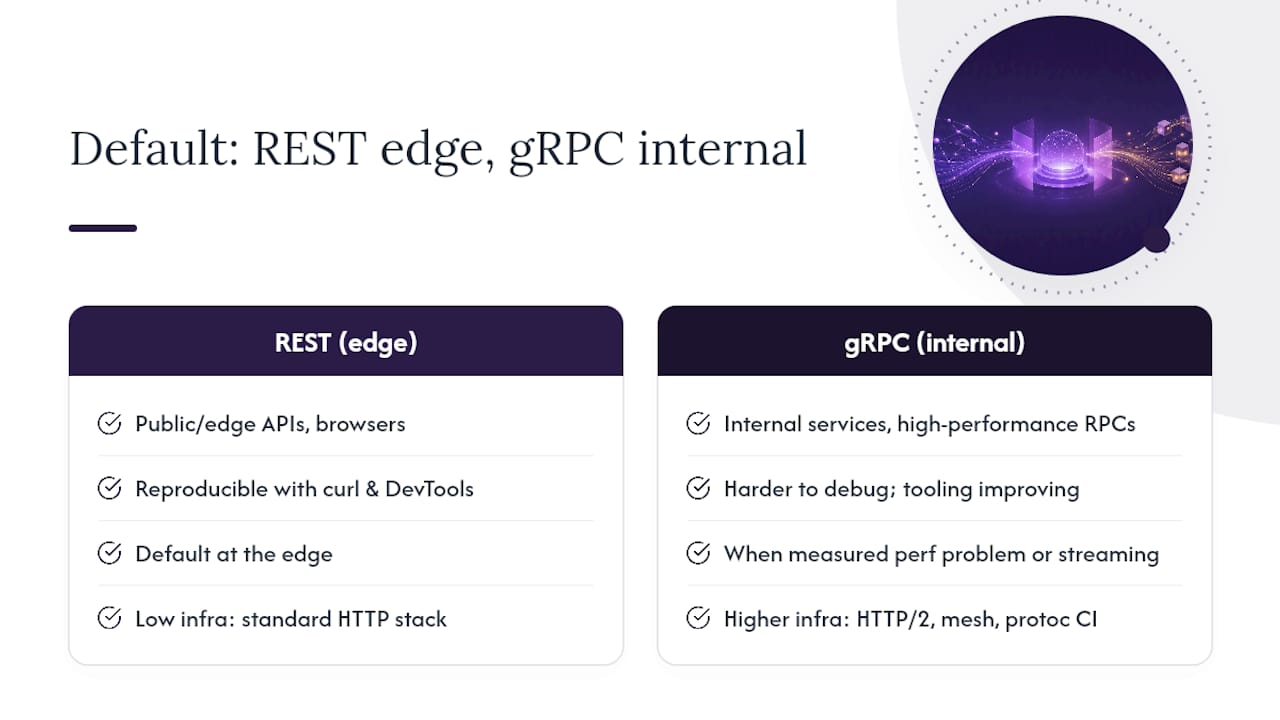
Use REST at the edge for browser and third-party clients; use gRPC internally for high-throughput, low-latency service-to-service calls. That split covers the majority of production architectures. According to Toptal’s industry analysis, many large organizations already run exactly this hybrid: gRPC for east-west traffic, REST for north-south.
Quick orientation before the deep dive:
- Pick REST when your clients are browsers, mobile apps on public networks, or third-party developers who need simple HTTP tooling and CDN caching.
- Pick gRPC when you control both client and server, need streaming, and latency or throughput is a real constraint.
- Run both when you have internal microservices that need performance AND external consumers who need a stable JSON surface.
The decision checklist in the “When to use gRPC vs. REST” section below gives you a step-by-step framework for edge cases.
Key Takeaways
The most reliable production architecture uses REST at the external edge for browser and third-party clients, and gRPC internally for high-throughput, latency-sensitive service-to-service communication.
| Point | Details |
|---|---|
| Default split: REST at edge, gRPC inside | Use REST for browser and third-party clients; use gRPC for internal, high-frequency service calls. |
| Browser support requires a proxy | Native gRPC does not work in browsers; gRPC-Web via Envoy is required, and it drops bidirectional streaming. |
| Caching favors REST | gRPC’s POST-based framing cannot be cached by CDNs or standard HTTP intermediaries. |
| Hybrid pattern reduces risk | grpc-gateway or Cloud Endpoints transcoding lets you expose a REST facade from a gRPC service without duplicating contracts. |
| Jundago for regulated hybrid deployments | Jundago generates and governs gRPC and REST APIs with HIPAA, PCI DSS, and Open Banking compliance enforced at generation time. |
Table of Contents
- What is REST in modern API design?
- What is gRPC and how does it work?
- Where gRPC and REST actually overlap
- How do gRPC and REST compare across key dimensions?
- How do you expose a gRPC service to REST clients?
- When should you use gRPC vs. REST?
- How do you migrate from REST to gRPC, or run both?
- How do large platforms deploy gRPC vs. REST in production?
- What should regulated enterprises check before choosing?
- The case for a conservative default
- Jundago accelerates compliant gRPC and REST deployments
- Sources
What is REST in modern API design?
REST (Representational State Transfer) is a resource-oriented architectural style built on HTTP semantics. You model your domain as resources (a user, an order, a payment), expose them at stable URLs, and manipulate them with standard HTTP verbs: GET, POST, PUT, PATCH, DELETE. Payloads are almost always JSON, occasionally XML.
What makes REST practical in 2026 is the tooling layer around it. OpenAPI (formerly Swagger) lets you describe a REST API as a machine-readable contract, and tools like Swagger Codegen or the OpenAPI Generator can produce client SDKs in dozens of languages from that contract. That lowers the barrier for third-party integrators considerably.
Browser and CDN compatibility are the two structural advantages REST has that no amount of performance tuning can replicate on the gRPC side. A GET request to a REST endpoint can be cached by Cloudflare, Fastly, or any other CDN with zero configuration. A browser’s fetch API speaks HTTP/1.1 and HTTP/2 natively and can call a REST endpoint without a proxy. Those two facts drive a lot of architectural decisions at the edge.
What is gRPC and how does it work?
gRPC is a contract-first RPC framework originally developed at Google. The “g” doesn’t stand for Google officially, though IBM’s overview notes the project is commonly associated with Google Remote Procedure Call. The contract lives in a .proto file written in Protocol Buffers (protobuf), a binary serialization format. The service is transported over HTTP/2, which gives you multiplexed streams, header compression, and persistent connections by default.
Baeldung’s comparison captures the core wire-format difference cleanly: gRPC uses Protocol Buffers over HTTP/2, while REST typically uses JSON or XML over HTTP/1.1, which produces higher text-based overhead per request.
gRPC supports four call shapes, and the right one depends on your communication pattern:
- Unary RPC: One request, one response. Functionally equivalent to a REST call. Use this for simple lookups or commands.
- Server streaming: One request, a stream of responses. Useful for log tailing, real-time feeds, or large dataset downloads.
- Client streaming: A stream of requests, one response. Good for uploading telemetry batches or sensor data.
- Bidirectional streaming: Both sides stream simultaneously. The right choice for chat, collaborative editing, or live dashboards.
The protoc compiler (Protocol Buffers compiler) generates strongly typed client and server stubs from your .proto files in Go, Java, Python, C#, Node.js, and more. That codegen is a genuine productivity multiplier in polyglot microservice environments: the contract is the single source of truth, and every language gets a generated client that stays in sync automatically when the contract changes.
Where gRPC and REST actually overlap
The gRPC vs. REST framing can obscure how much the two approaches share. Both are remote API patterns that decouple client from server, support multiple programming languages, and run over TCP/IP with TLS for encryption in transit. Neither forces a specific authentication mechanism: OAuth 2.0 and JWT work equally well with both.
Observability infrastructure is largely shared too. Distributed tracing with OpenTelemetry, Prometheus metrics, and structured logging all work with gRPC and REST. The instrumentation libraries differ, but the concepts and the backend tooling (Grafana, Jaeger, Datadog) are the same.
For simple request/response interactions with modest throughput requirements, either approach can satisfy the requirement. The choice often comes down to client constraints and team familiarity rather than a hard technical ceiling.
How do gRPC and REST compare across key dimensions?
The differences that actually matter in production cluster around five areas: wire format, transport, browser support, caching, and observability. The table below maps each dimension.
| Dimension | REST | gRPC |
|---|---|---|
| Data format and payload size | JSON (text, human-readable, larger) | Protocol Buffers (binary, compact, schema-enforced) |
| Transport and HTTP version | HTTP/1.1 (or HTTP/2 optionally) | HTTP/2 (required) |
| Communication patterns | Request/response only | Unary, server streaming, client streaming, bidirectional |
| Performance and latency | Moderate; JSON parsing adds CPU overhead | Lower latency; binary encoding reduces CPU and payload size |
| Code generation and typing | Optional via OpenAPI/Swagger codegen | Native via protoc; strongly typed stubs generated automatically |
| Browser and mobile support | Native; no proxy required | Requires gRPC-Web proxy (Envoy) for browsers; drops native bidirectional streaming |
| Caching and HTTP semantics | Full HTTP caching (CDN, ETags, Cache-Control) | Not cacheable by standard HTTP intermediaries |
| Observability and debugging | curl, Postman, browser DevTools work out of the box | Requires grpcurl, grpc-web-devtools, or Envoy access logs |
| Security and authentication | TLS + OAuth 2.0/JWT; standard HTTP auth headers | TLS (required); channel credentials + call credentials; same token patterns |
| Tooling and ecosystem maturity | Extremely mature; decades of HTTP tooling | Growing fast; strong in Go, Java, C#; thinner in some ecosystems |
| Interoperability with REST clients | Native | Via gRPC-Gateway, Envoy, or Cloud Endpoints transcoding |
HTTP/1.1 vs. HTTP/2 in practice
HTTP/2 is not just a faster version of HTTP/1.1. It changes the connection model entirely. HTTP/1.1 opens a new TCP connection (or reuses one sequentially) per request. HTTP/2 multiplexes many streams over a single connection, which eliminates head-of-line blocking at the HTTP layer and reduces connection overhead for high-frequency internal calls. For a service making hundreds of calls per second to a downstream dependency, that difference shows up in p99 latency.
Binary protobuf vs. JSON
JSON is text. Every field name is transmitted as a string on every request. Protobuf encodes fields as numbered tags with binary values, so a message that weighs 1,200 bytes as JSON might weigh 400 bytes as protobuf. The CPU cost of parsing also drops because binary deserialization is faster than JSON string parsing. Toptal’s analysis notes that benchmarks are sensitive to methodology and payload size, so treat published numbers as directional rather than absolute.
Caching and the streaming problem
Standard HTTP caching works on GET requests with predictable URLs. gRPC uses POST for all calls (HTTP/2 framing), so CDN and proxy caches cannot cache responses without custom configuration. Streaming calls make this worse: a long-lived stream has no natural cache boundary. If your architecture depends on CDN caching for scalability at the edge, gRPC is the wrong choice for that layer.
Pro Tip: L7 load balancers that understand HTTP/1.1 semantics (many older AWS ALB configurations, for example) will not correctly load-balance gRPC connections without explicit HTTP/2 support enabled. A gRPC service behind an HTTP/1.1-only load balancer will funnel all traffic to a single backend. Verify your load balancer’s HTTP/2 and gRPC support before deploying.
How do you expose a gRPC service to REST clients?
Three production-grade approaches exist, and the right one depends on your deployment environment.
Reverse-proxy transcoding with grpc-gateway
grpc-gateway is a protoc plugin that reads your .proto service definitions and generates a reverse-proxy server. The proxy translates incoming HTTP/JSON requests into gRPC calls and returns JSON responses. You annotate your .proto methods with google.api.http options to define the HTTP mapping:
rpc GetUser (GetUserRequest) returns (User) {
  option (google.api.http) = {
    get: "/v1/users/{user_id}"
  };
}
grpc-gateway also generates an OpenAPI spec from those annotations, so your REST facade gets documentation automatically. The proxy runs as a separate process, which adds a network hop but keeps the gRPC service clean.
Google Cloud Endpoints transcoding
Google Cloud Endpoints provides protocol transcoding as a managed service. HTTP/JSON clients call the Endpoints proxy, which maps requests to gRPC methods using proto annotations or a YAML configuration file. The operational considerations are similar to grpc-gateway: TLS termination, port configuration, and the latency cost of the additional hop. Cloud Endpoints adds managed authentication and API key enforcement on top.
In-process JSON transcoding for ASP.NET Core
For .NET services, ASP.NET Core gRPC JSON transcoding runs in-process and maps JSON HTTP requests directly to gRPC service methods without a separate proxy. This is simpler to deploy and avoids the network hop, making it the pragmatic choice for .NET-native environments.
Key operational notes across all three approaches:
- TLS: gRPC requires TLS in most production configurations; your REST facade should terminate TLS at the same boundary or upstream.
- Latency: The reverse-proxy approaches add one network hop. For latency-critical paths, in-process transcoding (ASP.NET Core) or a co-located sidecar (Envoy) minimizes that cost.
- Debugging: The REST surface is debuggable with standard tools; the underlying gRPC calls still require gRPC-aware tooling (grpcurl, Envoy access logs) for deep inspection.
When should you use gRPC vs. REST?
Work through these questions in order. The first constraint that applies usually determines the answer.
- Do browser clients need to call this service directly? If yes, use REST or add a gRPC-Web proxy. Native gRPC does not work in browsers without Envoy or a similar proxy, and gRPC-Web drops bidirectional streaming.
- Do third-party developers need to integrate with this API? If yes, use REST. JSON over HTTP is the universal integration language. Asking external developers to generate protobuf stubs raises the integration barrier significantly.
- Does this service sit behind a CDN or require HTTP caching? If yes, use REST. gRPC’s POST-based framing is not cacheable by standard intermediaries, as Vercel’s edge architecture guidance makes clear.
- Do you control both the client and the server? If yes, gRPC becomes viable. Internal microservices, backend-to-backend calls, and closed mobile ecosystems where you ship the client are the natural home for gRPC.
- Is latency or throughput a real constraint? If yes, gRPC’s binary encoding and HTTP/2 multiplexing give you a measurable advantage over REST/JSON for high-frequency internal calls. AWS’s comparison guidance highlights this as gRPC’s primary strength in microservice architectures.
- Do you need streaming? If yes, gRPC’s server, client, or bidirectional streaming shapes handle this natively. REST has no equivalent without WebSockets or SSE, which add their own complexity.
- What is your team’s operational maturity with gRPC tooling? Debugging a gRPC service requires grpcurl, protoc familiarity, and HTTP/2-aware load balancer configuration. If your team is new to gRPC, budget time for the learning curve.
Concrete use cases
Use REST for: public APIs, mobile apps on public networks, CDN-backed content APIs, webhook receivers, and any service consumed by third-party developers.
Use gRPC for: internal microservice meshes, IoT telemetry ingestion, real-time streaming pipelines, ML inference backends, and any service where you ship the client and latency is a design constraint.
Adoption effort: Adding gRPC to an existing REST-only stack requires protoc tooling, HTTP/2-capable infrastructure, and updated load balancer configuration. Plan for two to four weeks of infrastructure work before the first service is production-ready, depending on your deployment environment.
How do you migrate from REST to gRPC, or run both?
The lowest-risk path is additive: keep your REST API running and introduce gRPC alongside it, rather than replacing REST wholesale.
Step 1: Map your internal call graph. Identify the service-to-service calls that are high-frequency or latency-sensitive. These are the migration candidates. Public-facing endpoints stay REST.
Step 2: Write .proto contracts for the identified services. Start with the data models and service methods that map cleanly to your existing REST resources. Run protoc to generate stubs and validate the contract before touching any runtime code.
Step 3: Add a gateway for external clients. Deploy grpc-gateway or configure Cloud Endpoints transcoding so external clients continue to see a REST/JSON surface. This decouples the internal migration from external API stability.
Step 4: Incrementally replace hotspots. Migrate one service boundary at a time, measure latency and error rates, and roll back if something breaks. Do not attempt a big-bang migration.
Hybrid strategies
The most common production pattern is gRPC for east-west (internal) traffic with a generated REST facade for north-south (external) traffic. grpc-gateway and related tools let you expose a RESTful JSON surface from a proto-defined gRPC service, keeping a single source of truth for contracts.
A dual-run approach, where both REST and gRPC endpoints exist on the same service simultaneously, is useful during migration but adds maintenance overhead. Plan to deprecate the REST endpoint once all internal consumers have migrated.
Versioning warning: Protobuf has strong backward-compatibility rules (never reuse field numbers, never change field types), but they require discipline. A breaking .proto change that ships without a version bump will silently corrupt data in consumers that haven’t updated their stubs. Enforce contract linting in CI with tools like buf or protolint, and treat .proto changes with the same review rigor as a public API change.
How do large platforms deploy gRPC vs. REST in production?
The pattern that emerges from large-scale deployments is consistent: gRPC handles internal, east-west service traffic while REST handles external, north-south traffic. Google uses gRPC extensively for internal service communication, which is unsurprising given that gRPC originated there. Netflix has documented similar internal RPC patterns for high-throughput service meshes.
The rationale is infrastructure-driven, not purely benchmark-driven. Internal services run on controlled networks with HTTP/2-capable load balancers and gRPC-aware service meshes (Istio, Linkerd). External traffic crosses the public internet, hits CDN edges, and reaches browser clients, all of which favor REST semantics.
Where gRPC adoption concentrates:
- Internal microservice meshes with high call frequency
- Telemetry and metrics ingestion pipelines
- IoT device-to-backend communication
- ML model serving (TensorFlow Serving, Triton Inference Server both expose gRPC endpoints)
- Streaming data pipelines
Where REST remains dominant:
- Public APIs consumed by third-party developers
- Browser-facing services
- Webhook and event delivery endpoints
- Any API that needs CDN caching
What should regulated enterprises check before choosing?
For teams operating under HIPAA, PCI DSS, or Open Banking requirements, the gRPC vs. REST decision carries compliance implications beyond raw performance.
Compliance and governance checklist:
- Encryption in transit: Both gRPC and REST support TLS, but gRPC effectively requires it in production. Verify your certificate management and rotation process covers gRPC endpoints.
- Data residency: Confirm your transcoding proxies (grpc-gateway, Cloud Endpoints) process data within the required geographic boundary. A proxy in the wrong region can create a compliance violation.
- RBAC and ABAC enforcement: Verify that your API gateway or service mesh enforces role-based and attribute-based access controls at the gRPC method level, not just at the HTTP route level.
- Auditability: gRPC calls must be logged with sufficient detail (method name, caller identity, request metadata) to satisfy audit requirements. Standard HTTP access logs do not capture gRPC method-level detail automatically.
- Contract versioning in CI: Regulated environments need a documented change history for API contracts. Enforce
.protolinting and versioning in your CI pipeline.
Operational controls to verify:
- Distributed tracing covers gRPC spans (OpenTelemetry gRPC instrumentation is available but requires explicit configuration).
- Your load balancer and service mesh support HTTP/2 health checks, not just HTTP/1.1.
- Automated policy enforcement (rate limiting, quota, auth) applies to both REST and gRPC surfaces if you run a hybrid.
Pro Tip: Jundago’s platform generates gRPC and REST APIs from a single intent-driven contract, applies RBAC/ABAC policies automatically, and enforces compliance rules (HIPAA, PCI DSS) at generation time. That eliminates the manual checklist work above for teams that need to ship compliant APIs quickly.
The case for a conservative default
The conventional wisdom in API architecture circles is to reach for gRPC whenever performance matters. That framing is too simple, and it leads teams to adopt gRPC prematurely in places where the operational overhead outweighs the latency benefit.
My recommended default: REST at the edge, gRPC internally, and only where you have measured a real performance problem or a genuine streaming requirement. The reason is operational, not ideological. gRPC’s debugging story is still harder than REST’s. When something breaks at 2 AM, the ability to reproduce a failing request with curl and inspect it in browser DevTools is worth more than a few milliseconds of serialization savings. REST’s tooling ecosystem has thirty years of investment behind it. gRPC’s is excellent and growing, but it is not equivalent yet.
The exception is clear: if you are building a closed system where you ship every client, your call volumes are high enough that JSON parsing overhead is measurable, or you need bidirectional streaming, gRPC is the right choice and the operational investment pays off quickly. IoT telemetry pipelines and internal ML inference backends are the clearest examples.
What I see teams underestimate is the infrastructure tax. HTTP/2-capable load balancers, gRPC-aware service meshes, and protoc tooling in CI are not hard to set up, but they are not free either. Budget the infrastructure work honestly before committing.
Jundago accelerates compliant gRPC and REST deployments
Deciding between gRPC and REST is one problem. Generating, governing, and deploying both correctly in a regulated environment is another.
Jundago’s AI-native API platform generates REST, gRPC, GraphQL, and SOAP APIs from natural language intent, with protoc integration and JSON transcoding support built in. Governance and compliance policies (HIPAA, PCI DSS, Open Banking) are enforced at generation time, not bolted on afterward. RBAC and ABAC controls apply across both gRPC and REST surfaces from a single Command Center that spans AWS, Azure, GCP, and Oracle Cloud.
For regulated enterprises that need to ship a hybrid gRPC and REST architecture without building the compliance scaffolding from scratch, Jundago removes the manual checklist work the EEAT section above describes. Jundago to see how the platform handles contract generation, policy enforcement, and multi-cloud deployment for your specific compliance scope.
Sources
The following references are worth bookmarking for deeper reading on specific aspects of this decision.
- REST vs. gRPC | Baeldung
- gRPC vs. REST: Key Differences, Performance & Use Cases | Toptal®
- grpc-ecosystem/grpc-gateway
- gRPC transcoding | Cloud Endpoints
- gRPC vs REST: when each protocol fits - Vercel