FHIR API Integration for Regulated Enterprises: 2026 Guide
FHIR API Integration for Regulated Enterprises: 2026 Guide

For regulated enterprises in the U.S., the fastest, lowest-risk path to production-grade FHIR API integration combines a compliance-first architecture with SMART on FHIR OAuth 2.0 flows and an AI-native API lifecycle platform. That means targeting FHIR R4, conforming to US Core profiles, implementing asynchronous bulk data patterns, and governing every layer from discovery through deployment.
The short version: Start with SMART on FHIR auth, validate against US Core, design bulk exports as asynchronous workflows, and use a platform that automates conformance checks and governance from day one.
Key requirements at a glance:
- Target FHIR R4 as the production baseline (Unmandated for certified EHRs)
- Implement SMART on FHIR OAuth 2.0 with granular healthcare scopes
- Conform to US Core Implementation Guide profiles for U.S. interoperability
- Design bulk data exports using the asynchronous bulk interaction pattern
- Automate conformance validation in CI pipelines before any production deployment
Table of Contents
- What does FHIR API integration actually require?
- What compliance obligations govern U.S. FHIR integrations?
- How should you architect a FHIR integration at enterprise scale?
- Why do terminology bindings break enterprise FHIR projects?
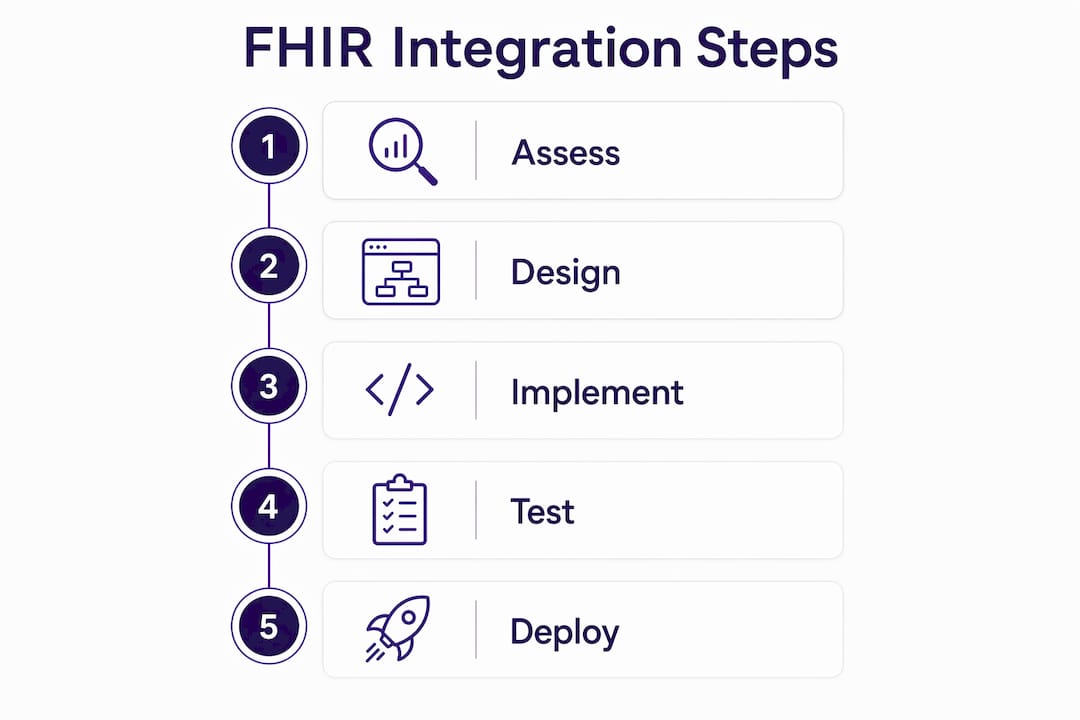
- What does a phased FHIR implementation plan look like?
- How do you test and validate a FHIR integration before production?
- What pitfalls derail enterprise FHIR projects?
- What governance and security controls does a regulated FHIR implementation need?
- How do you deploy FHIR services across multiple clouds?
- How does Jundago operationalize FHIR integration for regulated enterprises?
- Quick-start pilot template for a FHIR integration with Jundago
- Key Takeaways
- The part most teams get wrong about FHIR
- Jundago cuts your FHIR integration timeline without cutting corners
- Useful sources for your FHIR integration project
What does FHIR API integration actually require?
FHIR uses standard web protocols to make developer access easier, but privacy and security must be layered on separately from the REST mechanics. At its core, FHIR API integration means building against a RESTful, resource-based API where clinical data is modeled as discrete resources: Patient, Observation, Condition, MedicationRequest, and dozens more.

FHIR R4 is the production target for any U.S. deployment. The HL7 FHIR HTTP specification defines FHIR as Level 2 REST, supporting instance-level interactions (read, vread, update, patch, delete), type-level interactions (create, search), and whole-system operations like batch/transaction. Every server must publish its supported interactions in a CapabilityStatement at /metadata.
Core interactions your integration will use:
- GET for reads and searches; POST for creates, batch/transaction, and search-by-POST
- PUT/PATCH for updates; DELETE for removal
$exportat system, patient, or group level for bulk data access- CapabilityStatement (
/metadata) to discover what a server actually supports
SMART on FHIR layers OAuth 2.0 and OpenID Connect onto FHIR, defining healthcare-specific scopes like patient/Observation.read or user/Patient.* for EHR-launched and patient-facing apps. US Core profiles constrain base FHIR resources with mandatory fields and value set bindings that U.S. payers and providers expect.
Pro Tip: Before writing a single line of integration code, pull the target EHR’s CapabilityStatement and compare it against US Core requirements. Gaps discovered here cost hours to fix; gaps discovered in production cost weeks.
What compliance obligations govern U.S. FHIR integrations?
The ONC 21st Century Cures Act Final Rule requires certified EHRs to expose FHIR R4 APIs and prohibits information blocking, with civil monetary penalties for violations. That mandate is the regulatory floor, not the ceiling.
Your compliance checklist:
- ONC / US Core: Certified EHRs must expose FHIR R4 APIs aligned to US Core; your integration must consume those profiles correctly and document conformance
- CMS Interoperability and Prior Authorization Final Rule: Requires payers to implement prior-authorization APIs using FHIR R4 and Da Vinci implementation guides; operational dates are staggered by payer type
- HIPAA: Every FHIR integration touching PHI requires a signed Business Associate Agreement (BAA), audit logging of all access events, encryption in transit (TLS 1.2+), and encryption at rest
- Minimum necessary access: SMART on FHIR scopes enforce this at the protocol level; your IAM design must reflect it
- Practical deliverables: CapabilityStatement review documented in architecture records, trust framework and app registration completed before production access, and production review timelines factored into your project plan
HIPAA’s audit logging requirement is not optional and not lightweight. Every read, write, and search against a FHIR endpoint touching PHI needs an immutable, timestamped record tied to an authenticated identity.
How should you architect a FHIR integration at enterprise scale?
Three patterns cover most enterprise scenarios, and the right choice depends on your existing data estate.
Architecture principle: The CapabilityStatement is your contract. Document every deviation between what the spec requires and what your target vendor actually returns — those gaps become your integration risk register.
| Pattern | Description | Best For |
|---|---|---|
| FHIR façade | Thin FHIR API layer over legacy data stores (SQL, HL7 v2) | Existing EHR/EDW with no native FHIR |
| Direct FHIR store | Native FHIR server (HAPI FHIR or managed cloud service) as system of record | Greenfield or cloud-native builds |
| Adapter/translator | Bidirectional adapter converting HL7 v2 messages to FHIR resources | Hybrid environments with active v2 feeds |
Managed FHIR services on AWS, Microsoft Azure, Google Cloud Platform, and Oracle Cloud reduce operational overhead but introduce vendor-specific capability gaps. AWS HealthLake, Azure Health Data Services, and GCP Healthcare API each support FHIR R4 with varying levels of US Core conformance and bulk export support. Oracle Cloud’s FHIR capabilities are available through Oracle Health (formerly Cerner) infrastructure. Self-hosted HAPI FHIR gives you full control but demands your team to own upgrades, scaling, and security hardening.
Every architecture needs an API gateway in front of FHIR endpoints for rate limiting, request logging, and token validation. Observability is non-negotiable: distributed tracing, structured audit logs, and alerting on 4xx/5xx error rates catch auth failures and data quality issues before they become compliance events.
Why do terminology bindings break enterprise FHIR projects?
Selecting the wrong Implementation Guide (IG) before building is the single most common cause of expensive refactors. US Core is the baseline IG for U.S. deployments; Da Vinci guides layer on top for payer use cases.
Mandatory terminology bindings by clinical domain:
- LOINC for laboratory observations and vital signs
- SNOMED CT for conditions, procedures, and clinical findings
- RxNorm for medication codes
- ICD-10-CM for diagnoses in administrative and claims contexts
The practical challenge is mapping legacy codes (local lab codes, proprietary condition codes) to these standard value sets. That mapping work is iterative and never truly finished because source systems change. Build a mapping registry, version it, and treat it as a first-class artifact in your CI pipeline.
Pro Tip: Run FHIR Validator against every resource type in your CI pipeline with the US Core IG loaded. Terminology binding failures caught pre-merge cost minutes; the same failures caught post-deployment cost a sprint.
What does a phased FHIR implementation plan look like?
A three-phase structure keeps scope manageable and gives compliance teams clear gates.
Phase 1: Discovery (Weeks 1–3)
- Inventory all target EHR endpoints and pull CapabilityStatements
- Document supported resources, search parameters, and deviations from US Core
- Identify required IGs and obtain sandbox credentials
- Map HIPAA obligations, confirm BAA requirements, and draft the trust framework
Phase 2: Pilot (Weeks 4–8)
- Build a SMART on FHIR prototype with full OAuth 2.0 launch sequence
- Validate US Core conformance for priority resource types (Patient, Observation, Condition)
- Run small-scale bulk data exports using the asynchronous pattern
- Complete security review: token handling, scope enforcement, and TLS configuration
Phase 3: Production (Weeks 9–14)
- Complete app registration and trust framework with each EHR vendor
- Negotiate rate-limit agreements and document them in the architecture record
- Execute BAA setup and audit log verification
- Run cutover with monitoring dashboards live from day one
Typical cost drivers: sandbox and production access fees, app certification and review cycles, terminology licensing (SNOMED CT requires a license for commercial use), cloud compute and storage for bulk exports, and clinical SME time for terminology mapping.
How do you test and validate a FHIR integration before production?
Testing a FHIR integration requires five distinct layers, and skipping any one of them creates production risk.
- Resource-level unit tests: Validate individual resource structures against FHIR R4 schemas
- IG conformance tests: Run FHIR Validator with US Core profiles loaded against every resource type your integration produces or consumes
- Contract tests: Verify that your integration handles the actual responses your target EHR returns, including vendor-specific extensions and deviations
- Load and bulk-data stress tests: Confirm that your async bulk export state machine handles polling delays, partial manifests, and rate-limit responses with exponential backoff
- Security scans: Test SMART on FHIR launch flows, token expiry and refresh, scope enforcement, and TLS configuration
Testing principle: Treat bulk export as a distributed workflow, not an API call. Your test suite must cover kick-off, status polling, file retrieval, and failure recovery — not just the happy path.
Tooling that belongs in every FHIR testing stack: FHIR Validator for conformance checks, Touchstone for automated IG conformance testing, HAPI FHIR test servers for sandbox development, SMART Health IT sandbox for OAuth launch testing, and Postman or Insomnia for exploratory API work.
Pre-production sign-off checklist: conformance report (all resource types pass US Core), load test report (bulk export completes under SLA), security scan (no critical findings), and audit log verification (every test transaction logged with correct identity).
What pitfalls derail enterprise FHIR projects?
Most implementation failures trace back to three recurring mistakes.
- Underestimating clinical semantics: About 80% of the work is standard REST; the remaining 20% is terminology bindings, resource profiles, and authorization patterns. Teams that treat FHIR as “just another REST API” hit that 20% wall in production.
- Skipping SMART on FHIR or building custom auth: SMART on FHIR tokens expire, and vendor-specific scope interpretation often differs between sandbox and production. Custom auth solutions rarely handle token refresh correctly across all EHR vendors.
- Assuming vendor parity: No two EHR vendors implement FHIR R4 identically. Document deviations per vendor and test against each vendor’s sandbox independently.
Pro Tip: Assign a clinical SME to the integration team from week one, not as a reviewer at the end. The cost of a refactor after a terminology mapping error is discovered in UAT is 5–10x the cost of getting it right during design.
What governance and security controls does a regulated FHIR implementation need?
Authentication and authorization sit at the foundation. SMART on FHIR with OAuth 2.0 is required for patient-facing apps and mandated under ONC guidance; your IAM must support both user-context launches and machine-to-machine scenarios with granular consent and refresh handling.
- RBAC and ABAC: Role-based controls for service accounts; attribute-based controls for fine-grained patient-level access decisions
- Encryption: TLS 1.2+ in transit; AES-256 or equivalent at rest; cloud KMS integration across AWS, Azure, GCP, and Oracle Cloud for key lifecycle management
- Audit logging: Immutable audit trails with timestamps, authenticated identity, resource type, and action; retention policies aligned to HIPAA’s six-year minimum
- Operational controls: Vulnerability management program, annual penetration testing, incident response playbooks covering PHI breach scenarios, and documented data retention and disposition policies
FHIR’s REST mechanics do not include authentication or authorization by design. Every security control is a deliberate addition to the base protocol.
How do you deploy FHIR services across multiple clouds?
Deployment principle: Data residency requirements and HIPAA’s BAA obligations must be resolved before you choose a cloud region, not after. Every cloud provider offers HIPAA-eligible services, but eligibility is not the same as compliance.
Managed FHIR services (AWS HealthLake, Azure Health Data Services, GCP Healthcare API, Oracle Health) reduce operational burden and typically include HIPAA-eligible configurations. Self-hosted HAPI FHIR on any of these clouds gives you more control over versioning and extensions but requires your team to own the full operational stack.
Multi-cloud deployment checklist:
- Confirm data residency requirements and select regions accordingly
- Establish consistent IAM policies and KMS configurations across all clouds
- Design cross-cloud networking with private endpoints to avoid PHI traversing public internet
- Account for egress costs when bulk export files move between cloud environments
- Implement blue/green or canary deployment patterns to reduce cutover risk
- Configure centralized telemetry (logs, metrics, traces) feeding a single observability platform
- Validate backup and restore procedures before production go-live, not during an incident
How does Jundago operationalize FHIR integration for regulated enterprises?
Jundago maps directly to the integration checklist above. Its AI-native platform covers the full API lifecycle from schema generation through governance, with compliance controls built in rather than bolted on.
| Project Gate | Jundago Capability |
|---|---|
| Discovery | AI-assisted CapabilityStatement analysis and schema generation from intent |
| Pilot | SMART on FHIR-ready templates, automated US Core conformance validation |
| Production | Multi-cloud deployment (AWS, Azure, GCP, Oracle Cloud), RBAC/ABAC enforcement |
| Governance | Command Center for audit logging, policy automation, and compliance reporting |
Platform capabilities that reduce FHIR integration risk:
- API Studio generates FHIR REST APIs from natural language intent, reducing the time from IG selection to working prototype
- Automated FHIR validation runs conformance checks against US Core profiles in CI pipelines
- ETL/ELT integration studio handles HL7 v2-to-FHIR transformation and DB-to-API patterns for legacy data estates
- RBAC and ABAC security controls enforce minimum necessary access at the platform level
- EndPlex workbench with AI Assistant supports debugging, load testing, and security scanning in a single environment
Platform advantage: AI-assisted schema generation cuts the gap between IG selection and a conformance-passing prototype from weeks to days — the phase where most enterprise projects lose their schedule.
Quick-start pilot template for a FHIR integration with Jundago
A 12-week proof of value with clear milestones and acceptance criteria.
- Weeks 0–2 (Discovery): Inventory EHR endpoints, pull CapabilityStatements, obtain sandbox credentials, assign clinical SME and security lead
- Weeks 3–6 (Prototype): Build SMART on FHIR launch flow using Jundago templates, validate Patient and Observation resources against US Core, run first bulk export test
- Weeks 7–10 (Conformance and load testing): Run full US Core conformance suite, stress-test bulk export with production-scale data volumes, complete security scan
- Weeks 11–12 (Production readiness): Complete BAA setup, finalize audit log configuration, executive sign-off on conformance report and load test results
Roles: Clinical SME (terminology and resource validation), integration engineer (API build and testing), security/compliance lead (HIPAA controls and BAA), product owner (acceptance criteria and stakeholder sign-off).
Acceptance criteria:
- All priority resource types pass US Core conformance validation
- Bulk export completes successfully with correct async state management
- Security scan returns no critical findings
- Audit logs capture all test transactions with correct identity and resource metadata
Key Takeaways
A compliance-first FHIR API integration targeting FHIR R4, US Core profiles, and SMART on FHIR OAuth 2.0 is the required baseline for any regulated U.S. enterprise deploying in production.
| Point | Details |
|---|---|
| Target FHIR R4 and US Core | ONC mandates FHIR R4 for certified EHRs; US Core profiles define the U.S. interoperability baseline. |
| SMART on FHIR is non-optional | OAuth 2.0 with healthcare scopes is required for patient-facing apps and ONC-compliant deployments. |
| Bulk exports need async design | Bulk data operations require kick-off, status polling, and file retrieval — never synchronous calls. |
| Clinical SME involvement prevents rework | The 20% of FHIR work covering terminology and profiles causes 80% of production failures when skipped. |
| Jundago automates the checklist | Jundago’s AI-native platform covers API generation, US Core validation, RBAC/ABAC, and multi-cloud governance in one suite. |
The part most teams get wrong about FHIR
The conventional wisdom treats FHIR integration as an engineering problem. It is not. It is a clinical-technical collaboration problem that happens to have an engineering surface.
Every team I have seen struggle with FHIR in production hit the same wall: they built a technically correct REST integration that failed on terminology. A lab result with the wrong LOINC code, a condition coded in a local system with no SNOMED CT mapping, a medication reference that RxNorm cannot resolve. These are not edge cases. They are the default state of legacy clinical data, and no amount of API gateway configuration fixes them.
The teams that ship on time pair a clinical SME with engineering from the first sprint. They treat the Implementation Guide as a product requirement, not a reference document. And they automate conformance validation in CI so that terminology failures surface in minutes, not in a UAT cycle three months later.
Platform-level automation matters here too. When your tooling generates FHIR-conformant schemas from intent and runs US Core validation automatically, the engineering team spends its time on the hard 20% instead of rebuilding the same boilerplate across every resource type. That is the real argument for an AI-native approach: not speed for its own sake, but redirecting effort toward the work that actually requires human judgment.
Jundago cuts your FHIR integration timeline without cutting corners
Most regulated enterprises spend the first six weeks of a FHIR project rebuilding infrastructure that should already exist: SMART on FHIR auth templates, US Core validation pipelines, multi-cloud deployment configs. Jundago ships all of that as a starting point, not a deliverable.
API Studio generates FHIR REST APIs from natural language intent. Automated conformance validation runs against US Core profiles in your CI pipeline from day one. The ETL/ELT integration studio handles HL7 v2-to-FHIR transformation for legacy data estates. RBAC and ABAC controls enforce minimum necessary access across AWS, Azure, GCP, and Oracle Cloud from a single Command Center.
The result: a conformance-passing, governance-ready FHIR integration in weeks, not quarters. Request a pilot and see how Jundago maps to your specific regulatory environment.
Useful sources for your FHIR integration project
- HL7 FHIR HTTP Specification: Authoritative reference for REST interactions, CapabilityStatement, and asynchronous patterns. Cite this in architecture documentation.
- FHIR Bulk Data Access IG: Defines the
$exportoperation, async request pattern, output manifest format, and server capability documentation requirements. - ONC FHIR API Fact Sheet: Plain-language summary of FHIR’s role in ONC regulations; useful for compliance documentation and stakeholder briefings.
- FHIR Validator (validator.fhir.org): Run this against every resource type with US Core loaded; integrate into CI for pre-merge conformance checks.
- Touchstone (touchstone.aegis.net): Automated conformance testing against published IGs; use during pilot phase for US Core and Da Vinci guide validation.
- SMART Health IT Sandbox (launch.smarthealthit.org): Test SMART on FHIR OAuth 2.0 launch flows before requesting production credentials from EHR vendors.
- HAPI FHIR Test Server (hapi.fhir.org): Open-source FHIR R4 server for development and integration testing; useful for early-stage prototype work before sandbox access is granted.