Event-Driven APIs: A Practical Guide for Architects
Event-Driven APIs: A Practical Guide for Architects
Event-driven APIs push state changes as events to interested consumers the moment they happen, rather than waiting for a client to ask. Instead of a caller polling an endpoint, a producer publishes an event to a broker or channel, and every subscribed consumer reacts independently. That inversion is the architectural signal: if your system needs to notify multiple downstream services the instant something changes, you are looking at an event-driven design.
When to choose event-driven APIs over REST:
- Real-time fan-out — one event triggers reactions in many consumers simultaneously (order placed → inventory, billing, fulfillment, analytics all react)
- Replayability — persisted event logs let new consumers catch up on history and let teams recover state after failures
- Loose coupling — producers and consumers evolve independently; neither knows the other exists at the transport layer
- High-throughput streaming — systems like Apache Kafka handle millions of events per second with durable, partitioned logs
Key trade-offs to plan for:
- Eventual consistency replaces the synchronous guarantee REST gives you
- Operational complexity rises sharply: you now manage brokers, dead-letter queues (DLQs), schema registries, and distributed tracing
- Debugging loses the familiar call stack; distributed tracing and centralized event logging become non-negotiable
- AsyncAPI is the spec-first standard for documenting event contracts, the same way OpenAPI governs REST
If your dominant pattern is request/response with a single caller and a single answer, REST is simpler and you should keep it. If you need real-time propagation, fan-out to multiple consumers, or durable replay, read on.
Key Takeaways
Event-driven APIs are the right architectural choice when real-time fan-out, durable replay, or loose coupling between services matters more than the simplicity of synchronous request/response.
| Point | Details |
|---|---|
| Choose event-driven deliberately | Use event-driven APIs when you need real-time fan-out, replay, or high-throughput streaming; keep REST for single-answer queries. |
| Schema governance is non-negotiable | Register every event schema with AsyncAPI and a schema registry before any producer reaches staging. |
| Observability before go-live | Deploy distributed tracing, consumer lag dashboards, and DLQ alerts before the first production event flows. |
| Idempotency is a correctness requirement | Every consumer must deduplicate on event ID; at-least-once delivery guarantees duplicates will arrive eventually. |
| Jundago for governed pilots | Jundago provides AsyncAPI contract generation, schema registry integration, RBAC/ABAC controls, and compliance modules for regulated enterprise deployments. |
Table of Contents
- How event-driven APIs compare to REST
- Core concepts every architect must understand
- Design patterns architects reach for most
- Design and rollout checklist: from event discovery to production
- Tooling and broker choices: Kafka, RabbitMQ, Solace, and AsyncAPI
- Topology choices and observability: broker vs mediator
- Common pitfalls and how to fix them
- Bridging event-driven APIs with existing REST systems
- Concrete use cases and example flows
- An architect’s honest take on when event-driven APIs are worth the cost
- Jundago makes event-driven API governance production-ready for regulated teams
- Sources
How event-driven APIs compare to REST
The choice between event-driven and REST is not about which is better in the abstract. It is about which communication model fits the problem.
| Dimension | REST (Request/Response) | Event-Driven API |
|---|---|---|
| Communication direction | Client pulls; server responds | Producer pushes; consumers react |
| Coupling | Tight (caller knows the endpoint) | Loose (producer unaware of consumers) |
| Latency model | Synchronous; client blocks | Asynchronous; client is notified |
| Best for | CRUD, single-answer queries, simple integrations | Real-time updates, fan-out, long-running workflows |
| Failure model | Caller retries the same endpoint | DLQ, retry policies, compensation flows |
| Operational complexity | Low to moderate | Moderate to high (broker, schema registry, tracing) |
| Consistency model | Immediate (within the response) | Eventual |
When to prefer REST: user-facing reads, simple CRUD, or any flow where the caller needs an answer before it can proceed. A checkout page confirming a payment is a REST call.
When to prefer event-driven: order fulfillment that fans out to five downstream services, IoT telemetry ingestion at scale, or fraud detection that must react to a transaction without blocking the transaction itself.
When to use a hybrid: most production systems need both. A REST endpoint accepts a request and returns HTTP 202 Accepted; a background event stream carries the work. Asynchronous APIs free the client from blocking and use patterns like polling or callbacks to return results later, which is exactly the shape of a hybrid REST-plus-event architecture.
Statistic callout: According to GeeksforGeeks’ system design analysis, event-driven APIs in microservice architectures improve scalability and fault tolerance by decoupling producers from consumers, but they introduce asynchronous processing and eventual consistency as key trade-offs requiring explicit design attention.
Core concepts every architect must understand
Before you choose a broker or write a schema, you need a shared vocabulary. These are the pieces you will design, govern, and operate.
Producers generate events and publish them to a channel or topic. They know nothing about who consumes the event or how many consumers exist. A payment service that emits payment.completed is a producer.
Consumers subscribe to topics and react to events independently. Multiple consumers can subscribe to the same topic and each processes the event in its own way. The inventory service and the billing service both consume payment.completed without coordinating with each other.
Brokers and message buses sit between producers and consumers. They receive events, persist them (depending on the broker), and deliver them to subscribers. Apache Kafka, RabbitMQ, and Solace are brokers. The broker is also where delivery semantics are enforced.
Topics and channels are the named streams or queues through which events flow. In Kafka, a topic is a partitioned, durable log. In RabbitMQ, it is a queue or exchange. Naming topics clearly (orders.v1.placed, inventory.v2.updated) is a governance decision, not a cosmetic one.
Events vs commands: an event is a fact that already happened (OrderPlaced). A command is an instruction to do something (PlaceOrder). Mixing them in the same topic creates ambiguous contracts and makes replay semantics unpredictable.
Delivery semantics define what the broker guarantees:
- At-most-once: the event is delivered zero or one times; no retries; fast but lossy
- At-least-once: the event is delivered one or more times; consumers must handle duplicates
- Exactly-once: the event is delivered exactly once; highest consistency guarantee; most expensive to achieve and not all brokers support it natively
Event schemas and contracts define the structure of every event. AsyncAPI documents event-driven components and is the recommended spec-first approach for defining event contracts, the same way OpenAPI governs REST. Avro and JSON Schema are the two most common payload formats. A schema registry (Confluent Schema Registry, AWS Glue Schema Registry) enforces compatibility rules so a producer cannot silently break a consumer by changing a field type.
Pro Tip: Treat your event schema the same way you treat an OpenAPI spec: version it, review changes in pull requests, and publish it to a schema registry before any producer deploys. A schema that breaks a consumer in production is a broken API contract, full stop.
Design patterns architects reach for most
Pattern selection is where most event-driven designs succeed or fail. Each pattern solves a specific coordination problem, and each comes with a consistency model and an operational cost.
Publish-subscribe (pub/sub)
The simplest and most common pattern. A producer publishes to a topic; all subscribers receive a copy. Use it when multiple consumers need the same event and should react independently. The pitfall is fan-out storms: if 50 consumers all react to the same high-volume event, you need to plan for consumer lag and backpressure from the start.
Event streaming and log-based architectures
Kafka’s native model. Events are written to a durable, ordered log. Consumers read at their own pace using offsets. This gives you replayability and the ability to onboard new consumers using historical data. The trade-off is that log retention costs money and partition management adds operational overhead.
Event sourcing
Instead of storing current state, you store every event that led to that state. The current state is a projection derived by replaying the event log. This is powerful for audit trails, time-travel debugging, and regulatory compliance. The pitfall is that projections become stale and rebuilding them from a long log is slow. Snapshot strategies mitigate this. For a concrete example of how event replay and large event logs are used in analytical domains, the Assymetrix backtesting approach with 200M+ price snapshots illustrates the operational scale event sourcing can reach.
CQRS (Command Query Responsibility Segregation)
Separate the write model (commands) from the read model (queries). Events from the write side update one or more read-side projections optimized for queries. CQRS pairs naturally with event sourcing. The complexity cost is real: you now maintain two models and must handle eventual consistency between them. Schema design for a single, consistent event schema is a practical prerequisite before CQRS scales well.
Saga and compensation patterns
A saga coordinates a long-running, multi-step workflow across services without a distributed transaction. Each step publishes an event; the next step reacts. If a step fails, a compensation event triggers a rollback of prior steps. Sagas are the right answer for distributed checkout flows, loan origination, or any workflow that spans multiple bounded contexts.
Choreography vs orchestration
Choreography fits small, stable workflows. Orchestration fits complex workflows where visibility and control matter more than decentralization. Most mature systems end up using both, with choreography for high-volume event flows and orchestration for business-critical multi-step processes.
Design and rollout checklist: from event discovery to production
Follow this sequence. Skipping steps, especially schema governance and observability, is the most common reason event-driven migrations stall in production.
Phase 1: Discovery and design
- Run an event storming session with domain experts to identify domain events, their owners, and the bounded contexts they cross.
- Separate events (facts) from commands (instructions) and document each with a canonical name, owner service, and payload description.
- Define event schemas using AsyncAPI for channel and message contracts; use Avro or JSON Schema for payload structure.
- Register schemas in a schema registry and define compatibility rules (backward, forward, or full) before any producer goes to staging.
- Choose your topology: broker topology for broadcast-style distribution, mediator topology for orchestrated workflows, or a hybrid.
Phase 2: Broker and delivery semantics
- Select a broker based on throughput requirements, durability needs, and team operational maturity (see the tooling section below).
- Define delivery semantics per topic: at-least-once is the practical default; exactly-once where financial or compliance accuracy demands it.
- Design partitioning strategy: partition by entity ID (e.g.,
orderId) to preserve ordering within an entity’s event stream. - Set retention policies: how long must events be replayable? Compliance requirements often dictate this.
Phase 3: Resilience and error handling
- Implement idempotency in every consumer: use a deduplication key (event ID + consumer group) to handle at-least-once redelivery safely.
- Configure retry policies with exponential backoff and jitter; set a maximum retry count before routing to a DLQ.
- Design DLQ handling: who owns the DLQ, how are failures alerted, and what is the reprocessing runbook?
- Build compensation flows for saga steps that can fail after partial completion.
Phase 4: Observability and security
- Instrument every producer and consumer with distributed tracing (OpenTelemetry is the current standard); propagate trace context in event headers.
- Centralize event logs and set up consumer lag dashboards before go-live.
- Secure producer and consumer connections with mTLS; use OAuth scopes or API keys to authorize which services may publish to which topics.
- Apply RBAC or ABAC controls at the broker level to prevent unauthorized topic access.
Phase 5: Testing and rollout
- Write contract tests (Pact or AsyncAPI-based) that validate producer output against consumer expectations before deployment.
- Run a replay drill: spin up a new consumer against historical events and verify it reaches the expected state.
- Deploy the first producer-consumer pair as a canary pilot on a non-critical event stream before expanding.
Pro Tip: Define your rollback criteria before the canary goes live, not after. If consumer lag exceeds a threshold or DLQ depth spikes within the first 24 hours, have a documented decision tree for whether to pause, roll back, or fix forward.
Governance bullets:
- Version topics explicitly in the topic name (
orders.v1.placed,orders.v2.placed) so consumers can migrate at their own pace - Require a schema change review process (PR + registry check) for any field addition, rename, or removal
- Publish a change log for each schema version so consumer teams can plan migrations
Tooling and broker choices: Kafka, RabbitMQ, Solace, and AsyncAPI
No broker fits every workload. Here is a practical read on each required tool.
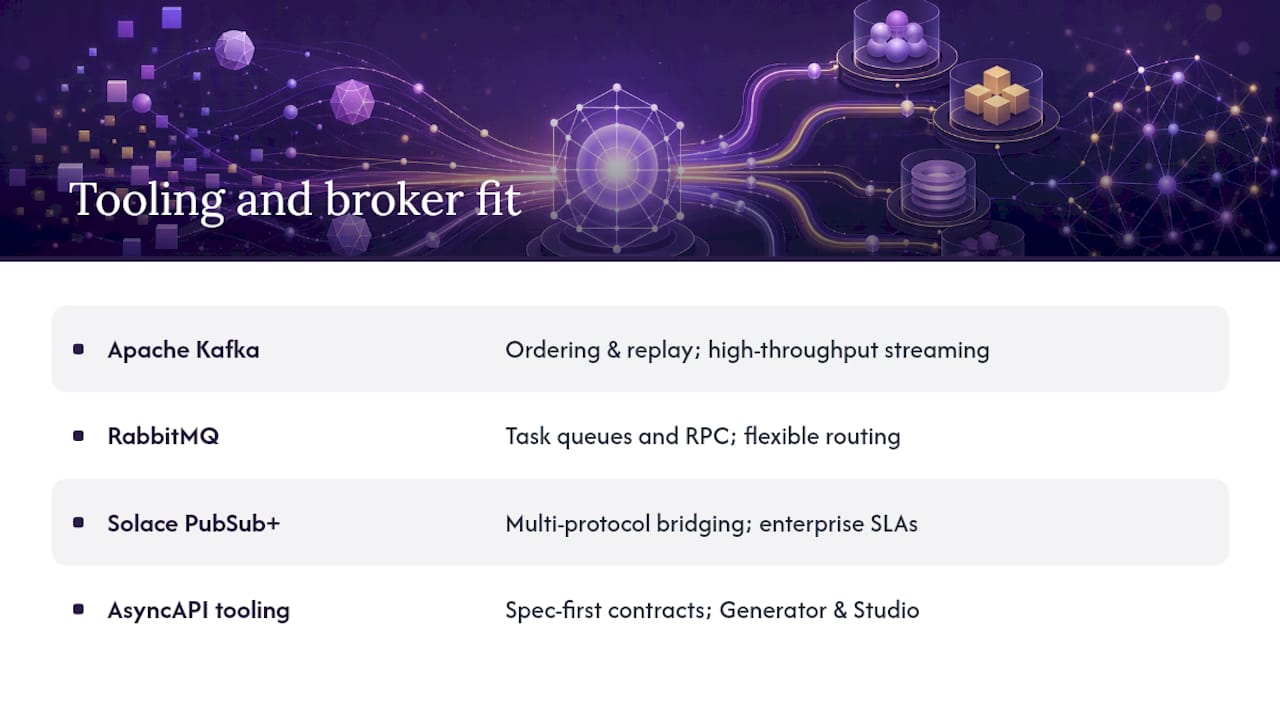
Apache Kafka
Kafka is designed as a durable, partitioned log that supports high throughput and event replay, making it well suited where ordering, replayability, and high-volume streaming are required. Throughput reaches millions of events per second with appropriate partitioning. Retention is configurable from hours to indefinitely. Delivery semantics: at-least-once by default; exactly-once available via the Kafka transactions API. Operational complexity is high: you manage brokers, ZooKeeper (or KRaft in newer versions), partition rebalancing, and consumer group offsets. Best for: event sourcing, audit logs, telemetry pipelines, and any workload where replay is a first-class requirement.
RabbitMQ
A message broker built on the AMQP protocol, optimized for task queues and routing flexibility. Throughput is lower than Kafka (tens of thousands of messages per second in typical deployments) but latency is lower for small payloads. Delivery semantics: at-most-once or at-least-once; exactly-once requires application-level deduplication. Messages are not retained after acknowledgment by default, so replay is not a native capability. Best for: task distribution, RPC-style async patterns, and workloads where routing logic (topic exchanges, header exchanges) matters more than log retention.
Solace PubSub+
A commercial broker that supports multiple protocols natively: AMQP, MQTT, JMS, and a proprietary SMF protocol. Solace targets enterprise and IoT deployments where protocol bridging and guaranteed delivery across hybrid cloud environments are priorities. It supports both queue-based and topic-based routing, with built-in support for wildcard subscriptions. Operational complexity is lower than self-managed Kafka for teams without deep Kafka expertise, but licensing costs are significant. Best for: regulated industries (financial services, healthcare) that need multi-protocol support and enterprise SLAs.
AsyncAPI tooling
AsyncAPI documents event-driven components and is the spec-first standard for event contracts. The AsyncAPI Generator produces server stubs, client SDKs, and documentation from a single spec file. AsyncAPI Studio provides a browser-based editor. The spec supports Kafka, AMQP, MQTT, WebSocket, and HTTP bindings, so one contract format covers most broker choices. Pair AsyncAPI with a schema registry for full contract governance.
Run a proof-of-concept with your actual message sizes and consumer counts before committing to a broker at scale. Throughput figures from vendor benchmarks rarely reflect your specific payload shape and network topology.
Topology choices and observability: broker vs mediator
The topology decision shapes how events flow and how much control you have over error handling.
In a broker topology, producers publish to a central broker and consumers subscribe independently. There is no central coordinator. This model scales well and avoids a single point of failure in the workflow logic, but it makes it harder to see the full picture of what happened during a complex flow. Event-driven architectures commonly use either a broker topology or a mediator topology; each has different trade-offs for control, error handling, and scalability.
In a mediator topology, a central orchestrator (a workflow engine or event mediator) receives initial events and coordinates subsequent steps. You gain visibility and explicit error handling at the cost of a central bottleneck. Apache Camel, Temporal, and AWS Step Functions are common mediator implementations.
Most enterprises end up with a hybrid: broker topology for high-volume, fan-out event streams and mediator topology for business-critical multi-step workflows where auditability matters. The Wikipedia overview of event-driven architecture notes that many enterprises use hybrids to balance performance and control.
Observability checklist (non-negotiable before production):
- Distributed tracing with OpenTelemetry: propagate
traceparentheaders through every event so you can reconstruct a full flow across services - Centralized event logging: ship all broker logs and consumer application logs to a single platform (Elasticsearch, Datadog, or equivalent)
- Correlation IDs: embed a unique
correlationIdin every event header and log it in every consumer - Schema registry monitoring: alert on schema compatibility violations before they reach consumers
- Consumer lag dashboards: track lag per consumer group per partition; a growing lag is the first signal of a struggling consumer
- Replay and recovery drills: run a scheduled drill where a new consumer replays the last 24 hours of a critical topic and verifies its output
Event-driven systems lose the traditional call stack, making debugging and testing harder. Teams must invest in distributed tracing and centralized event logging to maintain visibility. Without these controls, a production incident in an event-driven system can take hours to diagnose because there is no single log file that shows the sequence of what happened.
Pro Tip: Before you go live, run a “chaos replay” drill: deliberately corrupt one event in a test topic and verify that your DLQ alert fires, your tracing shows the failure path, and your runbook correctly describes the reprocessing steps. If any of those three fail, you are not ready for production.
Statistic callout: The Enterprise Integration Patterns analysis of event-driven architectures identifies the loss of the call stack as the primary reason debugging becomes disproportionately expensive in EDA systems — a cost that observability investment directly offsets.
Common pitfalls and how to fix them
Distributed monolith disguised as async
Services that communicate exclusively through events but share a database or deploy together are still a monolith. The fix: enforce bounded contexts at the data layer, not just the messaging layer.
Uncontrolled schema evolution
A producer adds a required field; consumers that do not know about it start failing silently. The mitigation is a schema registry with compatibility enforcement. A centralized schema registry and strict contract management are essential for long-lived event-driven architectures; without this, gradual schema evolution causes consumer breakage and expensive coordination.
Missing idempotency
At-least-once delivery means duplicates are guaranteed eventually. A consumer that processes a payment event twice charges the customer twice. Every consumer must check a deduplication key before processing. Store processed event IDs in a fast lookup store (Redis, a database unique index) and skip events already seen.
No replay strategy
Teams that treat their broker as a transient queue rather than a durable log lose the ability to recover state or onboard new consumers. Define retention policies and replay runbooks before the first producer goes to production.
Poor backpressure handling
A slow consumer falls behind, the broker’s unacknowledged message count grows, and eventually the consumer crashes under the accumulated load. The fix: implement consumer-side rate limiting, scale consumer instances horizontally, and set alert thresholds on consumer lag before it becomes a crisis.
Inadequate DLQ handling
A DLQ that nobody monitors is a graveyard. Events silently die there and nobody knows. Assign ownership of each DLQ to a specific team, set up alerts on DLQ depth, and include a reprocessing runbook in your on-call documentation.
A concrete failure and fix: A financial services team deployed an order processing saga with no idempotency keys on the payment consumer. During a broker restart, Kafka redelivered 3,000 events. The payment consumer processed each one again, triggering duplicate charges. The fix was a Redis-backed deduplication store keyed on eventId + consumerId, deployed within 48 hours. The deeper lesson: idempotency is not an optimization; it is a correctness requirement for at-least-once systems.
- Audit every consumer for idempotency before go-live
- Test duplicate delivery explicitly in your integration test suite
- Add DLQ depth alerts to your monitoring stack on day one
Bridging event-driven APIs with existing REST systems
Most systems cannot go fully event-driven overnight. You will bridge REST and event-driven patterns for years.
Webhooks are the simplest push mechanism over HTTP. A provider registers a callback URL and POSTs events to it when something changes. They are easy to implement but hard to scale: you need to handle retries, signature verification, and consumer unavailability. Webhooks are best for simple integrations where the consumer is a single external system.
WebSockets provide a persistent bi-directional channel suitable for low-latency streaming between browser clients and servers. MDN’s WebSocket API documentation explains the protocol behavior and use cases. Use WebSockets when the client is a browser or mobile app that needs real-time updates without polling.
Server-Sent Events (SSE) are a simpler, unidirectional alternative to WebSockets for browser clients that only need to receive updates. Lower operational overhead than WebSockets; no bidirectional channel.
HTTP 202 + status endpoint is the right pattern when a synchronous REST client triggers a long-running operation. Use HTTP 202 with a status endpoint and include Location and Retry-After headers; status responses should include fields such as status, createdAt, lastUpdatedAt, percentComplete, and structured error.
| Field | Type | Purpose |
|---|---|---|
status |
string | Current state: pending, processing, completed, failed |
createdAt |
standard datetime format | When the operation was accepted |
lastUpdatedAt |
standard datetime format | When the status last changed |
percentComplete |
integer range | Progress indicator for long-running operations |
error |
object | Structured error with code, message, and details |
Location (header) |
URL | Where the client polls for status |
Retry-After (header) |
seconds | How long to wait before the next poll |
Checklist for hybrid deployments:
- Map REST resource nouns to event topic names consistently (
/orders/{id}→orders.v1.placed) - Decide which operations are commands (REST POST/PUT) and which generate events (broker publish)
- Align auth models: OAuth tokens used in REST calls should map to broker-level scopes for the same identity
- Document eventual consistency windows explicitly in your API contract so consumers know how stale a read might be
- Test the full round-trip: REST call → event published → consumer processed → state visible via REST GET
Concrete use cases and example flows
E-commerce order lifecycle
POST /orders→ HTTP 202 Accepted; order service publishesorders.v1.placed- Inventory service consumes
orders.v1.placed→ reserves stock → publishesinventory.v1.reserved - Payment service consumes
inventory.v1.reserved→ charges card → publishespayments.v1.completed - Fulfillment service consumes
payments.v1.completed→ creates shipment → publishesshipments.v1.created - Notification service consumes
shipments.v1.created→ sends confirmation email
Each service is a separate consumer group. A failure in fulfillment does not block notification; the saga compensation flow handles rollback if payment fails after inventory reservation.
IoT telemetry ingestion
- Devices publish sensor readings to
telemetry.v1.{deviceId}at high frequency - A stream processor (Kafka Streams, Apache Flink) aggregates readings into 1-minute windows
- Anomaly detection consumes the aggregated stream and publishes
alerts.v1.threshold_exceededwhen a reading crosses a limit - Success criterion for a pilot: ingest 10,000 messages per second with consumer lag under 500ms at the 99th percentile
Fraud detection in financial services
- Transaction service publishes
transactions.v1.initiatedfor every card swipe - Fraud scoring service consumes the event, scores it within 200ms, and publishes
fraud.v1.scored - If score exceeds threshold, publishes
fraud.v1.flagged; the transaction service subscribes and blocks the transaction - Compliance requirement: every event must be retained for seven years; Kafka retention policy set accordingly
Domain mapping bullets:
- Commands belong in REST (or a command topic if async); events belong in the broker
- Services that own a domain entity are the only publishers to that entity’s event topics
- Read-heavy query services should subscribe to events and maintain their own projections rather than calling the source service synchronously
- Pilot success at 30 days: one producer, one consumer, schema registry live, DLQ monitored, replay drill completed
- Pilot success at 90 days: three or more consumer groups on the same topic, consumer lag SLA defined and met
- Pilot success at 180 days: schema version 2 deployed with zero consumer breakage; observability dashboard reviewed in a post-incident
An architect’s honest take on when event-driven APIs are worth the cost
The honest answer is that most teams underestimate the operational gap between a working event-driven proof-of-concept and a production-grade event-driven system. The gap is not in the broker setup. It is in schema governance, idempotency, DLQ ownership, and observability. Teams that skip those four things in the name of speed spend the next six months firefighting.
My advice: do not adopt a full event-driven architecture because it is architecturally elegant. Adopt it because you have a specific, named problem that REST cannot solve cleanly, whether that is real-time fan-out to a dozen consumers, a compliance requirement for a seven-year event log, or a throughput ceiling that synchronous calls cannot clear.
Pilot checklist for a responsible first deployment:
- Scope: one producer, one consumer, one non-critical event stream
- Observability targets: distributed tracing live, consumer lag dashboard live, DLQ alert configured
- Rollback criteria: if DLQ depth exceeds 100 events within 24 hours, pause and investigate before expanding
- Schema governance: AsyncAPI spec committed to version control, schema registry enforcing backward compatibility
At 30 days, you should have a working event stream with monitoring. At 90 days, you should have validated replay with a second consumer. At 180 days, you should have shipped a schema version 2 without breaking any consumer. If you cannot hit those milestones, the team needs more investment in tooling and process before expanding the architecture.
The teams that succeed with event-driven APIs treat the event schema as a product, not an implementation detail. They assign ownership, review changes, and version deliberately. The teams that fail treat the broker as a faster message queue and discover six months later that they have an unmonitorable, schema-inconsistent system that nobody wants to touch.
Jundago makes event-driven API governance production-ready for regulated teams
Building event-driven APIs in regulated industries means schema governance, security controls, and compliance are not optional extras. They are the baseline. Jundago is the AI-native API lifecycle platform built for exactly that baseline: AsyncAPI contract generation from natural language intent, built-in schema registry integration, RBAC and ABAC controls at the broker and API layer, and observability tooling that maps to your compliance audit trail.
For architects evaluating a pilot, Jundago’s platform covers the full checklist: spec-first contract design, automated testing and replay validation, multi-cloud deployment across AWS, Azure, GCP, and Oracle Cloud, and regulatory modules for healthcare (HIPAA, HL7 FHIR), finance (PCI DSS, Open Banking), and manufacturing (IEC 62443). You get governance built in, not bolted on after the fact. Start your evaluation at Jundago and see how quickly a governed event-driven pilot can go from schema definition to production deployment.
Sources
- Programming Without a Call Stack – Event-driven Architectures (Enterprise Integration Patterns)
- Event-driven architecture — Microsoft Learn
- Apache Kafka — Project website