Data Residency Compliance: A Practical Guide for Enterprises
Data Residency Compliance: A Practical Guide for Enterprises

Data residency compliance means keeping regulated data inside the physical or jurisdictional boundaries a law, contract, or customer requires, and being able to prove it during storage, processing, and transfer. Frameworks like the GDPR and transfer mechanisms like Standard Contractual Clauses (SCCs) define most of that obligation, and platforms such as Jundago show it’s possible to enforce region rules at the API layer instead of policing them after the fact.
If you’re staring down an audit deadline, do three things this week:
- Map sensitive datasets. Identify which data classes carry residency obligations and where every copy actually lives, not just the primary database.
- Region-pin critical workloads. Lock production databases, caches, and processing jobs to approved regions before you touch anything else.
- Block out-of-region backups. Backup jobs are the most common silent violation. Confirm every backup destination matches your primary region policy today.
Pro Tip: GDPR’s maximum fine reaches €20 million or 4% of global annual turnover, whichever is higher, and it applies even to companies with no EU office if they process EU residents’ data. Extraterritorial reach is the part most US and Asia-Pacific teams underestimate.
Key Takeaways
Data residency compliance succeeds when data classification, region-enforcing architecture, and contractual transfer mechanisms operate together and generate continuous audit evidence.
| Point | Details |
|---|---|
| Know the terms | Residency is physical location, sovereignty is applicable law, localization is a legal mandate with no exceptions. |
| Fix backups first | Out-of-region backups and unmonitored logs cause more real violations than production database placement. |
| Document transfer mechanisms | Confirm adequacy decisions, SCCs, or BCRs cover every cross-border flow, with contract clauses on audit rights. |
| Automate evidence generation | Manual audit prep doesn’t scale; configuration snapshots and transfer logs should generate themselves. |
| Consider API-led enforcement | Platforms like Jundago apply region-aware policy guardrails at the request level and log every check automatically. |
Table of Contents
- What Is Data Residency Compliance, Really?
- Why Does Data Residency Matter for Compliance Risk?
- Which Cross-Border Transfer Mechanisms Apply to You?
- What Cloud and Multi-Cloud Setups Get Wrong
- What Belongs on Your Data Residency Compliance Checklist?
- Which Architecture Patterns Actually Enforce Residency?
- How Do You Build an Audit-Ready Residency Program?
- Operationalizing Residency With an API-Led, Governed Platform
- How Do Edge Computing and Blockchain Change Residency Compliance?
- How Should You Train Employees on Data Residency Requirements?
- What I Learned Implementing Residency Controls the Hard Way
- Start Small With an API-Governed Residency Pilot
- Frequently Asked Questions
- Sources
What Is Data Residency Compliance, Really?
Data residency, data sovereignty, and data localization get used interchangeably, and that’s a problem when you’re writing policy or negotiating a vendor contract. They mean different things.
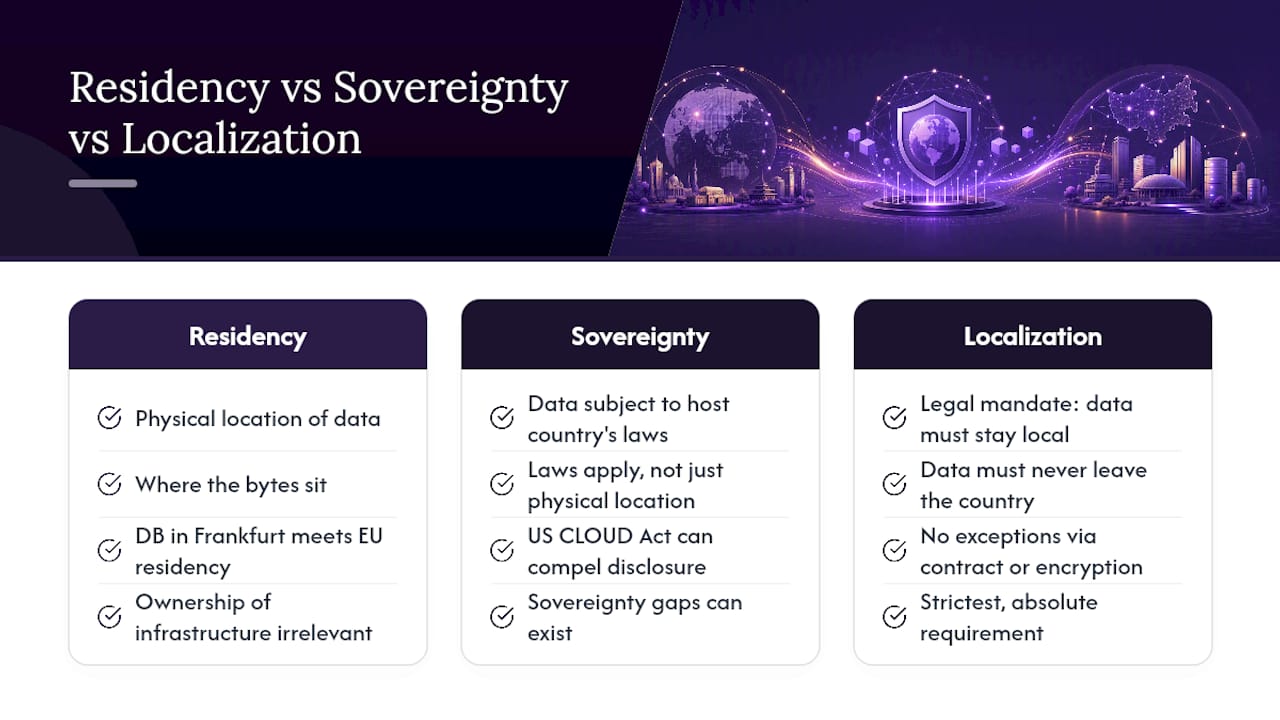
Data residency is purely physical: where the bytes sit. A database instance running in Frankfurt satisfies a residency requirement that says “store EU customer data in the EU,” regardless of who owns the infrastructure.
Data sovereignty goes further. It means the data is subject to the laws of the country where it sits, not just physically located there. Splunk’s explainer on the distinction makes this concrete: a US cloud provider’s Frankfurt region satisfies residency, but the US CLOUD Act can still theoretically compel that provider to disclose data to US authorities, which is a sovereignty gap even though residency is technically met.
Data localization is the strictest version: a legal mandate that certain data must never leave the country, full stop, no exceptions via contract or encryption.
Here’s why the distinction matters for policy language: writing “data residency” when you mean “data sovereignty” will pass an initial audit and fail a deeper one. Use the term that matches the actual legal obligation, and document which one applies per data class, per jurisdiction.
Why Does Data Residency Matter for Compliance Risk?
Residency matters because it determines which country’s laws apply to your data and whether you can prove that in an audit. Get it wrong and the exposure isn’t hypothetical.
The risk breaks into three categories:
- Legal risk: regulators can levy fines, and courts in the “wrong” jurisdiction can compel disclosure you never agreed to.
- Security risk: data replicated to an unmonitored region often means weaker encryption defaults, inconsistent access controls, or blind spots in your SIEM.
- Operational risk: enterprise procurement teams increasingly reject vendors who can’t demonstrate residency, which stalls deals and renewals.
The failures rarely happen at the primary database. They happen in backups replicated to a default region, application logs shipped to a global logging service, or a helpdesk agent exporting a customer record to a laptop in another country. Teradata’s guidance on residency compliance notes that effective programs treat backups and disaster recovery as first-class residency risks, not afterthoughts. One misconfigured backup job can undo months of careful region-pinning on the production system.
Which Cross-Border Transfer Mechanisms Apply to You?
Three mechanisms cover most legal cross-border transfers: adequacy decisions (a regulator has ruled the destination country’s laws are equivalent), Standard Contractual Clauses (pre-approved contract terms binding both parties), and Binding Corporate Rules (internal rules approved by regulators for transfers within a corporate group). Adequacy is fastest when it exists; SCCs are the default fallback; BCRs suit large multinationals moving data internally at scale.
Jurisdiction changes the checklist:
- EU/GDPR: Chapter V governs transfers outside the EU/EEA. Without an adequacy decision, you need SCCs plus a documented Transfer Impact Assessment showing the destination country’s surveillance laws don’t undermine EU protections.
- UK to US: the UK-US data bridge extends the US Data Privacy Framework to UK personal data, but only for US organizations that have self-certified under the framework. Confirm your US vendor is actually on that list before relying on it.
- Canada: the Consumer Privacy Protection Act imposes accountability obligations that follow the data even after it crosses a border, meaning your organization stays liable for a foreign processor’s mishandling.
- Australia: the Australian Privacy Principles require you to take reasonable steps to ensure an overseas recipient doesn’t breach the same principles you’re bound by domestically.
For procurement, insist on a contract clause that spells out backup locations, who can access production data for support, and your right to audit the vendor’s subprocessor list on demand. A vendor that won’t commit that to paper is telling you something about how seriously they take residency.
What Cloud and Multi-Cloud Setups Get Wrong
Region-pinning your primary database is one control among many, and it’s often the only one teams actually check. Compliance gaps hide in the flows nobody screenshots for the audit: backup jobs, disaster recovery failover regions, AI and machine learning training pipelines, monitoring and log aggregation, and third-party support access. TryVarsi’s compliance guidance points out that residency now has to be mapped across the full data lifecycle, not just the primary storage location, because analytics copies and AI training sets routinely leak data into unapproved regions.
Run these checks quarterly, not just before an audit; for implementing detection probes, evidence collection, and security control patterns, follow guidelines from Security & Data Privacy | Patterns Process Finder AI.
- Verify your backup destination region matches policy, not just the primary database.
- Check where your SIEM or log aggregation platform actually stores ingested data.
- Pull your vendor’s current subprocessor list and confirm none introduce a new region.
- Test disaster recovery failover once and confirm the failover region is also compliant, not just available.
What Belongs on Your Data Residency Compliance Checklist?
Treat this as a triage sequence, not a menu. Work top to bottom.
- Classify your data. Tag every dataset by sensitivity and applicable jurisdiction before you touch infrastructure. You can’t protect what you haven’t labeled.
- Map data flows end to end. Trace each classified dataset through storage, processing, backup, analytics, and any third-party integration. Commit Issues’ field guide on residency found that most organizations have a written residency policy that doesn’t match what’s actually deployed, and mapping is where that gap surfaces.
- Fix the highest-risk leaks first. Out-of-region backups and unmonitored third-party subprocessors usually carry the most regulatory exposure. Fix those before optimizing anything cosmetic.
- Lock down technical controls. Enable encryption at rest and in transit, use customer-managed keys scoped to region, apply network controls (VPC boundaries, private endpoints), and tag data with metadata that enforcement tools can read.
- Formalize contractual controls. Every processor agreement should specify backup regions, support access rules, audit rights, and subprocessor notification terms.
- Build organizational controls. Run a Data Protection Impact Assessment for any new high-risk processing activity, maintain audit logs with defined retention periods, and pursue SOC 2 or ISO 27001 attestations where customers require them.
- Produce evidence, continuously. Auditors want configuration snapshots, transfer records, DPIAs, and access logs, not a policy document alone.
A minimal policy fragment might read: “Personal data of EU data subjects shall be stored and processed exclusively within EU/EEA regions unless an adequacy decision or Standard Contractual Clause covers the destination, and all backups shall inherit the same regional restriction as their source system.”
Pro Tip: Lock customer-managed encryption keys to the same region as the data they protect, then actually test a disaster recovery failover. Teams frequently discover during a real failover that the backup region holds an unencrypted or differently-keyed copy, which is the kind of finding you want to catch in a drill, not a breach report.
Which Architecture Patterns Actually Enforce Residency?
Choose the pattern that matches your data’s sensitivity and your tolerance for latency and cost, not the one that’s easiest to deploy.
- Geo-fencing at the network layer blocks requests and replication outside approved regions. It’s strong for regulatory hard boundaries but can complicate global user experience if not paired with regional routing.
- Regional key management (KMS) ties encryption keys to a specific region, so even if data is copied elsewhere, it’s unreadable without a key that never left. This is one of the lowest-cost, highest-impact controls available.
- Tenant isolation dedicates infrastructure per customer or per region, which simplifies audits at the cost of higher infrastructure overhead.
- Limited cross-region replication allows disaster recovery within approved geographic clusters (say, all EU regions) without ever touching a non-adequate country.
AWS’s approach to digital sovereignty combines region controls with Dedicated Local Zones, but the provider’s own documentation is clear that region selection alone doesn’t guarantee sovereignty. You still need contractual audit rights and independent verification that support staff and subprocessors respect the same boundary.
Validate each pattern with a real test: attempt a replication job to a disallowed region and confirm it fails, not just that policy says it should.
How Do You Build an Audit-Ready Residency Program?
Residency compliance is an operational capability you maintain, not a project you finish. Programs that pass repeat audits share a structure: a named data protection owner, a living data inventory, scheduled testing, and an evidence repository that’s always current rather than assembled the week before an audit.
Build your evidence inventory around what auditors actually request: access logs, configuration snapshots showing region settings at a point in time, signed transfer records referencing the SCC or adequacy basis used, subprocessor attestations, and completed DPIAs for high-risk processing. A practical testing cadence looks like a 30-day check on backup and log destinations, a 60-day review of subprocessor lists against your contracts, and a 90-day full DPIA refresh for any system that changed materially.
Mergers, acquisitions, and restructuring events deserve a fast triage: inventory the acquired company’s data flows and vendor contracts within the first 30 days, flag any residency conflicts between the two organizations’ policies, and treat unresolved conflicts as a blocking issue for system integration, not a cleanup task for later.
Operationalizing Residency With an API-Led, Governed Platform
Manual residency audits don’t scale past a handful of systems. An API-led governance layer enforces the rules at the point of request instead of catching violations after the fact, through a few concrete capabilities: policy guardrails that reject a request routing data to a disallowed region, region-aware deployment controls tied to each API’s data class, customer-managed key integration scoped per region, and audit logging that’s generated automatically instead of assembled manually.

Conceptually, a policy check looks like this: an incoming API call carrying EU personal data hits a guardrail that checks the target region against the data’s classification tag; if the target region lacks an adequacy decision or valid SCC on file, the request is blocked and logged, not silently processed. That’s the same pattern behind proposed reference implementations for GDPR subject-rights APIs, which centralize access and erasure requests with built-in audit trails instead of leaving each team to handle them manually.
Teams that automate this way typically report far less manual audit prep, since transfer records generate themselves, and fewer post-deployment surprises, since policy violations get caught at deploy time instead of during a customer’s security review.
How Do Edge Computing and Blockchain Change Residency Compliance?
Edge computing pushes processing physically closer to users, which sounds like a residency win but often complicates it instead. An edge node in one country processing a request for a user physically located there is straightforward. The complication is when that edge node syncs state back to a central cluster in a different region, or when a content delivery network caches personal data at edge locations you don’t fully control. Every edge location that touches regulated data needs the same region classification and contractual review as a primary data center, which many teams skip because edge infrastructure feels like “just caching.”
Blockchain introduces a more fundamental tension. Distributed ledgers are, by design, replicated across many nodes in many jurisdictions simultaneously, and most public blockchains offer no mechanism to delete or restrict where a record propagates. That’s structurally at odds with both data localization mandates and the GDPR’s right to erasure. Enterprises exploring blockchain for regulated data generally solve this by keeping personal data off-chain entirely, storing only hashes or references on the ledger, and applying residency controls to the off-chain system where the actual regulated data lives.
Both technologies push the same lesson: new infrastructure patterns don’t get a residency exemption just because they’re new. Classify the data, map where it actually flows, and apply the same controls you’d apply to a conventional database, before rolling either technology out to production.
How Should You Train Employees on Data Residency Requirements?
Policy documents don’t stop violations. People clicking “export to CSV” or attaching a customer record to an email do. Training has to target the specific roles that touch regulated data, not deliver a generic annual privacy module nobody remembers.
Support and customer success teams need scenario-based training on what they can and can’t export or forward, since helpdesk data exports are one of the most common real-world residency breaches. Engineering teams need onboarding that covers which regions are approved for which data classes and how to check before spinning up a new service or integration. Procurement and legal teams need a standing checklist for vendor contracts so residency clauses aren’t negotiated fresh, and inconsistently, every time.
Make training role-specific and frequent rather than annual and generic: a five-minute refresher tied to a real incident (even a near-miss) sticks far better than a slide deck reviewed once a year. Tie completion to system access where you can, so a support agent can’t get production data access without having completed the current residency module. And close the loop: when a violation or near-miss happens, feed it back into training content within weeks, not at the next annual cycle.
What I Learned Implementing Residency Controls the Hard Way
The biggest pitfall isn’t malicious data movement, it’s the invisible copy: a monitoring tool, a backup job, or an AI training pipeline nobody flagged as “data” because it wasn’t the production database. That’s the gap between written policy and actual deployment that keeps showing up in audits.
If you’re resource-constrained, fix backups and logging before anything else. They’re boring, they’re rarely someone’s job to own, and they’re the first thing an auditor checks. Hand engineering one sprint ticket: “audit and region-lock every backup destination for regulated datasets.” That single ticket closes more exposure than most quarter-long compliance initiatives.
Start Small With an API-Governed Residency Pilot
The gap between a residency policy and what’s actually deployed usually isn’t a people problem, it’s a visibility problem. You wrote the rule, but nothing in your infrastructure actually enforces it or proves it happened. Jundago closes that gap at the API layer instead of the spreadsheet layer.
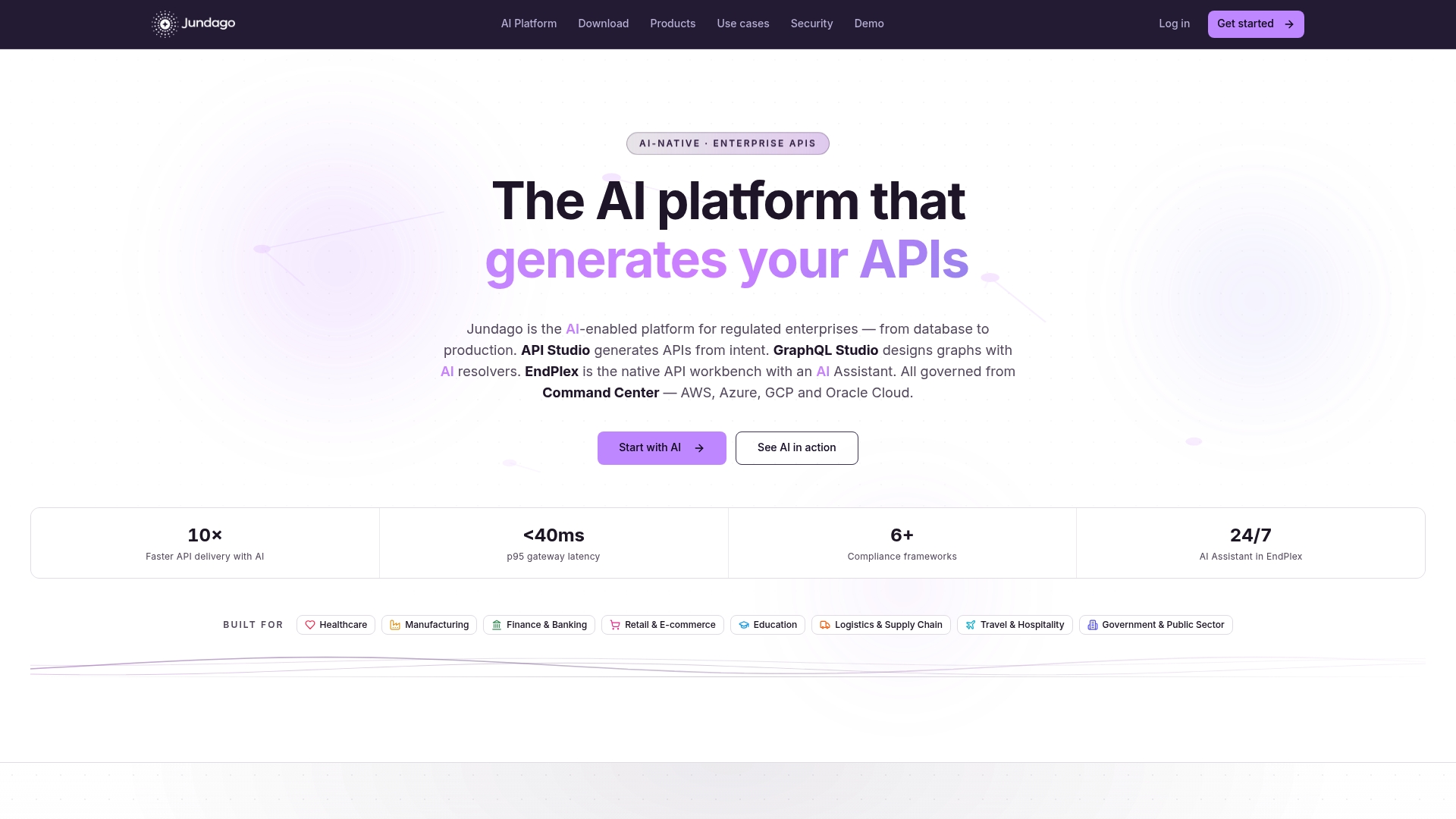
The platform maps directly to the checklist covered above: region-aware deployment controls that keep an API’s traffic inside its approved jurisdiction, policy guardrails that block a request before it reaches a disallowed region, customer-managed key integration scoped per region, and audit logging generated automatically instead of reconstructed after the fact. Vendor and subprocessor governance workflows run through the same Command Center, so you’re not chasing subprocessor lists across five different vendor portals.
Start with a narrow pilot: one regulated dataset, one API, one region, run for 30 days with success measured by whether every transfer generates an automatic audit record without manual intervention. If that works at that scale, expanding it is a configuration change, not a rebuild. Request a demo through Jundago to walk through how the guardrails map to your specific compliance scope, including industry modules built for healthcare, finance, and manufacturing environments.
Frequently Asked Questions
What’s the difference between GDPR and CCPA on data residency? GDPR restricts cross-border transfers of EU personal data unless a legal mechanism like an adequacy decision or SCC applies. The CCPA, by contrast, doesn’t impose residency or localization requirements at all; it focuses on consumer rights to access, delete, and opt out of the sale of personal information regardless of where the data is stored.
What does GDPR actually require for data residency? GDPR doesn’t mandate that EU data physically stay in the EU. It requires that any transfer outside the EU/EEA rely on a valid legal mechanism, such as an adequacy decision, SCCs, or BCRs, and that the destination’s laws don’t undermine the protections EU data subjects are guaranteed.
Are there US equivalents to GDPR-style residency rules? No single US federal law mirrors GDPR. State laws like the CCPA address consumer privacy rights rather than residency, and sector-specific rules (HIPAA for health data, GLBA for financial data) impose their own controls without a unified national residency mandate.
Does data residency compliance require on-premises infrastructure? No. Major cloud providers offer region-specific deployment options, and compliance depends on documented controls, contractual terms, and verification rather than the type of infrastructure you use.
How often should a residency program be tested? A reasonable cadence checks backup and log destinations every 30 days, reviews subprocessor lists every 60 days, and refreshes DPIAs for materially changed systems every 90 days.
This article is general information, not a substitute for advice from a qualified lawyer. Consult a qualified legal professional about your own circumstances before acting on anything here.
Sources
- What Is Data Residency? Definition and Compliance | Teradata
- Gov
- Consumer Privacy Protection Act | Innovation, Science and Economic Development Canada
- Australian Privacy Principles | Office of the Australian Information Commissioner