Consumer-Driven Contracts: A CI/CD Guide for Engineers
Consumer-Driven Contracts: A CI/CD Guide for Engineers

Consumer-driven contracts (CDC) are a testing pattern where API consumers, not providers, define the contract a provider must satisfy. Instead of a provider publishing a spec and hoping every client stays compatible, each consumer captures exactly what it expects in a contract file, and the provider verifies against that file before shipping any change.
Your next move is simple: write a consumer-side test that records the requests and responses your service actually needs, generate a contract file from it, and push that file to a broker so the provider verifies it in CI.
You can realistically write one consumer test for a real integration point you already have, generate a contract file (like a Pact file) from that test run, and push it to a broker while wiring a verification step into the provider’s pipeline.
Key Takeaways
Consumer-driven contracts work because they let each client define its own minimal expectations, giving providers precise, auditable proof of what a change will and won’t break.
| Point | Details |
|---|---|
| CDC flips ownership | Consumers define what they need; providers verify against those exact expectations, not a full spec. |
| Follow the three-step cycle | Consumer test generates a contract, the contract is published to a broker, the provider verifies it in CI. |
| Specify only what’s used | Documenting unused fields creates schema bloat and removes the flexibility CDC is meant to protect. |
| CDC complements, not replaces, e2e testing | Keep a small set of end-to-end tests for critical flows; use CDC for fast, targeted integration checks. |
| Governance needs audit trails | Jundago pairs contract publishing and verification with audit logs and RBAC/ABAC for regulated teams. |
Table of Contents
- What Are Consumer-Driven Contracts?
- Why Does CDC Matter for Microservice Teams?
- How Does the Consumer-Driven Contract Cycle Work?
- Example: Evolving a User API Without Breaking Consumers
- Which Tools Handle Consumer-Driven Contract Testing?
- What Are the Gold Rules for Writing Contracts?
- When Is CDC Not the Right Tool?
- How Do You Wire CDC Into a CI/CD Pipeline?
- How Do You Get Started With Consumer-Driven Contracts?
- How Does CDC Support Governance in Regulated Environments?
- When Does CDC Actually Pay Off?
- Simplify Contract Governance With an AI-Native API Platform
- Frequently Asked Questions
- Sources
What Are Consumer-Driven Contracts?
A consumer-driven contract flips the usual ownership of API expectations. In a provider-driven model, the team running the service publishes an OpenAPI spec or schema and consumers build against it, guessing at what actually matters. In a consumer-driven model, each client writes down precisely the fields and behaviors it depends on, and the provider derives a leaner “provider contract” from the sum of those consumer expectations.
There are three related artifacts worth knowing by name:
- Consumer contract: what one specific client expects from the provider, generated from that client’s own tests.
- Provider contract: the traditional, provider-authored spec describing everything the API can do.
- Consumer-driven provider contract: the derived contract built by combining every consumer contract, showing only what is genuinely in use.
This is “contract by example” rather than “contract by specification.” One contract exists per consumer, and each moves through its own lifecycle of authoring, publishing, verifying, and retiring. The tradeoff is coordination: provider-driven specs are easier to write once, but consumer-driven contracts catch real breakage because they’re grounded in actual usage, not theoretical coverage.
Why Does CDC Matter for Microservice Teams?
Speed is the first payoff. A consumer test that runs against a mocked provider in milliseconds catches an integration problem long before a slow, flaky end-to-end suite would even finish spinning up. Contract tests are cheaper to maintain precisely because they check one narrow thing instead of an entire live environment, which is why they complement rather than replace end-to-end testing.
The second payoff is precision. When a provider team plans a change, consumer contracts tell them exactly which teams to loop in. No guessing, no “let’s ask around Slack and hope someone remembers who uses this endpoint.”
Statistic callout: Pattern reports and implementation write-ups consistently point to the same driver behind adoption: teams that rely on end-to-end suites for every integration check spend disproportionate effort maintaining them, while contract verification isolates just the compatibility question and gives faster CI feedback.
For regulated organizations, there’s a third benefit that matters just as much: an audit trail. Every verification run against a published contract becomes evidence that an integration was checked, when, and against which version. That’s a very different story than “we ran the full test suite and it passed,” which auditors tend to find unsatisfying.
- Faster CI feedback than end-to-end regression suites.
- Clear, targeted impact analysis before a provider ships a change.
- Verification history that doubles as compliance evidence.
How Does the Consumer-Driven Contract Cycle Work?
The pattern runs on a three-step loop that repeats every time a consumer’s needs or a provider’s implementation changes.
- The consumer writes a test and generates a contract. A test using a mock provider records the exact request it sends and the response it expects, then serializes that interaction into a contract file, commonly a Pact file, right inside the consumer’s own test suite.
- The contract gets published. The file moves to a broker or artifact repository where it’s tagged by consumer, version, and environment, becoming a shared source of truth rather than a file sitting in someone’s repo.
- The provider verifies it. In the provider’s own CI pipeline, a verification step pulls every relevant contract and replays it against the real implementation, confirming the provider still produces what each consumer expects.
A minimal contract is mostly bookkeeping: a consumer name, a provider name, and one or more interactions, each holding a request description and the exact response the consumer expects back. Something like a GET /users/42 request paired with an expected response containing id, name, and email, nothing more. The consumer never declares interest in fields it doesn’t touch, which is the whole point.
There’s a distinction worth internalizing here: explicit contracts are files like Pact’s, checked in CI whenever the provider build runs. Implicit contracts show up when teams don’t formalize anything and instead rely on a shared test harness or staging environment to catch drift after the fact. Implicit enforcement works in small setups with one or two consumers. It falls apart fast once you have five teams depending on the same service.
The real shift consumer-driven contracts force is a change in who holds power over the schema. Providers stop guessing what “might” break and start knowing exactly what will, because every consumer has already told them.
Pro Tip: Add a visible verification badge to your provider’s README that links to the broker’s latest verification results. It turns “did we check this?” into a five-second glance instead of a Slack thread.
Picture the flow as consumer, then broker, then provider, then CI verification, with tagging applied at the broker step so the provider knows exactly which contract version belongs to which environment.
Example: Evolving a User API Without Breaking Consumers
Say a provider exposes a /users/{id} endpoint returning id, name, email, and phone. Consumer A, a billing service, only reads id and email. Consumer B, a notifications service, reads name and phone.
The provider team decides phone is legacy and wants it removed. Without contracts, that’s a coin flip: maybe nothing breaks, maybe Consumer B’s notification job silently fails in production three days later.
With CDC, the outcome is immediate and specific:
- Consumer A’s contract has no
phonedependency, so its verification passes without incident. - Consumer B’s contract explicitly expects
phonein the response, so provider verification fails the moment the field is dropped, right there in the provider’s CI run. - The failure names the exact consumer and interaction affected, so the provider team knows precisely who to talk to before merging anything.
That’s the practical value in one sentence: the break gets caught at build time, attached to a name and a reason, instead of surfacing as a mysterious support ticket after deployment. The coordination that follows is straightforward, too. The provider team pings the notifications team, agrees on either keeping phone or migrating it, and Consumer B updates its contract once the plan is set. No archaeology required.
Which Tools Handle Consumer-Driven Contract Testing?
Pact remains the default answer for most teams doing API contract testing, largely because it supports a wide range of languages and integrates cleanly into existing CI setups. It’s code-first: contracts get generated directly from your test suite rather than written by hand as a separate spec.
PactFlow is the hosted broker and verification platform built around that workflow, giving teams a place to publish, tag, and inspect verification results without running their own broker infrastructure. Spring Cloud Contract is worth knowing about too if your stack is Java-heavy, since it integrates tightly with Spring’s testing conventions.
- Pact: code-first consumer-driven contract testing, multi-language support, generates explicit contract files.
- PactFlow: managed broker plus verification dashboards, tagging, and webhook-driven CI triggers.
- Generic brokers/artifact repos: viable if you already run something like an internal package registry and want to store contracts alongside it.
If your organization leans heavily on OpenAPI as the single source of truth and has few, tightly coupled consumers, a provider-driven schema validation approach can be lighter weight than full CDC. Once you have more than a couple of independent consumer teams, the consumer-driven model earns its overhead quickly. For code-first setups, Pact’s own documentation is the most direct reference for examples and API details, and PactFlow’s explainer on CDC is useful for understanding broker-level verification patterns.
What Are the Gold Rules for Writing Contracts?
The single most valuable discipline in CDC is restraint: specify only the fields and behaviors your consumer actually uses. Documenting a field “just in case” defeats the purpose, because it locks the provider into supporting something nobody needs, which is exactly the schema flexibility the pattern is designed to protect.
Ownership follows naturally from that rule. Consumer teams author and maintain their own contracts, since they’re the only ones who know what they truly depend on. Provider teams don’t write contracts; they incorporate verification against every published contract into their own CI, treating a failed verification the same way they’d treat a failed unit test.
- Consumers own contract content; providers own verification execution.
- Tag contracts by environment (dev, staging, production) so verification targets the right version.
- Version contracts alongside consumer releases, not on a separate arbitrary schedule.
- Maintain a simple matrix of which consumers a provider must verify against before any release.
Pro Tip: Run provider verification directly in pull requests, not just on merge to main. Catching a contract failure before code lands saves a revert and an apology later.
Tagging strategy deserves its own mention because it’s where teams get sloppy. A contract tagged dev should never gate a production release, and a contract tagged main from a consumer’s latest deploy is the one your provider’s release pipeline actually needs to check.
When Is CDC Not the Right Tool?
CDC does not replace functional or end-to-end testing. It answers one narrow question: “does this integration still work the way this specific consumer expects?” It says nothing about whether the underlying business logic is correct, which is why treating contract tests as a substitute for broader testing leaves real gaps.
A few pitfalls show up repeatedly in practice:
- Schema bloat: teams document every field “for completeness,” which defeats the gold rule and locks providers into unnecessary rigidity.
- Cultural friction: shifting ownership from provider to consumer requires real coordination, and teams that skip that conversation end up with stale or ignored contracts.
- Contracts mistaken for documentation: a contract describes what’s tested, not everything the API can do; using it as your only API reference misleads new consumers.
The fix for all three is largely procedural: keep a handful of true end-to-end tests for critical user journeys, enforce the “only what’s used” rule in code review, and give consumer and provider teams a standing channel, even an informal one, to talk through upcoming changes before they land.
How Do You Wire CDC Into a CI/CD Pipeline?
The pipeline pattern is consistent across most implementations, whether you’re using Pact, PactFlow, or a generic broker setup.
- Consumer CI runs the test suite, generates the contract file, and publishes it to the broker, tagged with the consumer’s branch or release version.
- Provider CI, on its own build, pulls every contract tagged for the relevant environment and runs verification against the live provider code.
- If verification fails, the provider build fails too, gating the release before a breaking change ever reaches a shared environment.
Tagging is what makes this survivable at scale. A common approach uses tags that mirror your branching model: dev contracts verify against feature branches, staging contracts verify before a staging deploy, and production tags mark the contract version currently live. Broker tagging paired with verification badges is specifically what prevents “version hell,” where nobody’s sure which consumer version is actually compatible with which provider release.
- Track a verification matrix: one row per consumer, one column per environment, updated automatically from broker results.
- Set up webhook alerts so a failed verification notifies both teams immediately, not just the provider’s on-call.
- Gate merges to main on successful verification against at least the
production-tagged contracts.
How Do You Get Started With Consumer-Driven Contracts?
Adopting CDC doesn’t require a company-wide rollout. Start with one integration point and prove the pattern before expanding it.
- Pick one consumer and one provider pair that has broken before, since that’s where the value will be obvious fastest.
- Write a single consumer test that generates a contract file and publish it to a broker.
- Add a provider verification step to that provider’s CI, even if it only runs on a schedule at first.
- Add a badge or dashboard link so both teams can see verification status without digging through CI logs.
- Agree explicitly on who owns the contract, which tagging convention you’ll use, and how failures get triaged.
A reasonable milestone plan: within a week, you should have one passing contract verified in a staging pipeline. Within a sprint, the workflow should feel stable enough that a second consumer team wants in. That’s usually the signal you’re ready to standardize tooling and tagging conventions across the rest of the organization, rather than leaving it as one team’s experiment.
How Does CDC Support Governance in Regulated Environments?
Regulated teams, healthcare and finance especially, need more than “the tests passed.” They need a record of who published which contract, when it was verified, and who approved the release that depended on it.

A broker that logs every publish and verification event gives you exactly that trail without extra process overhead. Combine that with role-based access control over who can publish or approve a contract, and you’ve got a defensible answer when an auditor asks how an integration was validated before shipping.
Look for these capabilities regardless of which platform you run:
- Audit logs covering contract publication and every verification run, not just pass/fail status.
- Role-based or attribute-based access control over who can publish, approve, or modify a contract.
- Environment tagging that ties a specific contract version to a specific deployment target.
- Retention policies that keep verification history available for the length of your compliance review cycle.
When these pieces are in place, contract verification becomes usable evidence during a compliance review, not just an engineering nicety. That distinction is often what separates a team that adopts CDC smoothly from one that has to bolt on paperwork after the fact.
When Does CDC Actually Pay Off?
CDC earns its keep fastest in messy, real-world conditions: a dozen microservices, several independent teams, and at least one system where an auditor will eventually ask how an integration was verified. In a monolith with two developers, the overhead of contracts and brokers probably outweighs the benefit. In a regulated system with six consumer teams hitting one provider, it’s close to essential.
The mistake I see most often isn’t technical, it’s cultural: teams treat a contract file as free API documentation, then get surprised when a field they never tested silently disappears. The second most common mistake is writing consumer tests without ever wiring provider verification into CI, which means you’ve built half the pattern and none of the safety net.
One warning worth repeating: when a large provider ships a breaking change without checking consumer contracts, the recovery isn’t glamorous. Someone reverts, someone apologizes, and the team adds the verification step they should have had from day one. Better to add it before that Tuesday happens than after.
Simplify Contract Governance With an AI-Native API Platform
Jundago cuts the operational overhead that usually slows CDC adoption, especially inside regulated organizations juggling multiple compliance frameworks. Instead of stitching together a broker, an access control layer, and separate audit logging, Jundago’s platform handles contract publishing, verification pipelines, and RBAC/ABAC access control in one governed environment across AWS, Azure, GCP, and Oracle Cloud.
That matters most for healthcare and finance teams where every verification run needs a traceable audit record tied to who published and approved it. Environment tagging and audit logs come built in, so your compliance evidence doesn’t depend on a separate homegrown script somebody wrote two years ago and half-forgot about.
None of this replaces the collaboration CDC still requires between consumer and provider teams. What it removes is the plumbing: the broker setup, the access control wiring, the audit trail you’d otherwise build by hand. If your team is evaluating how to scale contract testing across a growing set of microservices, explore Jundago’s API lifecycle platform and request a demo to see the governance layer in action.
Frequently Asked Questions
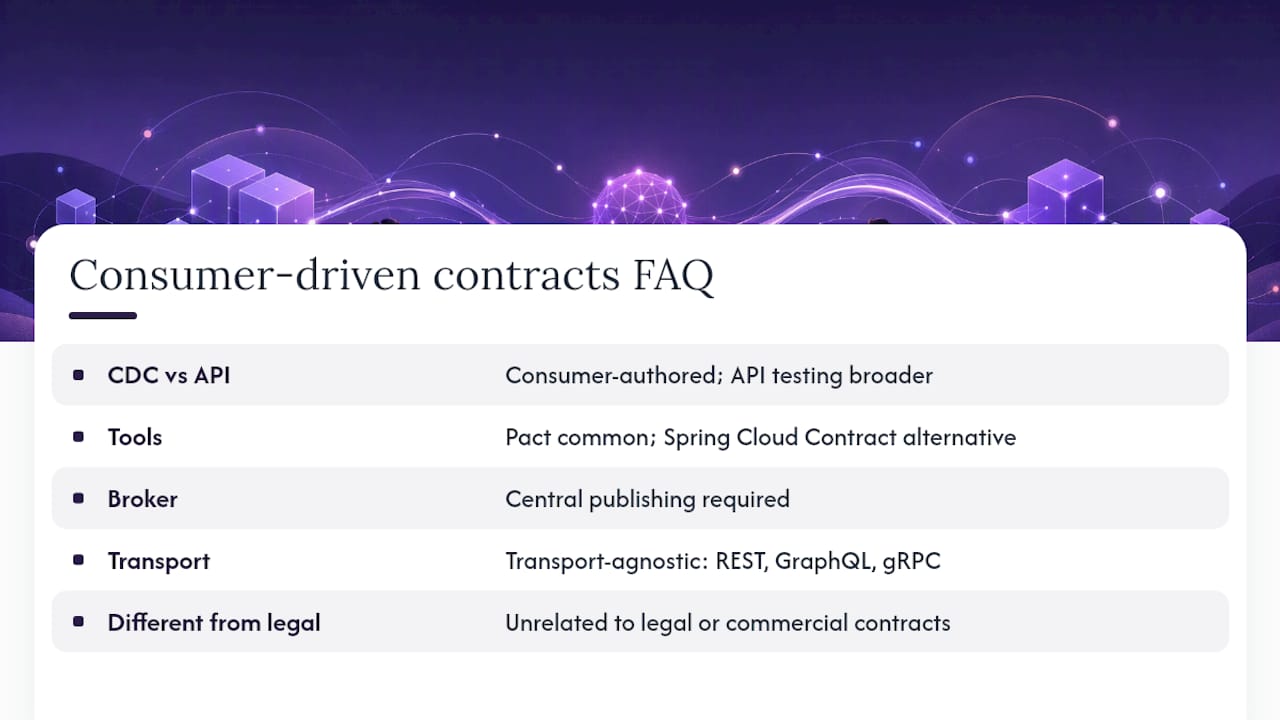
What is the difference between consumer-driven contracts and API contract testing in general? API contract testing is the broader category, checking that a provider and consumer agree on request and response shapes. Consumer-driven contracts are a specific style of contract testing where the consumer, not the provider, authors that contract based on real usage.
Is Pact the only tool for consumer-driven contract testing? No. Pact is the most widely used option and supports many languages, but Spring Cloud Contract is a common alternative in Java-heavy stacks, and some teams build lighter implicit enforcement using shared test harnesses instead of explicit contract files.
Do I need a broker to do consumer-driven contract testing? You need somewhere central to publish and retrieve contracts, whether that’s a hosted broker like PactFlow or a self-hosted one. Without it, providers have no reliable way to discover every contract they need to verify against.
Can consumer-driven contracts work with GraphQL or gRPC, not just REST? Yes, the pattern is transport-agnostic. What matters is capturing real consumer expectations and verifying them against the provider’s actual implementation, regardless of whether the interface is REST, GraphQL, or gRPC.
How is this different from personalized contracts or consumer choice contracts in other industries? Those terms usually describe legal or commercial agreements tailored to individual customers, such as personalized service terms or healthcare consumer contracts negotiated per patient. Consumer-driven contracts in software are a technical testing pattern for API compatibility and share no direct relationship with those legal concepts beyond the name.
Sources
Start with Martin Fowler’s original pattern write-up for the architectural reasoning behind consumer-driven contracts. For hands-on code examples and API references, Pact’s documentation is the most direct resource. PactFlow’s explainer covers broker and verification workflows in more depth, and ThoughtWorks’ Pacto pattern page frames CDC alongside related service-evolution patterns worth knowing.
- Introduction | Pact Docs
- Consumer-Driven Contracts: A Service Evolution Pattern
- API Contract Testing 101: Benefits, challenges, and when you need it