Best Boomi Alternatives for Regulated Enterprises
Best Boomi Alternatives for Regulated Enterprises

If you’re evaluating Boomi alternatives, the short answer is this: for regulated enterprises that need a full API lifecycle with built-in governance and AI-native capabilities, start your shortlist with AI-native API lifecycle platforms before looking at broader iPaaS options.
Here’s where to focus your evaluation:
- AI-native API lifecycle platforms (like Jundago): best when compliance automation, schema generation, and governed API delivery are non-negotiable
- API-led enterprise platforms (MuleSoft Anypoint): strongest for large-scale API programs with deep SAP/Salesforce ecosystem dependencies
- Data governance platforms (Informatica IICS): right fit when data quality, cataloging, and MDM matter as much as integration
- Business-led automation platforms (Workato): suited to ops and finance teams running self-service workflows without heavy IT involvement
- Hybrid/EDI specialists (SnapLogic, Azure Logic Apps): practical when legacy connectivity and cloud-native coexistence are the primary pain point
Your immediate next step: run a POC using a real compliance workflow, whether that’s a HIPAA-governed HL7 FHIR API or a PCI DSS-scoped payment integration. Analyst frameworks like Gartner Peer Insights consistently show that platform fit diverges sharply once you stress-test governance and AI claims against production-grade scenarios.
Table of Contents
- What do the best Boomi alternatives look like side by side?
- How do you choose the right platform for your integration needs?
- How long does migrating from Boomi actually take?
- What should enterprise buyers actually demand from API lifecycle and AI features?
- Which alternative is right for your use case?
- Key Takeaways
- What most integration evaluations get wrong
- Jundago covers the full API lifecycle for regulated enterprises
- Useful sources and further reading
What do the best Boomi alternatives look like side by side?
No single iPaaS wins across all dimensions; the right choice depends on your primary technical debt. Use this table to orient your shortlist before diving into vendor demos.
| Category | Best for | API lifecycle coverage | AI-native vs bolted-on | Hybrid & EDI support | Security & compliance | Deployment | Pricing posture |
|---|---|---|---|---|---|---|---|
| AI-native API lifecycle (Jundago) | Regulated enterprises needing governed API generation | Full: design → generate → test → govern | Native AI core | EDI + multi-cloud | RBAC, ABAC, HIPAA, PCI DSS | AWS, Azure, GCP, Oracle Cloud | Custom subscription |
| API-led enterprise platform (MuleSoft) | Large API programs, SAP/Salesforce ecosystems | Strong, developer-heavy | Bolted-on AI features | Good hybrid runtime | Enterprise-grade | Multi-cloud, on-prem | High; per-core licensing |
| Data governance platform (Informatica) | Data quality, MDM, catalog-first orgs | Integration + data governance | Bolted-on AI | Moderate | Strong data governance | Multi-cloud | Enterprise licensing |
| Business-led automation (Workato) | Ops/finance self-service workflows | Workflow-centric, limited API lifecycle | Bolted-on | Limited legacy/EDI | Standard | Cloud-native | Per-recipe/connector |
| Hybrid/EDI specialist (SnapLogic) | Legacy + cloud coexistence, EDI | Moderate API support | Bolted-on | Strong EDI/legacy | Standard | Hybrid | Consumption-based |
| Cloud-native automation (Azure Logic Apps) | Microsoft-stack shops, lightweight workflows | Basic API support | Bolted-on | Azure-native connectors | Azure compliance tiers | Azure-only | Consumption |
| Managed integration service | Orgs without a staffed integration team | Outcome-based, vendor-managed | Varies | Varies | Vendor-defined | Vendor-managed | Subscription/outcomes |
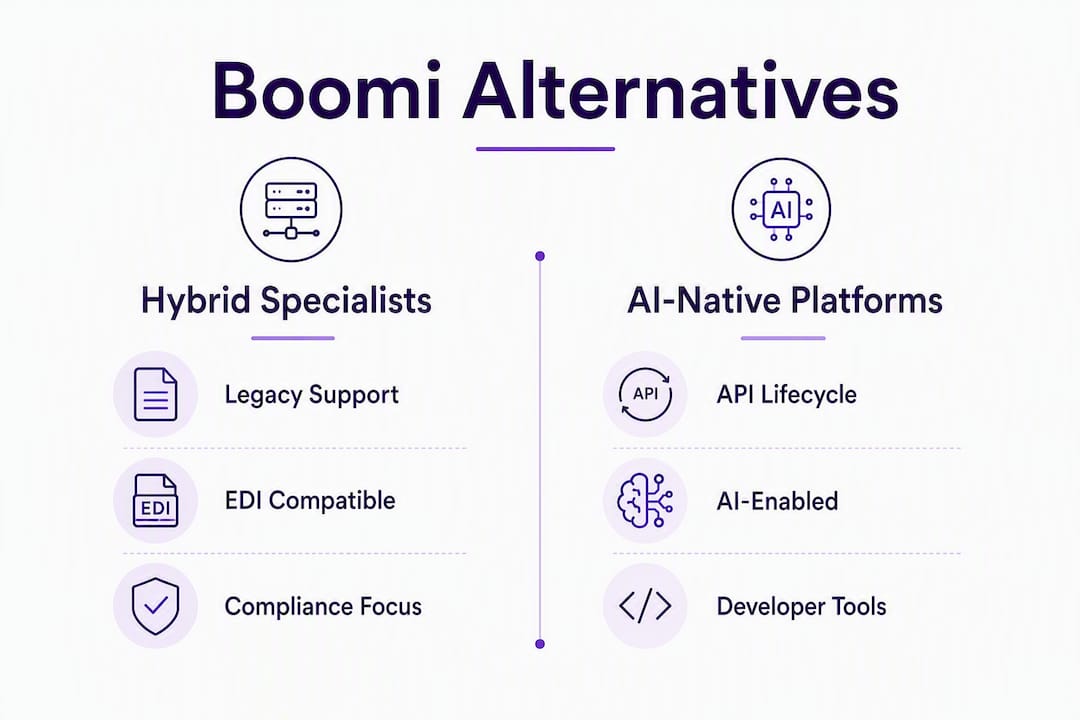
If your primary technical debt is legacy/EDI connectivity, start with hybrid specialists. If it’s API lifecycle and compliance automation, evaluate AI-native platforms first. Jundago maps to that second category.
How do you choose the right platform for your integration needs?
Picking the right replacement comes down to one discipline: match the platform to your primary technical debt, not to feature checklists or analyst quadrant position alone.
Step-by-step decision checklist:
- Map your primary integration patterns. Are you moving data between legacy ERPs and cloud apps, building governed APIs for external partners, or enabling business users to automate workflows? Each pattern favors a different category.
- Assess team skills. MuleSoft Anypoint rewards developer-heavy teams comfortable with Java and DataWeave. Workato suits ops teams who need low-code. AI-native platforms like Jundago reduce the skill burden on schema design and test authoring through generation.
- Define your regulatory scope. HIPAA, PCI DSS, Open Banking, and IEC 62443 each impose specific audit, encryption, and access-control requirements. Confirm the platform ships those controls, not just certifications.
- Set performance SLAs. Throughput, latency under load, and failover behavior vary significantly. Get benchmark data from the vendor for your specific workload profile.
- Calculate migration tolerance. Migration costs can be 40–60% of the original implementation investment, driven largely by proprietary mapping languages and connector rework. Factor that into your TCO model before signing.
Red flags to watch for in vendor proposals:
- Per-connector pricing with no cap: unchecked connector growth can add $5,000–$15,000 per new integration annually
- Proprietary transformation languages with no export path
- AI claims that can’t be demonstrated on your actual schema samples during a POC
- No hybrid runtime option for on-prem or private cloud workloads
- Vague SLA language that doesn’t specify per-region uptime
Questions to put in your RFP:
- Does the platform support full API lifecycle from schema generation through governance enforcement?
- How does the AI handle HL7 FHIR or PCI DSS schema generation specifically?
- What is the automated test coverage model, and can tests be version-controlled?
- How are governance policies enforced at runtime, not just at design time?
- Which compliance certifications are included versus add-on modules?
- What is the EDI readiness for X12 and EDIFACT transaction sets?
How long does migrating from Boomi actually take?
A realistic pilot runs 4–8 weeks; a full enterprise cutover typically takes 4–9 months, depending on connector count, custom mapping complexity, and compliance validation requirements.
Primary cost drivers:
- Training and professional services: — MuleSoft implementations typically run 6–8 months; Boomi itself averages 4–6 months; lighter automation platforms can deploy in 2–4 weeks. Your replacement timeline will generally be comparable to typical implementation durations.
Practical migration sequence:
Pro Tip: Don’t replicate your existing Boomi flows one-for-one. Fragile conditional mapping logic copied into a new platform is technical debt in the cloud. Use the migration as the forcing function to re-architect for API lifecycle patterns and, where applicable, agentic AI workflows.
What should enterprise buyers actually demand from API lifecycle and AI features?
The differentiator for regulated enterprises isn’t connector count. It’s whether the platform treats API generation, testing, and governance as a single governed workflow rather than three separate tools bolted together.
What to test in each lifecycle stage:
- Design and generate: Can the platform produce a valid HL7 FHIR or PCI DSS-compliant schema from a natural language prompt? Test this with your actual data models, not vendor-supplied samples.
- Automated testing: Does the platform generate test cases from the schema, or does a developer write them manually? Measure coverage percentage on a real endpoint.
- Governance enforcement: Are policies enforced at runtime with audit trails, or only flagged at design time? Request a live demonstration of policy violation capture.
- Audit and compliance: Can the platform produce an audit log that satisfies your compliance officer’s requirements without custom development?
Capability comparison: what to expect by platform type
| Capability | AI-native platform | Bolted-on AI (traditional iPaaS) | Traditional iPaaS (no AI) |
|---|---|---|---|
| Schema automation | Native, from natural language | Partial, template-based | Manual |
| Automated test generation | Built-in, schema-driven | Limited or add-on | Manual |
| Governance automation | Policy-as-code, runtime enforcement | Design-time only | Manual policy docs |
| Industry compliance modules | Shipped (HIPAA, PCI, Open Banking) | Certification only | Certification only |
| Audit trail depth | Full lifecycle, reproducible | Partial | Partial |
Analyst testing consistently shows a performance gap between native AI-enabled API lifecycle platforms and traditional iPaaS vendors adding AI as a feature layer. During your POC, test schema precision against real regulated data samples and measure false-positive rates on governance policy enforcement.
Trust signals to confirm during evaluation: published compliance certifications (SOC 2, HIPAA, PCI DSS), customer case studies from your industry vertical, access to a sandbox or POC environment, and a clear performance benchmark methodology the vendor will share.

Which alternative is right for your use case?

Jundago (AI-native API lifecycle)
Best for: Regulated enterprises in healthcare, finance, and manufacturing that need to generate, test, and govern APIs at scale with compliance built in.
- API Studio generates REST, GraphQL, gRPC, and SOAP APIs from natural language; GraphQL Studio adds AI-powered resolvers
- Command Center governs the full lifecycle across AWS, Azure, GCP, and Oracle Cloud with RBAC and ABAC controls
- Industry modules ship HIPAA, HL7 FHIR, PCI DSS, KYC/AML, Open Banking, and IEC 62443 compliance out of the box
- ETL/ELT integration studio covers DB-to-API, API-to-DB, and EDI integrations in one platform
Migration note: Moving from Boomi to Jundago is most efficient when you use the migration to re-architect rather than replicate. The AI-assisted schema generation reduces the manual rework that drives migration costs on other platforms.
MuleSoft Anypoint Platform (API-led enterprise)
Best for: Large organizations with mature API programs, heavy Salesforce or SAP dependencies, and dedicated integration engineering teams.
- Strong API design and management layer; deep connector library for enterprise ERPs
- Developer-heavy; DataWeave transformation language has a learning curve
Migration note: High implementation cost and timeline (typically 6–8 months). Proprietary DataWeave creates its own lock-in.
Informatica IICS (data governance)
Best for: Organizations where data quality, cataloging, and MDM are as important as application integration.
- Strongest data governance and lineage capabilities in the market
- Less suited to API lifecycle management as a primary use case
Migration note: Moderate complexity; best when data governance is the primary driver, not API delivery speed.
Workato (business-led automation)
Best for: Operations, finance, and HR teams running self-service workflow automation without heavy IT involvement.
- Low-code recipe model; fast time-to-value for business users
- Limited API lifecycle governance; per-recipe pricing scales unpredictably
Migration note: Fast initial deployment (2–4 weeks for scoped workflows), but not a fit for compliance-heavy API programs.
SnapLogic (hybrid/EDI specialist)
Best for: Enterprises with significant legacy system footprints and EDI transaction volumes needing cloud coexistence.
- Solid hybrid runtime; handles X12 and EDIFACT EDI well
- AI features are bolted-on; governance depth is limited compared to AI-native platforms
Azure Logic Apps (cloud-native automation)
Best for: Microsoft-stack organizations running lightweight workflow automation within Azure.
- Native Azure integration; consumption-based pricing keeps costs low for low-volume workflows
- Limited outside the Azure ecosystem; not suited for multi-cloud or regulated API lifecycle management
Managed integration services
Best for: Mid-market organizations without a staffed integration team that need predictable outcomes over platform ownership. Outcomes-based managed integration subscriptions remove the platform ops burden entirely, trading control for simplicity.
Migration note: Lowest internal effort; highest dependency on vendor execution quality.
Key Takeaways
Regulated enterprises evaluating Boomi alternatives should shortlist by primary technical debt first: AI-native API lifecycle platforms for compliance-driven API programs, hybrid specialists for legacy/EDI connectivity, and business-led automation only for non-regulated workflow use cases.
| Point | Details |
|---|---|
| Match platform to technical debt | Legacy/EDI needs favor hybrid specialists; API lifecycle and compliance needs favor AI-native platforms. |
| Migration costs are significant | Expect 40–60% of the original implementation cost; re-architect rather than replicate to avoid cloud-based technical debt. |
| Test AI claims in your POC | Bolted-on AI underperforms on complex schema design; test against real HIPAA or PCI DSS samples, not vendor demos. |
| Watch for pricing traps | Per-connector pricing can add substantial annual costs per integration; audit connector usage before renewal. |
| Jundago for regulated API programs | Jundago covers the full API lifecycle with native AI, industry compliance modules, and multi-cloud governance in one platform. |
What most integration evaluations get wrong
The evaluation mistake I see most often is treating the iPaaS selection as a feature comparison rather than an architectural decision. Teams spend weeks scoring connector counts and UI ratings, then discover six months into implementation that the platform’s governance model doesn’t satisfy their compliance officer, or that the AI features only work on simple flat schemas.
For regulated organizations, the sequence should be inverted: start with governance and compliance enforcement, then test AI-native schema generation against your actual data models, then assess migration complexity. Everything else is secondary.
The bimodal strategy is worth taking seriously. Many mature enterprise teams run a developer-first enterprise platform for core regulated systems and an AI-native platform for rapid departmental API delivery. That’s not a compromise; it’s a deliberate architecture choice that balances governance rigor with delivery velocity. The mistake is assuming one platform must do everything, which usually means it does nothing particularly well.
One more thing: the vendors who resist giving you sandbox access or a structured POC environment during evaluation are telling you something. Any platform confident in its AI-native claims should be able to demonstrate schema generation accuracy and governance enforcement on your data in under two weeks.
— vivek
Jundago covers the full API lifecycle for regulated enterprises
Regulated enterprises that need to generate, test, and govern APIs at scale with compliance built in from day one have a direct path with Jundago.
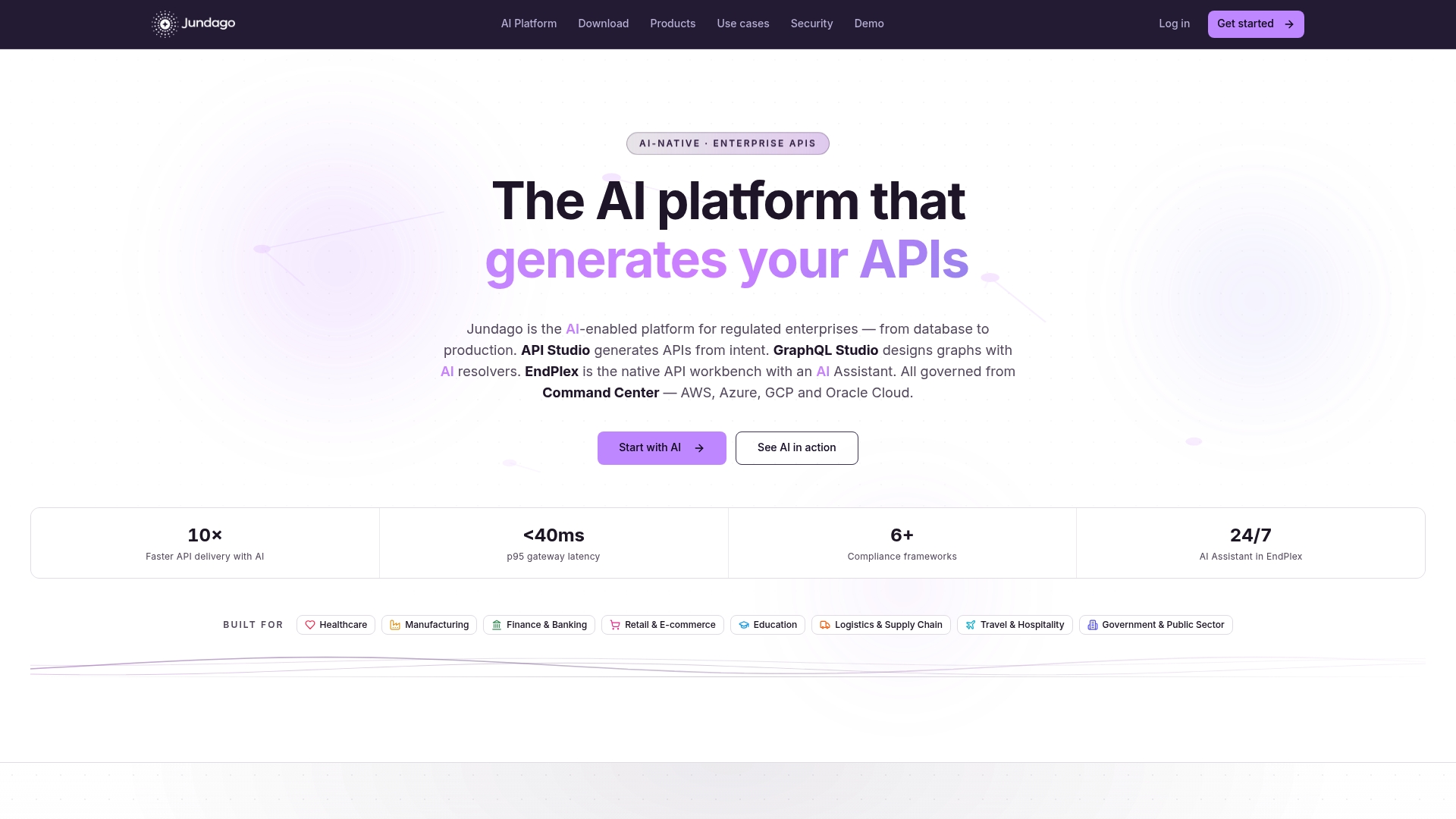
Jundago’s API Studio generates REST, GraphQL, gRPC, and SOAP APIs from natural language intent. GraphQL Studio adds AI-powered resolvers. EndPlex provides a native multi-cloud workbench. Command Center governs every API across AWS, Azure, GCP, and Oracle Cloud with RBAC and ABAC controls. Industry modules for HIPAA, PCI DSS, Open Banking, and IEC 62443 ship as part of the platform, not as add-ons you negotiate separately. The ETL/ELT integration studio handles EDI, DB-to-API, and API-to-DB integrations in the same governed environment.
If you’re running a vendor evaluation and want to stress-test those claims against your own compliance scenarios, request a POC at jundago.com. Bring a real schema, a real governance requirement, and a real data model. That’s the fastest way to know whether the platform fits.
Useful sources and further reading
- Top Boomi Enterprise Platform Alternatives & Competitors 2026 | Gartner Peer Insights — Verified buyer reviews comparing Boomi against alternatives across evaluation, deployment, and support dimensions.
- Top Boomi Competitors & Alternatives 2026 | Gartner Peer Insights (Data Integration Tools) — Market-level view of Boomi alternatives in the data integration tools category, including AWS, Workato, and Matillion.
- MuleSoft vs Boomi vs Workato vs Celigo vs SAP IS | knowledgelib.io — Comparative analysis covering implementation timelines, migration costs, and connector depth across major iPaaS platforms.
- Intelligent Assessments | Plans for Regulated Organizations — Third-party compliance assessment plans useful for vendor evaluation in regulated industries; relevant when building a structured POC scoring framework.