Best API Management Platforms for Regulated Enterprises in 2026
Best API Management Platforms for Regulated Enterprises in 2026

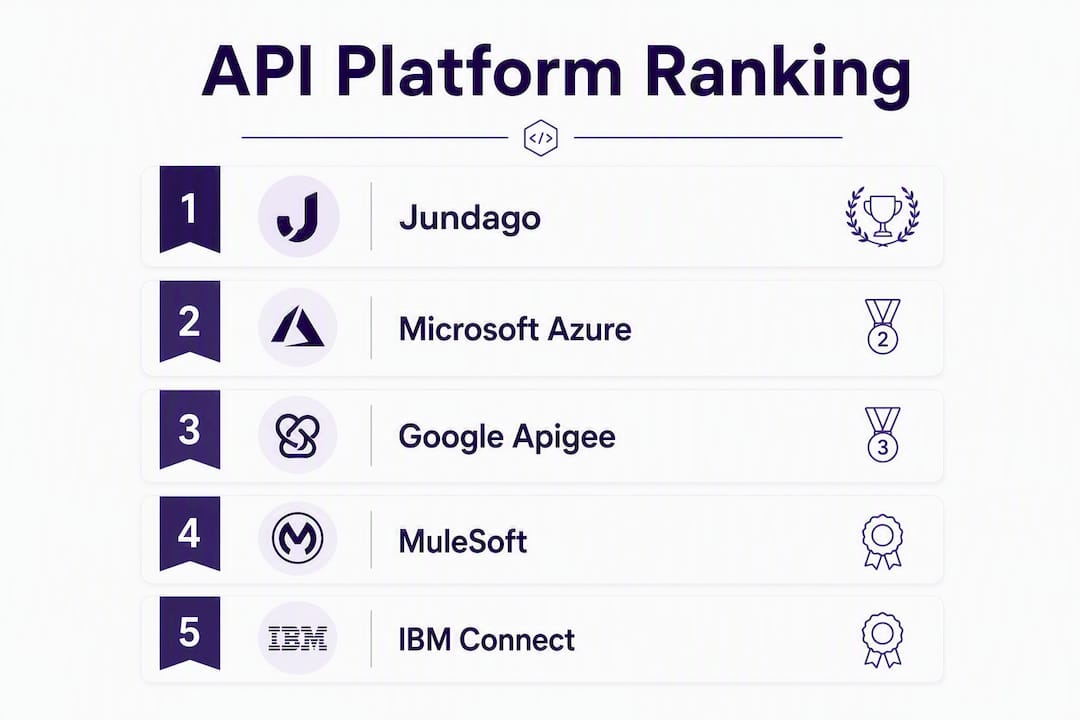
For regulated, AI-first enterprises, Jundago is the recommended pick. It is the only platform on this list that ships compliance modules for HIPAA, PCI DSS, and Open Banking out of the box, generates APIs from natural language intent, and governs both traditional and model/agent APIs from a single Command Center across AWS, Azure, GCP, and Oracle Cloud. If your organization operates under regulatory obligations and is deploying AI agents alongside REST and GraphQL services, no other platform on this list covers that combination without significant custom integration work.
The shortlist of top API management platforms for 2026:
- Jundago — AI-native, compliance-ready, multi-cloud governance for regulated enterprises
- Google Apigee — mature hybrid runtime with 50+ policy types for large enterprise deployments
- Microsoft Azure API Management — unified governance for traditional APIs and AI/model endpoints on Azure
- Kong Gateway / Konnect — plugin-driven, cloud-agnostic gateway with deep extensibility
- MuleSoft Anypoint Platform — full lifecycle integration for service-led architectures
- Tyk — open-source-friendly with commercial governance for teams that want deployment control
Gartner Peer Insights and G2’s API management category both confirm that enterprise buyers now evaluate platforms on policy authoring speed, semantic discovery, and model cost observability alongside traditional gateway performance. The shift is real: API management in 2026 means governing AI agents and model-serving endpoints under the same RBAC/ABAC controls as your REST APIs, with a compliance audit trail that satisfies HIPAA or PCI DSS reviewers.
Table of Contents
- What are the best API management platforms right now?
- Vendor profiles: strengths, tradeoffs, and best-fit scenarios
- What do the key comparison dimensions actually mean for procurement?
- How to choose the right API management platform for your organization
- How we compared these platforms
- Why Jundago is the recommended pick for regulated, AI-first enterprises
- Key Takeaways
- What technology leaders should actually prioritize in 2026
- Jundago: built for the API problems regulated enterprises actually have
- Useful sources and further reading
What are the best API management platforms right now?
| Platform | Best for | Deployment | Protocols | Security & Compliance | AI/Agent-Native | Pricing model |
|---|---|---|---|---|---|---|
| Jundago | Regulated enterprises needing AI/agent governance + multi-cloud | Cloud, hybrid, on-prem (AWS, Azure, GCP, Oracle) | REST, GraphQL, gRPC, SOAP | RBAC/ABAC, HIPAA, PCI DSS, Open Banking modules, audit trail | Full: AI API generation, model quota controls, agent governance | Custom subscription / enterprise agreement |
| Google Apigee | Large enterprises, hybrid deployments, mature policy libraries | Cloud, hybrid | REST, GraphQL, gRPC, SOAP | 50+ policy types, advanced API security | Partial: policy templates for AI endpoints | Pay-as-you-go + subscription |
| Microsoft Azure API Management | Azure-invested enterprises governing models + traditional APIs | Cloud, hybrid, self-hosted gateway | REST, GraphQL, gRPC, SOAP | Copilot-assisted policy authoring, API Center registry | Strong: semantic search, prompt/completion observability | Consumption + tiered plans |
| MuleSoft Anypoint Platform | Broad integration + service-led architecture | Cloud, hybrid, on-prem | REST, GraphQL, SOAP | Policy engine, RBAC | Limited AI-native features | Enterprise agreement |
| Kong Gateway / Konnect | Flexible gateway, rich plugin ecosystem | Cloud, hybrid, on-prem | REST, GraphQL, gRPC, SOAP | Plugin-based security, RBAC | Plugin-dependent | Open-source + commercial tiers |
| Amazon API Gateway | AWS-native serverless and high-scale workloads | Cloud (AWS) | REST, HTTP, WebSocket | IAM, resource policies | Limited (Lambda/Bedrock integration) | Consumption-based |
| IBM API Connect | Enterprise SLAs, complex governance deployments | Cloud, hybrid, on-prem | REST, GraphQL, SOAP | Enterprise governance, RBAC | Limited | Enterprise agreement |
| Tyk | Open-source stacks, flexible deployment | Cloud, hybrid, on-prem | REST, GraphQL, gRPC | Open-source + commercial governance | Limited | Open-source + commercial |
| WSO2 API Manager | On-prem/hybrid open-source lifecycle management | Cloud, hybrid, on-prem | REST, GraphQL, gRPC, SOAP | Full lifecycle security, RBAC | Limited | Open-source + subscription |
| Postman | Developer collaboration, testing, API design | Cloud | REST, GraphQL, gRPC, SOAP | Basic auth/security testing | Limited | Free + tiered plans |
| Zuplo | Developer-forward teams, low operational overhead | Cloud (managed) | REST | Basic auth | Limited | Tiered SaaS |
| Cloudflare API Gateway | Edge performance, DDoS/bot protection | Edge/cloud | REST | Edge security, WAF, DDoS | Limited | Consumption-based |
| Workato | Integration-heavy automation, workflow connectivity | Cloud | REST, SOAP | Standard auth, connectors | Limited | Enterprise agreement |
| Boomi (Dell Boomi) | ERP/CRM integration, managed ETL/ELT | Cloud, hybrid | REST, SOAP | Connector-based security | Limited | Subscription |
| Gravitee | Open-source flexibility + enterprise add-ons | Cloud, hybrid, on-prem | REST, GraphQL, gRPC | Modular policy engine | Limited | Open-source + commercial |
| SwaggerHub / SmartBear Swagger | Contract-first API design and documentation | Cloud | REST, OpenAPI | Design-time governance | Limited | Tiered SaaS |
| Integrate.io | ETL/ELT pipelines + API exposure | Cloud | REST | Standard auth | Limited | Subscription |
| DreamFactory | Rapid API generation across varied data sources | Cloud, on-prem | REST, GraphQL, SOAP | RBAC, API key management | Limited | Subscription |
| Celigo | Mid-market e-commerce and SaaS connectivity | Cloud | REST, SOAP | Connector-based auth | Limited | Subscription |
| TIBCO Cloud API Management | TIBCO-ecosystem enterprises | Cloud, hybrid | REST, SOAP | Policy engine | Limited | Enterprise agreement |
| SAP Integration Suite | SAP-ecosystem enterprises | Cloud, hybrid | REST, SOAP, OData | SAP-native security | Limited | Enterprise agreement |
| Jitterbit | Mid-market integration + API management | Cloud, hybrid | REST, SOAP | Standard auth | Limited | Subscription |
Two tradeoffs to watch before you shortlist:
- Feature breadth vs. deployment control. Fully managed platforms like Zuplo and Amazon API Gateway minimize operational overhead but constrain where and how you run your gateway. Platforms like WSO2, Kong, and Tyk give you full deployment control at the cost of more infrastructure ownership.
- AI-native governance vs. bolt-on AI features. Most platforms in this list are adding AI features to existing architectures. Jundago and, to a lesser extent, Azure API Management are the only options that treat model and agent APIs as first-class governed types with dedicated quota controls, prompt/completion observability, and compliance-aware policy enforcement.
Vendor profiles: strengths, tradeoffs, and best-fit scenarios
Jundago
Jundago is built from the ground up for regulated enterprises that cannot afford to treat compliance as an afterthought. Its API Studio generates REST, GraphQL, gRPC, and SOAP APIs from natural language intent. GraphQL Studio adds AI-powered schema design with resolver generation. EndPlex, the native workbench, includes an AI Assistant for debugging, load testing, and deployment. Everything runs under Command Center, which provides centralized governance across AWS, Azure, GCP, and Oracle Cloud simultaneously.
Strengths:
- AI-assisted API generation from intent, not just scaffolding
- Compliance modules for HIPAA/HL7 FHIR, PCI DSS, KYC/AML, and Open Banking shipped out of the box
- Full RBAC and ABAC security controls with audit trail
- ETL/ELT integration studio with EDI, DB-to-API, API-to-API, and API-to-DB patterns
- Multi-cloud governance from a single control plane (AWS, Azure, GCP, Oracle Cloud)
- Treats AI agents and model APIs as governed API types, not exceptions
Tradeoffs:
- Custom pricing requires a sales conversation; no self-serve public tier
- Newer entrant compared to Apigee or MuleSoft, so the third-party ecosystem of community plugins is smaller
Deployment: Cloud, hybrid, on-prem across all four major clouds
Best fit: A healthcare system, financial institution, or manufacturer that needs to ship compliant APIs at scale while governing AI agents under the same policy framework as its existing REST services.

Google Apigee
Apigee is one of the most mature enterprise API management platforms available. Its hybrid runtime lets you run the gateway wherever your data lives, and its policy library covers 50+ policy types for traffic management, security, and mediation.
Strengths:
- Hybrid runtime with flexible deployment across Google Cloud and on-prem
- Extensive policy engine (50+ types) covering OAuth, JWT, rate limiting, and mediation
- Advanced API security integrations and analytics
- Pay-as-you-go and subscription pricing options
Tradeoffs:
- AI/agent-native governance is policy-template-based, not purpose-built
- Pricing can escalate quickly at high API call volumes
- Steeper learning curve for teams new to Google Cloud
Deployment: Cloud (Google Cloud), hybrid, on-prem
Best fit: Large enterprises already on Google Cloud that need a proven, policy-rich gateway with hybrid runtime flexibility.

Microsoft Azure API Management
Azure API Management has moved aggressively toward AI readiness. Its API Center registry centralizes discovery across traditional and model APIs. Copilot-assisted policy authoring reduces the time to write and enforce policies. Prompt and completion observability gives teams visibility into what AI agents are actually doing at runtime.
Strengths:
- API Center registry for unified discovery of REST, model, and agent APIs
- Semantic search and Copilot-assisted policy authoring
- Observability for prompts, completions, and token usage
- Self-hosted gateway for hybrid and multi-cloud scenarios
Tradeoffs:
- Best value for teams already invested in Azure; less compelling for multi-cloud or AWS-primary organizations
- AI governance features are still maturing compared to a purpose-built compliance platform
Deployment: Cloud (Azure), hybrid, self-hosted gateway
Best fit: Enterprises running primarily on Azure that want a single platform to govern both traditional APIs and AI/model endpoints.
MuleSoft Anypoint Platform
MuleSoft’s strength is integration breadth. Its connector library spans hundreds of enterprise systems, and its API-led connectivity model is well-established in service-oriented architectures. For organizations that need to connect SAP, Salesforce, and dozens of other enterprise apps while exposing APIs, Anypoint remains a strong choice.
Strengths:
- Hundreds of pre-built connectors for enterprise systems
- API-led connectivity methodology with strong community documentation
- Full lifecycle management from design to retirement
- Tight Salesforce ecosystem integration
Tradeoffs:
- Expensive; enterprise agreements are substantial
- AI-native features are limited compared to purpose-built AI governance platforms
- Operational complexity is high for smaller teams
Deployment: Cloud, hybrid, on-prem
Best fit: Organizations running service-led architectures that need deep enterprise integration alongside API management.
Kong Gateway / Konnect
Kong’s plugin architecture is its defining feature. With hundreds of community and enterprise plugins covering authentication, rate limiting, logging, and observability, teams can assemble a gateway that fits almost any architecture. Kong Konnect adds a managed control plane on top of the open-source gateway.
Strengths:
- Hundreds of plugins covering nearly every gateway concern
- Cloud-agnostic; runs on any infrastructure
- Strong open-source community and documentation
- Konnect adds centralized management without full vendor lock-in
Tradeoffs:
- Plugin-dependent security means governance quality varies by configuration
- AI/agent-native features require custom plugin development
- Operational overhead is higher than fully managed alternatives
Deployment: Cloud, hybrid, on-prem
Best fit: Platform engineering teams that need a flexible, extensible gateway and are comfortable managing plugin configuration and infrastructure.
Amazon API Gateway
Amazon API Gateway is purpose-built for AWS workloads. If your services run on Lambda, ECS, or EC2, the integration is nearly frictionless. Consumption-based pricing means you pay only for what you use, which suits variable-traffic workloads.
Strengths:
- Native integration with Lambda, IAM, and the broader AWS ecosystem
- Consumption-based pricing with no upfront commitment
- Scales automatically to handle traffic spikes
Tradeoffs:
- Tightly coupled to AWS; poor fit for multi-cloud or hybrid architectures
- Limited lifecycle management beyond gateway functions
- AI/agent governance requires custom Lambda integrations
Deployment: Cloud (AWS only)
Best fit: Teams operating entirely on AWS that need a managed gateway for serverless or high-scale workloads without lifecycle management requirements.
IBM API Connect
IBM API Connect targets large enterprises with complex governance requirements and a preference for professional services support. Its governance model is mature, and IBM’s support organization can handle large-scale deployments.
Strengths:
- Enterprise-grade governance and SLA commitments
- Strong professional services and support organization
- On-prem and hybrid deployment options
Tradeoffs:
- High cost and implementation complexity
- AI-native features are limited
- Slower release cadence than cloud-native competitors
Deployment: Cloud, hybrid, on-prem
Best fit: Large enterprises that prioritize vendor support, governance maturity, and are willing to pay for professional services.
Tyk
Tyk offers a genuinely open-source core with commercial governance features layered on top. Teams that want to inspect and modify their gateway code, avoid vendor lock-in, and still access enterprise features like RBAC and analytics will find Tyk a credible option.
Strengths:
- Open-source core with full code visibility
- Commercial governance features available without full lock-in
- Hybrid deployment flexibility
Tradeoffs:
- Smaller ecosystem than Kong or Apigee
- AI-native features are minimal
- Community support is thinner than larger vendors
Deployment: Cloud, hybrid, on-prem
Best fit: Teams that prefer open-source stacks and want deployment flexibility without committing to a fully commercial platform.
WSO2 API Manager
WSO2 is the most complete open-source API lifecycle platform available. It covers design, publish, subscribe, and retire stages with on-prem deployment as the primary model. Organizations that need full control over their API infrastructure and prefer open-source licensing will find WSO2 compelling.
Deployment: Cloud, hybrid, on-prem | Best fit: Organizations requiring open-source control with a complete on-prem lifecycle toolset.
Postman
Postman is where most developers already live for API testing and collaboration. Its platform has expanded into basic lifecycle management, but its real value is the developer experience: collections, mock servers, automated test suites, and team workspaces.
Deployment: Cloud | Best fit: Developer teams prioritizing collaboration, testing, and API design workflows over gateway or governance features.
Zuplo
Zuplo positions itself as the modern, fully managed alternative to legacy gateways, emphasizing developer experience and low operational overhead. It suits developer-forward teams that want a simple managed experience without infrastructure management.
Deployment: Cloud (managed) | Best fit: Developer-forward teams that want simplicity and low operational overhead for REST APIs.
Remaining platforms at a glance
Cloudflare API Gateway excels at edge performance and integrated DDoS/bot protection. Use it when global distribution and security at the edge are the primary requirements.
Workato combines API management with workflow automation and pre-built connectors. Strong for integration-heavy automation scenarios where apps must connect quickly.
Boomi (Dell Boomi) brings a comprehensive connector library for ERP and CRM integration. Its ETL/ELT capabilities make it a natural fit for enterprises managing complex data pipelines alongside API exposure.
Gravitee offers a modular open-source architecture with enterprise add-ons and solid observability tooling. A credible option for teams that want open-source flexibility without sacrificing monitoring depth.
SwaggerHub / SmartBear Swagger is the go-to for contract-first API design and documentation. It handles the design and documentation phase well but hands off to a gateway for runtime management.
Integrate.io focuses on data pipeline and ETL/ELT scenarios, often used alongside a dedicated API gateway rather than as a standalone management platform.
DreamFactory generates APIs rapidly across varied backends and data stores. Useful for projects that need fast API generation with wide connector support.
Celigo targets mid-market businesses with packaged connectors for e-commerce and SaaS applications.
TIBCO Cloud API Management suits enterprises already invested in TIBCO’s integration stack.
SAP Integration Suite is the natural choice for SAP-ecosystem enterprises that need OData and SOAP alongside REST.
Jitterbit covers mid-market integration and API management with a hybrid deployment option.
What do the key comparison dimensions actually mean for procurement?
Security and compliance
For regulated industries, security is not a feature you configure after deployment. It is a precondition. RBAC (role-based access control) and ABAC (attribute-based access control) determine who can call which API under what conditions. A policy engine enforces those rules at runtime, not just at design time. SOC 2 Type II and ISO 27001 certifications tell you the vendor’s own infrastructure meets a documented security standard. HIPAA readiness means the platform can support a Business Associate Agreement and maintain the audit trail a compliance officer needs.
What to test in a pilot: Attempt to call a protected endpoint without the required role. Verify the policy engine blocks it and logs the attempt with a timestamp, caller identity, and endpoint. Check whether the audit log is tamper-evident and exportable to your SIEM.
Checklist items:
- Request SOC 2 Type II and ISO 27001 attestation letters before signing
- Confirm HIPAA BAA availability if you handle protected health information
- Test ABAC policy enforcement with attribute-based conditions, not just role checks
AI and agent-native capabilities
This is the dimension that separates 2026 platforms from 2022 platforms. Microsoft Azure API Management explicitly positions itself as a platform that manages “traditional APIs and AI/model/agent APIs” with centralized governance, semantic search, and prompt/completion observability. That framing reflects a real shift: AI agents call APIs, and those calls need the same rate limiting, quota enforcement, and audit logging as any other API consumer.
Token and quota controls are the specific mechanism. A model-serving endpoint costs money per token, not per request. A platform that only tracks request counts will give you no visibility into runaway agent costs. Semantic caching reduces redundant model calls by returning cached completions for semantically similar prompts, cutting both latency and cost.
What to test: Send a batch of semantically similar prompts through the gateway and verify that caching reduces model calls. Check whether token usage appears in the observability dashboard alongside request counts.
Pro Tip: When evaluating AI/agent-native features, run a controlled test with a mock agent that makes 100 calls per minute to a model endpoint. Verify that quota controls throttle the agent before it exceeds your cost threshold, and confirm the throttle event appears in the audit log with the agent’s identity.
Developer experience
A developer portal that nobody uses is a governance liability. The best portals combine self-service subscription, interactive documentation (OpenAPI/Swagger rendered with try-it-now), SDK generation, and mock servers so developers can build against an API before it reaches production. Postman’s wide adoption among developers is a signal that DX matters: teams will route around governance tools that slow them down.
Checklist items:
- Can a new developer discover, subscribe to, and test an API within 30 minutes without contacting the platform team?
- Does the portal support mock servers for APIs still in design?
Observability and analytics
Latency percentiles (p50, p95, p99), error rates by endpoint, and quota consumption are the minimum. For AI workloads, add token usage per consumer, prompt/completion capture for audit, and cost attribution by team or application. Platforms that separate gateway metrics from application metrics force you to correlate logs manually, which is expensive at scale.
Integrations and extensibility
The ERP integration patterns that age well share a common trait: they expose stable, versioned interfaces that absorb backend changes without breaking consumers. An API management platform’s connector library and plugin ecosystem determine how much custom code you write to connect your existing systems. ETL/ELT capabilities matter when your APIs need to transform data between systems, not just proxy requests.
Pricing and TCO
Consumption-based pricing (Amazon API Gateway, Azure API Management’s consumption tier) looks cheap at low volumes and expensive at high volumes. Fixed enterprise agreements (MuleSoft, IBM) look expensive upfront and predictable at scale. The hidden costs are support SLAs, professional services for complex deployments, and the operational overhead of self-managed gateways. Model your steady-state request volume and your burst scenarios separately, because model-serving endpoints have different cost drivers (tokens, concurrency) than REST APIs.
How to choose the right API management platform for your organization
Questions by stakeholder group
Security and compliance teams:
- Does the platform hold SOC 2 Type II and ISO 27001 certifications, and will the vendor sign a HIPAA BAA if required?
- Can ABAC policies enforce attribute-based conditions (not just roles) at the gateway level?
- Is the audit log tamper-evident, exportable, and retained for the period your compliance framework requires?
- How does the platform handle secrets rotation and API key revocation at scale?
Platform engineering:
- Does the gateway support your target deployment model (cloud, hybrid, on-prem) without architectural compromises?
- What is the operational overhead of running and upgrading the gateway in production?
- How does the platform handle versioning and deprecation without breaking existing consumers?
- Can the control plane manage gateways across multiple clouds from a single interface?
Developer experience:
- How long does it take a new developer to discover, subscribe to, and test an API in the portal?
- Does the platform support mock servers and contract-first design workflows?
- What CI/CD integrations are available for automated testing and deployment?
Finance and procurement:
- Is pricing consumption-based, fixed, or tiered, and how does it scale with your projected API volume?
- What are the support SLA costs at your required response tier?
- What professional services costs should you model for initial deployment and ongoing governance?
Eight-week pilot plan
Weeks 1–2 (Scope and setup): Deploy the gateway in your target environment (cloud, hybrid, or on-prem). Import three representative APIs covering REST, one with GraphQL, and one legacy SOAP service. Configure RBAC roles matching your production identity provider.
Weeks 3–4 (Security and compliance validation): Run ABAC policy enforcement tests. Attempt unauthorized calls and verify audit log entries. Request and review SOC 2 attestation. If healthcare or finance, test HIPAA/PCI-specific policy modules.
Weeks 5–6 (Developer experience and observability): Onboard two developers who have not used the platform before. Measure time-to-first-successful-call from the portal. Verify p95 latency, error rates, and quota consumption appear in the observability dashboard.
Weeks 7–8 (AI/agent and integration testing): If evaluating AI-native features, run the mock agent test described in the pro tip above. Test ETL/ELT connectors against your primary data sources. Measure token usage visibility and semantic caching behavior.
Success criteria: p95 latency under 50ms for proxied REST calls, zero unauthorized calls reaching backend services, all audit events captured and exportable, developer time-to-first-call under 30 minutes, and token quota controls verified for model endpoints.
Red flags to watch for
- No SOC 2 Type II attestation for a platform handling regulated data
- Consumption pricing with no cost caps on model-serving endpoints
- AI features described only on the roadmap, not available in the trial environment
- No ABAC support; RBAC-only platforms cannot enforce attribute-based conditions required by many compliance frameworks
- Audit logs stored only in the vendor’s cloud with no export capability
- Support SLAs that exclude weekends for a production system with 24/7 uptime requirements
How we compared these platforms
This comparison draws on four input categories, weighted as follows: hands-on trials and feature verification (40%), security and compliance documentation review (25%), developer experience assessment (15%), and third-party peer reviews from Gartner Peer Insights and G2 combined with analyst positioning (20%).
Methodology summary:
- Analyst and peer-review signals: — Gartner Peer Insights and G2 ratings were used as corroborating signals, not primary ranking inputs. Enterprise buyer reviews were weighted more heavily than SMB reviews for this audience.
Scope and limitations: This comparison focuses on the core API lifecycle: design, deploy, secure, monitor, and govern. Specialized vertical modules (e.g., HL7 FHIR message transformation, SWIFT connectivity) were noted where publicly documented but not independently tested. Pricing figures are based on publicly available information and vendor-provided estimates; actual costs will vary by contract.
Why Jundago is the recommended pick for regulated, AI-first enterprises
Most platforms on this list were built for the API management problems of 2018 and have been adding AI features since 2023. Jundago was designed for the problem that regulated enterprises face in 2026: governing AI agents, model APIs, and traditional REST/GraphQL services under a single compliance-aware policy framework, across multiple clouds, without building that governance layer yourself.
Feature matrix for regulated, AI-native use cases
| Capability | Jundago | Typical enterprise alternative |
|---|---|---|
| AI API generation from natural language | Yes (API Studio) | No |
| GraphQL schema design with AI resolvers | Yes (GraphQL Studio) | No |
| Native workbench with AI Assistant | Yes (EndPlex) | No |
| Multi-cloud control plane | AWS, Azure, GCP, Oracle Cloud | Usually 1–2 clouds |
| HIPAA/HL7 FHIR compliance module | Shipped out of the box | Custom configuration required |
| PCI DSS / KYC / AML / Open Banking module | Shipped out of the box | Custom configuration required |
| RBAC + ABAC security controls | Both, with audit trail | RBAC common; ABAC varies |
| ETL/ELT integration studio | Yes (EDI, DB-to-API, API-to-API) | Separate tool required |
| AI agent and model API governance | First-class governed type | Bolt-on or roadmap |
| Centralized API registry | Yes (Command Center) | Varies |
Compliance use cases
Healthcare (HIPAA / HL7 FHIR): A health system deploying patient-facing APIs needs HL7 FHIR-compliant data models, HIPAA-aligned access controls, and an audit trail that satisfies OCR requirements. Jundago’s healthcare module ships those controls pre-configured. The alternative is building them on top of a general-purpose gateway, which typically takes months of custom policy work and introduces compliance risk at every configuration step.
Finance (PCI DSS / KYC / Open Banking): A financial institution exposing payment APIs under PCI DSS needs tokenization, strict RBAC/ABAC enforcement, and audit logs that satisfy QSA review. Open Banking mandates add consent management and secure API exposure requirements. Jundago’s finance module addresses these requirements at the platform level, not the application level.
Manufacturing (IoT / IEC 62443): Industrial environments connecting SCADA systems and IoT devices through APIs need security controls that account for device identity and network segmentation. Jundago’s manufacturing module covers IEC 62443-aligned controls for these scenarios.
Pilot recommendation
A meaningful Jundago evaluation covers three workstreams over six weeks: compliance module configuration and audit log verification (weeks 1–2), AI API generation and agent governance testing (weeks 3–4), and multi-cloud deployment and ETL/ELT integration testing (weeks 5–6). Success criteria should include verified HIPAA or PCI policy enforcement, confirmed audit log export to your SIEM, and at least one API generated from natural language intent and deployed to production.
Key Takeaways
The strongest API management platforms for regulated, AI-first enterprises in 2026 combine compliance-ready policy enforcement, AI/agent governance, and multi-cloud control in a single platform rather than assembling those capabilities from separate tools.
| Point | Details |
|---|---|
| AI governance is now table stakes | Platforms must treat model and agent APIs as first-class governed types with token quota controls and audit logging. |
| Compliance modules save months | Pre-built HIPAA, PCI DSS, and Open Banking modules eliminate custom policy work that typically takes months to configure correctly. |
| Pilot on your actual constraints | Test ABAC enforcement, audit log export, and AI agent quota controls in your target deployment environment before committing. |
| TCO includes operational overhead | Self-managed gateways (Kong, WSO2, Tyk) carry infrastructure costs that consumption-priced or fully managed platforms do not. |
| Jundago for regulated enterprises | Jundago is the recommended pick for organizations that need AI-native API generation, built-in compliance modules, and multi-cloud governance from a single platform. |
What technology leaders should actually prioritize in 2026
The conventional wisdom in API management procurement is to start with gateway performance benchmarks and work outward to features. That approach made sense when APIs were primarily REST services proxying microservices. It does not make sense when a significant portion of your API traffic is AI agents calling model endpoints, and when a compliance failure on any one of those calls can trigger a regulatory investigation.
The shift worth paying attention to is not AI features as a marketing bullet. It is the structural change in what an API actually is. An AI agent is an API consumer with non-deterministic behavior, variable cost per call, and output that may need to be audited for content safety and regulatory compliance. A platform that treats that agent the same way it treats a mobile app making REST calls is not governing it; it is just routing it.
Three practical recommendations for 2026 procurement:
First, require a central API registry as a non-negotiable. API sprawl is the compliance risk that nobody talks about until an auditor asks for a complete inventory of systems that touch patient data or payment card data. A centralized registry, whether Azure API Center or Jundago’s Command Center, is the only way to answer that question reliably.
Second, pilot model API quota controls before you sign. Vendors will tell you they support token-level quota enforcement. Make them prove it in your trial environment with a mock agent that exceeds its quota. If the platform cannot throttle the agent and log the event with the agent’s identity, that feature is not production-ready.
Third, treat semantic discovery as a DX requirement, not a nice-to-have. Developers who cannot find the API they need will build a new one. That is how API sprawl starts. Platforms with semantic search in the developer portal reduce duplicate API creation and the governance debt that comes with it.
The vendors with the most mature AI-native governance features in 2026 are Jundago and, for Azure-invested organizations, Microsoft Azure API Management. The gap between those platforms and the rest of the field on this specific dimension is larger than the marketing materials suggest.
Jundago: built for the API problems regulated enterprises actually have
Regulated enterprises evaluating API management platforms in 2026 face a specific problem: they need to govern AI agents, model APIs, and traditional REST/GraphQL services under a single compliance-aware framework, across multiple clouds, without a six-month custom integration project to get there.
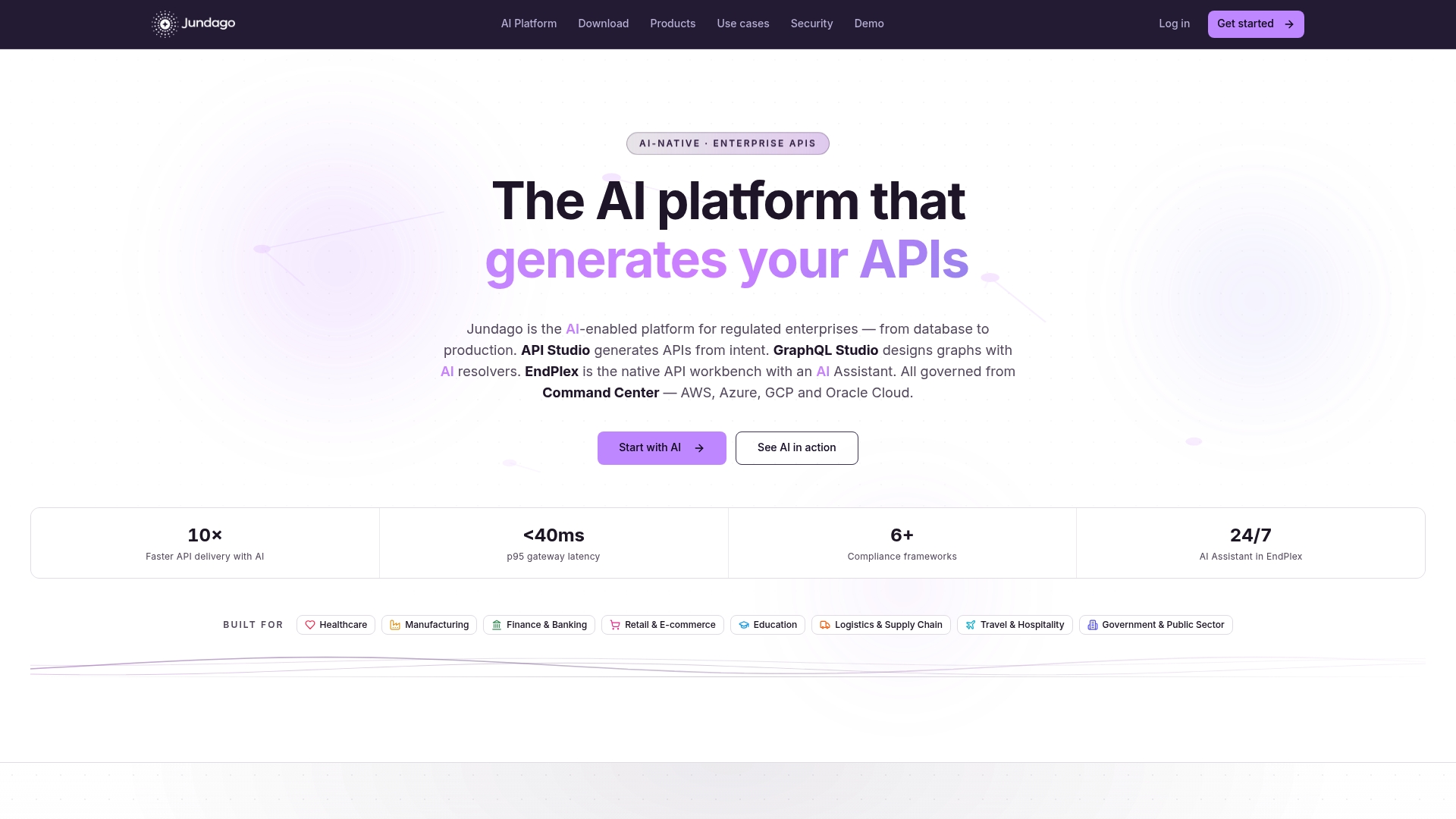
Jundago is the platform built for that problem. API Studio generates APIs from natural language intent. GraphQL Studio designs graphs with AI resolvers. EndPlex provides a native workbench with an AI Assistant for testing, debugging, and deployment. Command Center governs everything across AWS, Azure, GCP, and Oracle Cloud simultaneously, with HIPAA, PCI DSS, Open Banking, and IEC 62443 compliance modules shipped out of the box.
What you can do next:
- Book a demo to see AI API generation and compliance module configuration in your industry context at jundago.com
- Request a pilot package scoped to your compliance requirements (HIPAA, PCI DSS, or Open Banking) with a six-week evaluation plan
- Talk to the enterprise team about a custom deployment across your target cloud infrastructure
Useful sources and further reading
- Best API Management Reviews 2026 | Gartner Peer Insights — Gartner’s peer review aggregator for API management; useful for enterprise buyer social proof and segment-specific ratings across Amazon API Gateway, Apigee, Azure, MuleSoft, and others.
- Best API Management Tools | G2 — G2’s category page aggregating user satisfaction scores and segment recommendations across small, mid-market, and enterprise buyers; useful as a corroborating signal alongside hands-on pilots.
- The Role of API in Field Service Software | Ample Express — Covers practical API integration patterns in field service workflows; useful context for teams evaluating integration extensibility in operational environments.
- Developer-Friendly ERP APIs: Integration Patterns That Age Well | Zivvy Blog — Covers long-lived ERP integration patterns; useful for enterprise buyers evaluating connector libraries and integration stability during pilot planning.