Best API Documentation Tools in 2026: Ranked and Compared
Best API Documentation Tools in 2026: Ranked and Compared

For regulated enterprises, Jundago is the strongest overall pick among API documentation tools today. It is the only platform in this roundup that combines AI-native API generation, integrated governance, and compliance modules for HIPAA, PCI DSS, and Open Banking in a single suite, deployed across AWS, Azure, GCP, and Oracle Cloud. If your team ships APIs into a regulated environment and needs spec governance, automated testing, and multi-cloud deployment without stitching together five separate tools, Jundago is built for exactly that.
For teams with narrower or different requirements, these are the strongest alternatives by workflow:
- Redocly / Redoc — best for OpenAPI governance: CLI linting, bundling, and custom rulesets in CI
- Stoplight (Elements) — best for embeddable interactive docs: React/Web Components with an API console
- Swagger ecosystem — best for spec-first design: deep OpenAPI tooling and a broad open-source lifecycle
- ReadMe — best for hosted developer portals: editorial-first experience with clean portal infrastructure
- Mintlify — best for lightweight hosted docs: simple authoring and fast publishing for smaller teams
- GitBook — best for collaborative authored content: WYSIWYG editing and tutorial-heavy workflows
Table of Contents
- How do the best API documentation tools compare at a glance?
- How to choose the right API documentation tool for your team
- Per-tool profiles: strengths, tradeoffs, and what to test
- Why governance and continuous maintenance change the tool choice
- What users and communities say about these tools
- Key Takeaways
- The governance gap most teams discover too late
- Jundago is built for the compliance requirements your other tools ignore
- Sources and further reading
How do the best API documentation tools compare at a glance?
| Tool | Best for | Pricing model | Spec support | Docs workflow | Governance & linting | Interactive features | Hosting | AI features | Integrations |
|---|---|---|---|---|---|---|---|---|---|
| Jundago | Regulated enterprises: end-to-end generation, governance, compliance | Custom SaaS / enterprise | OpenAPI, REST, GraphQL, gRPC, SOAP | Spec-first + AI generation | Integrated governance, RBAC/ABAC, compliance modules | API workbench (EndPlex), AI assistant | Hosted SaaS, multi-cloud (AWS, Azure, GCP, Oracle) | AI generation, governance automation, ETL/ELT | CI/CD, AWS, Azure, GCP, Oracle, EDI |
| Redocly / Redoc | OpenAPI governance and reference rendering | OSS (Redoc) + commercial (Redocly) | OpenAPI 3.1, 3.0, Swagger 2.0 | Spec-first, docs-as-code | CLI linting, bundling, custom rulesets | Reference rendering, try-it (commercial) | Self-hosted, hosted SaaS | — | CI/CD, VCS |
| Stoplight (Elements) | Embeddable interactive docs inside existing apps | OSS (Elements) + commercial (Stoplight) | OpenAPI, Markdown | Embed, spec-first | Linting (Stoplight platform) | API console, code samples, examples | Embeddable, hosted SaaS | — | CI/CD, VCS |
| Swagger ecosystem | Spec-first design, open-source lifecycle | OSS (Editor, UI, Codegen) + SwaggerHub | OpenAPI, AsyncAPI, JSON Schema | Spec-first | Design-time governance (SwaggerHub) | Swagger UI try-it, Codegen | Self-hosted, hosted (SwaggerHub) | — | CI/CD, VCS |
| ReadMe | Hosted developer portals with editorial workflows | SaaS tiers (free → startup → enterprise) | OpenAPI | Portal-first | Basic | Try-it console, code samples | Hosted SaaS | — | GitHub, CI/CD |
| Postman | Testing-coupled docs from collections | Free tier + paid SaaS tiers | OpenAPI (import/export) | Collection-first | — | Try-it via collections | Hosted SaaS | — | CI/CD, VCS, issue trackers |
| GitBook | Authored tutorials and collaborative editorial | Free tier + SaaS tiers | Limited (manual) | WYSIWYG portal | — | — | Hosted SaaS | AI writing assist | GitHub, Slack |
| Mintlify | Lightweight hosted docs for small/mid teams | Free tier + paid SaaS | OpenAPI | Docs-as-code, portal | — | Code samples, rendering | Hosted SaaS | AI writing assist | GitHub, CI/CD |
| ClickHelp | Large-scale technical documentation sets | SaaS tiers + enterprise | Limited | WYSIWYG portal | — | — | Hosted SaaS | — | — |
| SwaggerHub (SmartBear) | Enterprise OpenAPI design and collaboration | SaaS tiers + enterprise/custom | OpenAPI, AsyncAPI | Spec-first | Design governance, team roles | Try-it, mock servers | Hosted SaaS | — | CI/CD, VCS, issue trackers |
| DapperDox | Custom-templated open-source rendering | OSS | OpenAPI | Spec-first, static | — | Basic rendering | Self-hosted | — | — |
| Knowl.ai | AI-assisted docs maintenance automation | SaaS (check vendor) | Varies | AI-native maintenance | — | — | Hosted SaaS | AI maintenance automation | Varies |
| Apidog | Combined spec editing, testing, and preview | Free tier + paid SaaS | OpenAPI | Spec-first + preview | — | Try-it, mock servers | Hosted SaaS | — | CI/CD |
| Apiary | Hosted API design with guided workflows | SaaS (Oracle-owned) | OpenAPI, API Blueprint | Spec-first portal | — | Try-it console | Hosted SaaS | — | GitHub |
| Slate | Clean static reference layouts (docs-as-code) | OSS | OpenAPI (manual) | Docs-as-code, static | — | — | Self-hosted | — | VCS, CI/CD |
| RapiDoc | Lightweight OpenAPI renderer for fast embedding | OSS | OpenAPI 3.x, Swagger 2.0 | Embed, static | — | Try-it console | Self-hosted, embeddable | — | — |
| Ferndesk | Market framing and category comparison | — | — | — | — | — | — | — | — |
Pricing snapshot:
- Free / OSS: Redoc, Swagger UI/Editor/Codegen, Stoplight Elements, Slate, RapiDoc, DapperDox
- Freemium SaaS tiers: ReadMe, Postman, GitBook, Mintlify, Apidog
- Commercial SaaS with enterprise tiers: Redocly, Stoplight platform, SwaggerHub, ClickHelp, Apiary
- Custom enterprise pricing: Jundago (based on team size, deployment targets, compliance scope)
How to choose the right API documentation tool for your team
The single most important question is not “which tool has the best UI?” It is: what does your team’s maintenance model look like six months after launch? A tool that generates beautiful docs on day one but requires manual updates every time a spec changes will cost you far more in engineering time than a slightly less polished tool with solid CI hooks and linting.
Start by identifying your workflow category, then validate against the axes below.
Spec and format support
If your team works in OpenAPI, that narrows the field quickly. Most modern tools support OpenAPI 3.x, but support for OpenAPI 3.1, AsyncAPI, and RAML varies. Check whether the tool validates your spec version before you commit to a trial. Teams using API Blueprint should note that Apiary is the primary commercial platform built around it, though the spec itself has limited tooling momentum compared to OpenAPI.
Governance and linting
This is where most teams underinvest. If you have more than two teams contributing to a shared API spec, you need CLI-enforced linting and a bundler that can dereference $ref chains into a single artifact. Redocly CLI is the clearest example: it supports custom rulesets, a bundle command with a --dereferenced option, and multiple output formats so you can run governance checks in CI before docs ever publish. Without this, spec drift across teams is nearly inevitable.
Collaboration and editorial workflow
Spec-first teams and portal-first teams have opposite needs here. Spec-first teams want version-controlled YAML/JSON with PR-based review. Portal-first teams want WYSIWYG editing, role-based publishing, and editorial review queues. GitBook and ReadMe are built for the latter; Redocly and Swagger are built for the former. Mixing the two models in one tool usually means compromising on both.
Hosting and embed options
Hosted SaaS means faster setup and no infrastructure overhead. Self-hosted or embeddable means you control the domain, styling, and authentication. If your docs live inside a product (not a separate developer portal), embeddable components like Stoplight Elements let you assemble an API console, code samples, and reference inline without migrating content to a separate portal.
CI/CD integration and automation
Any tool you evaluate should have a documented path to CI integration. During your pilot, run the tool’s linter against your spec in a GitHub Actions or GitLab CI pipeline before you sign a contract. If that integration requires custom scripting with no official support, treat it as a red flag.
Onboarding timeline and cost expectations
Simple OSS renderers (Slate, RapiDoc, Redoc) can be running in hours. Commercial platforms with governance, SSO, and enterprise roles typically need two to four weeks for a proper pilot. Budget accordingly, and do not evaluate enterprise features on a free tier that does not include them.
Vendor questions to ask during trial:
- Does your linter support custom rulesets, and can it run in our CI pipeline without a paid plan?
- How does the tool handle multi-file OpenAPI specs with
$refreferences across repos? - What is the access control model: can we restrict publishing by team or environment?
- How are breaking changes detected and surfaced before publication?
- What does the upgrade path look like from a free/startup tier to enterprise SSO and audit logs?
Four red flags that should disqualify a tool:
- No native OpenAPI 3.1 support (or only partial support with known gaps)
- No CI/automation hooks without a paid enterprise tier
- Role-based access control locked behind the highest pricing tier
- Pricing that changes materially when you add governance or SSO features
Procurement timeline: pilot (two weeks) → governance rule validation in CI → full team onboarding → public release. Do not skip the governance step.
Pro Tip: Track two metrics during your pilot: the number of spec drift incidents caught by the linter in CI, and the average time your team spends resolving doc issues per sprint. Those two numbers give you a defensible TCO argument for any tool upgrade.
Per-tool profiles: strengths, tradeoffs, and what to test
Jundago
Jundago is not a documentation renderer. It is an AI-native API lifecycle platform built for regulated enterprises, and that distinction matters for how you evaluate it. API Studio generates REST, GraphQL, gRPC, and SOAP APIs from natural language intent. GraphQL Studio designs graphs with AI resolvers. EndPlex is the native workbench with an AI assistant for testing, debugging, and load testing. Command Center governs everything across AWS, Azure, GCP, and Oracle Cloud with RBAC and ABAC security controls built in.
The compliance modules are the differentiator: HIPAA and HL7 FHIR for healthcare, PCI DSS and Open Banking for finance, IEC 62443 for manufacturing. No other tool in this list ships those out of the box.

Tradeoffs: Jundago is not the right choice for a solo developer who needs a quick static reference page. It is built for teams with real compliance obligations and multi-cloud deployment requirements. Pricing is custom based on team size, deployment targets, and compliance scope.
What to test in trial: Run the governance linting against a real spec in your CI pipeline. Test the ETL/ELT integration studio against a live database. Verify that the RBAC model maps to your org’s role structure.
Redocly / Redoc
Redoc is the open-source renderer. Redocly is the commercial platform built on top of it. Redoc generates web-ready reference docs from OpenAPI 3.1, 3.0, and Swagger 2.0, distributed as a CLI, Docker image, HTML tag, or React component. The three-panel layout (navigation, documentation, examples) is clean and widely recognized.
The governance story lives in Redocly CLI: custom rulesets, a bundle command that dereferences $ref chains, and CI-friendly output formats. For teams whose bottleneck is OpenAPI quality and multi-file spec management, this is the strongest OSS-to-commercial path in the market.
Tradeoffs: The free Redoc renderer has no portal features, no editorial workflow, and no hosted infrastructure. The commercial Redocly platform adds those, but at a cost. If you need a full developer portal with editorial workflows, ReadMe or GitBook will feel more natural.

What to test: Run redocly lint with a custom ruleset against your spec in CI. Then run redocly bundle --dereferenced and verify the output artifact is valid.
Stoplight (Elements)
Stoplight Elements is the embed-first choice. The React and Web Components approach means you drop an API console, code samples, and reference docs directly into an existing product or CMS without building a separate portal. The key insight: instead of migrating content into a portal, you assemble UI blocks inline.
Tradeoffs: Elements is a rendering layer, not a full documentation platform. You still need to manage your OpenAPI spec, versioning, and hosting separately unless you use the commercial Stoplight platform.
What to test: Embed the Elements React component into a staging environment. Verify that the API console works against your actual API endpoints and that code samples generate correctly for your target languages.
Swagger ecosystem
Swagger places OpenAPI, AsyncAPI, and JSON Schema at the center of its architecture and publishes Swagger Editor, Swagger UI, and Swagger Codegen as open-source tools. The ecosystem is the broadest in the market for spec-first workflows. SwaggerHub (SmartBear) adds enterprise collaboration, team roles, and hosted governance on top.
Tradeoffs: The OSS tools are powerful but require assembly. Swagger UI’s default look is functional rather than polished. SwaggerHub’s enterprise pricing can surprise teams that start on the free tier and then need SSO or audit logs.
What to test: Validate your OpenAPI spec in Swagger Editor, then generate a client SDK with Codegen. If you are evaluating SwaggerHub, test the team role model and the governance workflow against a shared spec.
ReadMe
ReadMe is the portal-first choice. The platform prioritizes developer experience: clean hosted portals, editorial workflows, integrated product examples, and a try-it console. It works well for companies that want to publish a polished developer portal without managing infrastructure.
Tradeoffs: ReadMe’s spec governance is basic compared to Redocly CLI. If your team needs CI-enforced linting and custom rulesets, ReadMe is not the right fit. It is a publishing platform, not a governance platform.
Postman
Postman ties documentation directly to test collections. If your team already uses Postman for API testing, the hosted docs feature lets you publish collection-based reference pages quickly. The integration between test examples and docs is the standout.
Tradeoffs: Postman docs are collection-driven, not spec-driven. They work well for quick demos and internal reference but are harder to maintain as a primary public-facing developer portal.
GitBook
GitBook excels at collaborative authored content: tutorials, how-tos, and conceptual guides. The WYSIWYG editor and editorial review workflows are genuinely good. It has added AI writing assistance.
Tradeoffs: GitBook is not a spec-first tool. OpenAPI reference integration is limited and largely manual. For teams that need generated reference docs alongside authored content, GitBook requires external tooling to fill that gap.
Mintlify
Mintlify offers a simple content-first editor with quick publishing and some automation for code samples. It suits small to mid-size teams that want a clean hosted docs experience without heavy configuration.
Tradeoffs: Governance and linting are not Mintlify’s focus. It is a good fit for teams that prioritize writing speed over spec enforcement.
ClickHelp
ClickHelp handles large-scale technical documentation sets with structured publishing workflows. It is better suited to teams producing full product documentation suites than to teams focused purely on API reference.
SwaggerHub (SmartBear)
SwaggerHub builds enterprise collaboration on top of the Swagger/OpenAPI foundation: team roles, design governance, mock servers, and hosted infrastructure. It is the natural upgrade path for organizations already deep in the Swagger ecosystem.
Tradeoffs: SwaggerHub’s pricing scales with team size and features. Governance features that feel basic in Redocly CLI require a paid tier in SwaggerHub.
DapperDox
DapperDox is an open-source renderer with flexible templating for custom layouts. It suits teams that need an alternative to Redoc or Swagger UI with more control over the output structure. Community support is limited compared to Redoc.
Knowl.ai
Knowl.ai focuses on AI-assisted documentation maintenance: content suggestions, automated updates, and upkeep automation. It is worth evaluating for teams whose primary pain point is keeping docs current as APIs evolve, rather than initial generation.
Apidog
Apidog integrates spec editing, testing, and docs preview in one interface. The tight loop between editing a spec and seeing the rendered output is useful for teams that want a combined design-and-preview workflow without switching tools.
Apiary
Apiary (Oracle-owned) supports OpenAPI and API Blueprint with a hosted design environment and guided collaborative design workflows. It is the primary platform for teams committed to API Blueprint, though OpenAPI has broader tooling momentum.
Slate
Slate is a static site generator for clean, readable API reference layouts. It is widely used in docs-as-code projects and works well for teams comfortable with Markdown and Git-based workflows. No interactive console; purely a reference renderer.
RapiDoc
RapiDoc is a lightweight OpenAPI renderer with a small bundle size and fast rendering. It supports OpenAPI 3.x and Swagger 2.0 and includes a try-it console. The right choice when you need a fast, embeddable renderer without the weight of a full platform.
Pro Tip: When evaluating any renderer (Redoc, RapiDoc, Slate, DapperDox), test it against your actual OpenAPI spec, not a sample spec. Edge cases in your spec’s $ref handling, discriminators, or polymorphism will surface immediately and often reveal compatibility gaps that the vendor’s demo hides.
Why governance and continuous maintenance change the tool choice
The practical difference between a doc renderer and a documentation platform is whether the tool treats docs as a living, operational surface that stays correct as specs change. Most teams discover this the hard way.
“A common failure mode for OpenAPI multi-team governance is decentralized publishing without consistent rules. Tools that support custom rulesets and CI enforcement allow teams to codify guidelines once and run them in CI to prevent drift.” — Redocly CLI README
Consider a scenario: three teams own separate microservices, each publishing their own OpenAPI spec. Without a shared linting ruleset enforced in CI, naming conventions diverge, required fields go missing, and the consumer-facing reference docs start contradicting the actual API behavior. By the time someone notices, the drift has accumulated across dozens of endpoints. Fixing it manually takes days.
The solution is not a better renderer. It is governance tooling: a shared ruleset, a bundle step that dereferences all $ref chains into a single artifact, and a CI gate that fails the build when the spec violates the rules. Redocly CLI’s approach demonstrates this clearly: separate lint and bundle commands, multi-file handling, and custom ruleset support mean teams can validate specs before docs ever generate.
For regulated enterprises, the stakes are higher. A spec that drifts from the actual API behavior is not just a developer experience problem. In healthcare or finance, it can mean a partner integration fails a compliance audit or a security control is documented incorrectly.
How to test governance in CI during a POC:
- Add
redocly lint --config=your-ruleset.yamlas a CI step before any docs generation step - Run
redocly bundle --dereferencedand validate the output artifact against your OpenAPI version - Introduce a deliberate spec violation and confirm the CI step fails with a clear error
- Measure how long the lint step adds to your pipeline (it should be under 30 seconds for most specs)
2025–2026 roundups consistently frame tool selection around this maintenance question: spec-first governance, docs-as-code workflows, and AI-native maintenance have replaced static reference generation as the primary buying criteria.
Evaluation methodology for this roundup: Tools were assessed across ten dimensions: spec format support, governance and linting capabilities, docs workflow type, interactive features, hosting model, collaboration, AI features, integrations, pricing model, and community/support. OSS tools were evaluated against their GitHub repositories and official docs. Commercial tools were assessed against published feature pages and available trial configurations. Jundago was assessed on its published platform capabilities and industry module specifications.
What users and communities say about these tools
Redocly / Redoc has a large and active GitHub community. The open-source Redoc repository has accumulated substantial adoption across enterprise and startup teams alike, and the Redocly CLI has active issue tracking and regular releases. Teams consistently cite the three-panel layout and OpenAPI 3.1 support as the primary reasons for adoption.
Swagger / SwaggerHub benefits from the longest community history in this list. The Swagger ecosystem predates the OpenAPI Initiative’s formalization of the spec, and that history means a deep base of Stack Overflow answers, tutorials, and third-party integrations. SwaggerHub’s enterprise user base tends to be large organizations already invested in the SmartBear toolchain.
Stoplight has strong developer community engagement around Elements, particularly among teams building embedded docs inside products. The GitHub repository for Elements is actively maintained, and the embeddable component model has attracted contributions from teams across the industry.
Postman has one of the largest developer communities of any API tool, with a public API network and extensive community forums. Its documentation feature benefits from that installed base: many teams already have Postman collections and find the docs feature a natural extension.
GitBook users frequently cite the editorial experience as its strongest point. The platform has a vocal community among developer advocates and technical writers who prioritize writing quality over spec automation.
Mintlify has grown quickly among developer-focused startups. Community feedback centers on its speed to publish and the quality of its default design, though some users note that governance features are limited compared to spec-first tools.
ReadMe has a well-established user community and a reputation for responsive support. Teams that have migrated from Swagger UI to ReadMe often cite the portal experience and the try-it console as the primary improvements.
Slate remains popular in the docs-as-code community despite being a static generator. Its GitHub repository has a long history of forks and community-contributed themes, and it is frequently cited in developer blog posts about docs-as-code setups.
RapiDoc has a smaller but focused community of developers who prioritize bundle size and rendering speed. It is commonly used in projects where the docs are embedded inside a product rather than hosted as a standalone portal.
Key Takeaways
Governance and continuous maintenance determine the total cost of ownership for API documentation tools more than initial setup, making spec-first tooling with CI enforcement the critical differentiator for teams at scale.
| Point | Details |
|---|---|
| Best overall pick | Jundago is the strongest choice for regulated enterprises needing AI-native generation, governance, and compliance modules in one platform. |
| Best by workflow | Redocly for OpenAPI governance; Stoplight Elements for embeddable docs; Swagger for spec-first OSS; ReadMe for hosted portals. |
| Top evaluation criteria | Validate spec format support, CI linting, role-based access, and governance rulesets during a two-week pilot before committing. |
| Red flag to watch | Any tool that locks CI/automation hooks or RBAC behind an enterprise tier should be disqualified early in procurement. |
| Jundago’s edge | Jundago is the only platform in this roundup with built-in compliance modules for HIPAA, PCI DSS, and Open Banking alongside AI-driven generation and multi-cloud governance. |
The governance gap most teams discover too late
Most API documentation tool evaluations focus on the wrong thing. Teams spend hours comparing portal designs and code sample formatting, then sign a contract, and six months later they are manually chasing spec drift across three teams because the tool they chose has no CI enforcement.
The tools in this roundup fall into two fundamentally different categories. The first category treats documentation as a publishing problem: generate something readable from your spec, host it somewhere, and call it done. The second category treats documentation as an operational problem: keep the docs correct as the API changes, enforce quality rules before anything publishes, and give every team a shared set of constraints to work within.
Most teams need the second category and buy the first. The reason is that the first category is easier to demo. A polished portal with a try-it console looks impressive in a 30-minute evaluation. A governance ruleset that catches a breaking change in CI before it reaches production does not photograph well, but it is worth far more over a two-year horizon.
For regulated enterprises, this is not a preference. A healthcare API that documents an endpoint incorrectly is a compliance liability. A finance API that drifts from its published spec can fail an Open Banking audit. The tool choice is not about aesthetics. It is about whether your documentation infrastructure can keep pace with your API development velocity without requiring a dedicated team to maintain it manually.
The 2026 framing in this roundup reflects that shift. Spec-first governance, AI-native maintenance, and CI-enforced quality are not advanced features for power users. They are the baseline for any team that ships APIs into a production environment with real consumers.
Jundago is built for the compliance requirements your other tools ignore
The tools reviewed here cover a wide range of workflows, from OSS renderers to hosted portals. For teams in healthcare, finance, manufacturing, or any regulated sector, most of them require significant additional work to meet compliance requirements that Jundago ships out of the box.
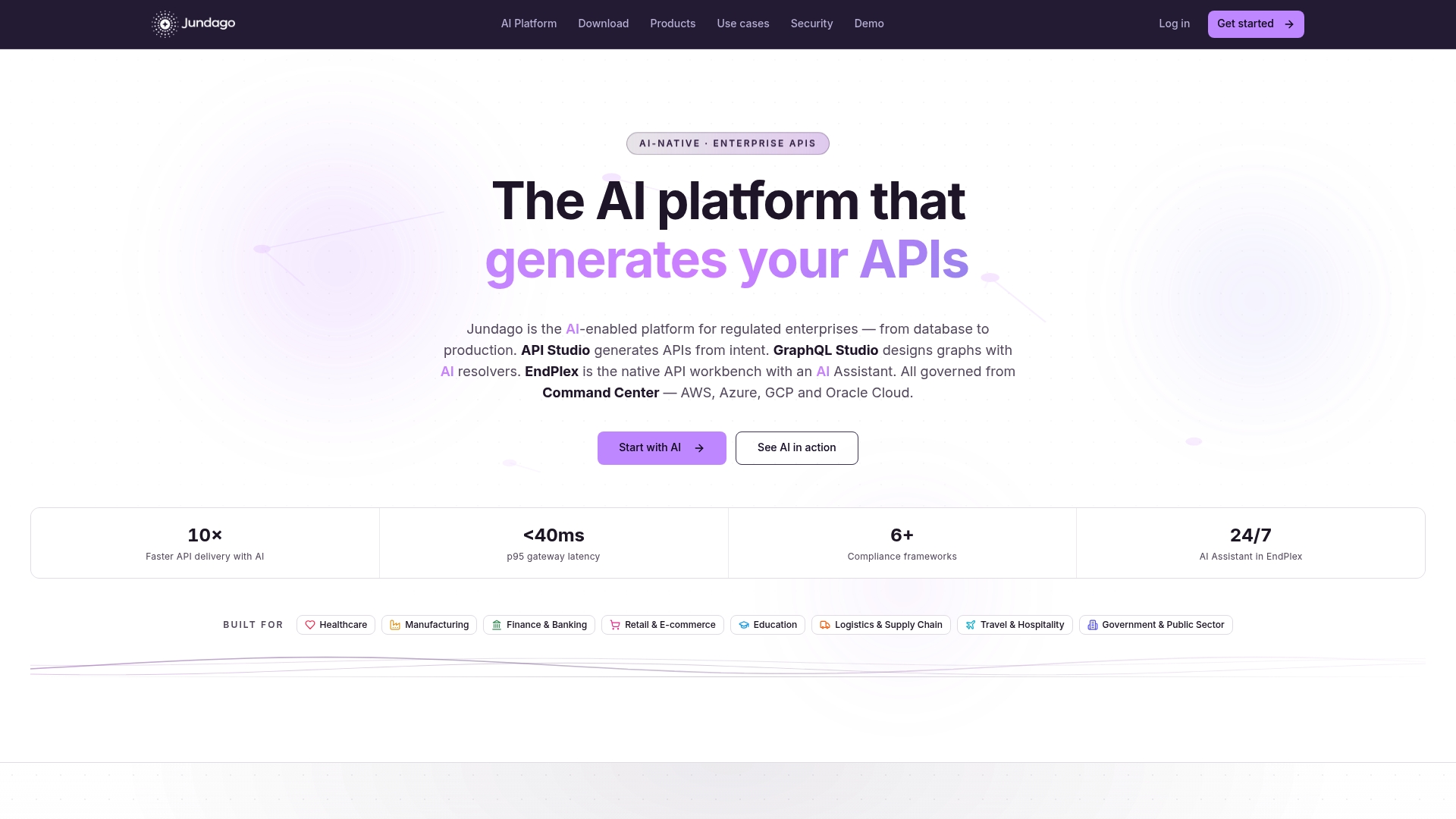
Jundago generates REST, GraphQL, gRPC, and SOAP APIs from natural language intent, governs them with RBAC and ABAC security controls, and deploys across AWS, Azure, GCP, and Oracle Cloud from a single Command Center. The compliance modules for HIPAA, PCI DSS, Open Banking, and IEC 62443 are not add-ons. They are built into the generation and governance layer.
Key capabilities that map directly to the evaluation criteria in this article:
- AI-native API generation from intent, covering REST, GraphQL, gRPC, and SOAP
- Integrated governance linting and compliance automation across multi-cloud deployments
- RBAC and ABAC security controls built into the platform, not bolted on
- ETL/ELT integration studio for API-to-API, DB-to-API, and EDI integrations
- Industry compliance modules for healthcare (HIPAA, HL7 FHIR), finance (PCI DSS, KYC/AML), and manufacturing (IEC 62443)
Request a demo or start a POC at jundago.com to see how the governance and compliance layer performs against your actual spec and deployment environment.
Sources and further reading
- Swagger — API Documentation & Design Tools for Teams: Official Swagger platform page covering OpenAPI, AsyncAPI, and JSON Schema tooling including Editor, UI, and Codegen.
- Redoc — OpenAPI/Swagger-generated API Reference Documentation: Redoc open-source repository covering OpenAPI 3.1, 3.0, and Swagger 2.0 support and distribution options.
- Redocly CLI — Bundle command docs: Official CLI documentation for the
bundlecommand, including--dereferencedoption and multi-file spec handling. - API Blueprint: Official site for the API Blueprint specification, relevant for teams evaluating Apiary
- RAML: Official RAML specification site for teams evaluating RAML-based tooling