API-to-API Integration: A Complete Enterprise Guide
API-to-API Integration: A Complete Enterprise Guide

API-to-API integration is the practice of connecting two or more APIs so they exchange data and trigger actions directly, without a human intermediary. In enterprise settings, three approaches get you to production fastest: routing requests through an API gateway that handles orchestration and cross-cutting concerns, using a DB→API generator to expose your database as a typed REST or GraphQL surface, and deploying a lightweight bridge service that maps and forwards payloads between endpoints. If you’re starting from a legacy database with no existing API layer, the DB→API generator wins on speed. If you have multiple downstream services and need centralized auth and rate limiting, lead with the gateway. If the integration is a focused webhook-to-CRM or form-to-service flow, a bridge service keeps the footprint small.
Key Takeaways
API-to-API integration succeeds when integration logic is centralized at a governed control plane, contracts are locked and tested, and security controls are enforced at the gateway rather than duplicated across services.
| Point | Details |
|---|---|
| Start with the right pattern | Match your pattern (gateway, orchestration, pub/sub, DB→API) to your scale, latency budget, and governance needs before writing code. |
| Centralize security at the gateway | Enforce JWT validation, mTLS, RBAC, and rate limiting once at the gateway rather than duplicating logic across every service. |
| Lock and test contracts | Use contract testing (Pact) and schema locking in a contract registry to catch breaking changes before they reach production. |
| DB→API accelerates regulated access | Tools like Data API Builder and Faucet expose tables and views as governed REST/GraphQL endpoints with row-level RBAC, cutting time-to-first-request significantly. |
| Jundago for full-lifecycle governance | Jundago generates, tests, and governs APIs across AWS, Azure, GCP, and Oracle Cloud with HIPAA, PCI, and IEC 62443 compliance built in. |
Table of Contents
- What does API-to-API integration actually mean?
- Why API-to-API integration drives real business outcomes
- What are the essential architecture components?
- Which integration pattern fits your situation?
- How do you connect one API to another in production?
- How do you secure API-to-API integrations for enterprise compliance?
- How do you test and monitor API-to-API integrations?
- What does an API integration project actually cost and how long does it take?
- When should you use a gateway, iPaaS, DB→API tool, or an AI-native platform?
- What do API-to-API integrations look like across industries?
- What does current research say about DB-centric API architectures?
- What most teams get wrong about API integration (and what to do instead)
- Jundago covers the full API-to-API integration lifecycle for regulated enterprises
- Sources
What does API-to-API integration actually mean?
Before going further, a few terms worth pinning down, because the industry uses them loosely and the distinctions matter for architecture decisions.
Core terms:
- API-to-API integration: A server-side connection where one API calls another API directly, typically mediated by a gateway, orchestration engine, or bridge service. The client never fans out to multiple backends.
- API gateway: A reverse proxy that sits in front of services and handles routing, auth, rate limiting, and policy enforcement centrally.
- Backend for Frontend (BFF): A purpose-built API layer that aggregates upstream APIs for a specific client type (mobile, web, third-party). It is a consumer of API-to-API integration, not a synonym for it.
- Orchestration: A workflow engine controls the sequence of API calls, handles errors, and assembles the final response. One service is in charge.
- Choreography: Services react to events published by other services. No central controller; each service knows its own trigger.
- DB→API integration: A tool or service introspects a database schema and auto-generates REST or GraphQL endpoints, exposing the database as an API surface without hand-written controllers.
The key distinction between API-to-API integration and client-to-multiple-APIs is where the fan-out happens. When a mobile app calls five services directly, the client owns the complexity, the latency compounds, and every auth token must be managed client-side. When a mediating layer handles that fan-out, the client sees one endpoint, and the integration logic lives where it can be governed, versioned, and monitored.
Synchronous API-to-API interactions (REST, gRPC, GraphQL) are request-response: the caller waits. Asynchronous interactions (event streams, message queues, webhooks) decouple the caller from the response cycle entirely. DB→API fits in the synchronous tier by default, though some implementations support change-data-capture streams for event-driven patterns.
Why API-to-API integration drives real business outcomes
The business case for well-designed API integrations is not abstract. Engineering teams that centralize integration logic at a gateway or orchestration layer ship features faster because they stop rebuilding auth, rate limiting, and error handling in every service. That duplication is one of the most expensive hidden costs in distributed systems.
Security posture improves measurably when cross-cutting concerns live in one place. A single gateway enforcing mutual TLS, JWT validation, and RBAC means a policy change propagates everywhere instantly, rather than requiring coordinated deploys across a dozen services.
Auditability follows the same logic. When every inter-service call passes through a governed control plane, you get a complete log of who called what, when, and with what payload. For regulated industries, that audit trail is not optional.
Operational ROI that shows up in sprint reviews:
- Fewer support tickets from auth failures caused by inconsistent token handling across services
- Faster deprecation cycles because contract registries track which consumers depend on which endpoints
- Reduced onboarding time for new engineers who only need to understand the gateway contract, not each upstream service’s quirks
When integration failures become strategic problems is worth naming explicitly. A downstream API timing out during checkout is a revenue event, not a technical footnote. API gateway patterns such as aggregation and orchestration reduce client chatiness and centralize the failure-handling logic that prevents those events from cascading.
What are the essential architecture components?
A production-grade API-to-API integration has two planes: the control plane and the data plane. Getting this separation right is the difference between a system you can govern and one that grows into a maintenance liability.
The control plane owns policy: routing rules, auth enforcement, rate limit configurations, RBAC/ABAC policies, and schema contracts. Changes here propagate without touching service code. The data plane carries the actual traffic: request routing, payload transformation, response assembly, and observability instrumentation.
Core components:
- API gateway: The entry point for inter-service traffic. Handles TLS termination, JWT/mTLS validation, rate limiting, and request routing. Kong, AWS API Gateway, and IBM API Connect are common enterprise choices.
- Orchestration/workflow engine: Sequences multi-step API calls, manages retries, and handles conditional branching. Lives in the control plane but executes in the data plane.
- Service mesh vs. gateway: A service mesh (Istio, Linkerd) handles east-west traffic between services at the network layer. A gateway handles north-south traffic from external clients. In complex environments, you need both; in simpler ones, the gateway alone is sufficient.
- Connector/adapters: Translate between protocols (REST to SOAP, JSON to XML) or data models. Critical for legacy system integration.
- Schema and contract registry: Stores OpenAPI specs, GraphQL schemas, and Avro/Protobuf definitions. Enables contract testing and prevents silent breaking changes.
- Observability plane: Collects traces, metrics, and logs across all integration hops. Jaeger, OpenTelemetry, and Datadog are common here.
- RBAC/ABAC control plane: Enforces who can call what, under what conditions, down to the row and column level for DB→API scenarios.
Pro Tip: When drawing the architecture diagram for an enterprise review, show the control plane and data plane as distinct layers. Place the schema registry, policy engine, and RBAC configuration in the control plane box. Place the gateway, mesh, and connectors in the data plane box. Reviewers from security and compliance teams will immediately understand the governance model.
For DB→API scenarios, Azure Data API Builder demonstrates how modern platforms can introspect database schemas to auto-generate endpoints and provide a control plane for routing, orchestration, and security, reducing the boilerplate that typically consumes the first two weeks of an integration project.
Which integration pattern fits your situation?
No single pattern works for every integration. The right choice depends on your latency budget, team size, governance requirements, and how many downstream services are involved.
| Pattern | Best for | Key tradeoff | Failure mode |
|---|---|---|---|
| Point-to-point | Two services, low complexity, internal only | Fast to build, hard to scale | Spaghetti topology at 5+ services |
| Gateway aggregation | Fan-out to multiple services, single client response | Centralizes concerns; gateway becomes a bottleneck | Gateway SPOF if not HA |
| Orchestration/workflow | Multi-step processes with conditional logic | Explicit control flow; easier to debug | Tight coupling to orchestrator |
| Pub/sub choreography | High-throughput, decoupled event flows | Scales well; hard to trace end-to-end | Event ordering and idempotency bugs |
| BFF | Client-specific aggregation (mobile, web) | Clean client contracts; more services to maintain | Duplicated logic across BFFs |
| DB→API | Expose structured data without hand-written controllers | Fast time-to-first-request; schema changes need care | Schema drift breaks consumers |
Pattern selection in practice:
- Point-to-point works for internal service calls where both services are owned by the same team and the integration is unlikely to grow. Stop using it the moment a third service needs the same data.
- Gateway aggregation (scatter-gather) is the right call when a client needs data from three or more services in a single request. The gateway fans out, waits for responses, and assembles the payload. Latency is bounded by the slowest upstream, so set aggressive timeouts.
- Orchestration fits payment flows, onboarding sequences, and anything with compensating transactions. The workflow engine owns the state machine.
- Pub/sub choreography handles order events, telemetry streams, and audit logs well. The tradeoff is that distributed tracing becomes mandatory, not optional.
- DB→API is the fastest path when your data already lives in a well-structured relational or document database and you need a governed API surface quickly. Data API Builder exposes tables, views, and stored procedures as REST and GraphQL endpoints with configuration-driven RBAC, making it a practical choice for regulated environments.
How do you connect one API to another in production?
The most common mistake teams make is skipping the preflight work and going straight to writing code. That shortcut costs more time in debugging than the preflight would have taken.
Preflight checklist before writing a single line:
- Obtain and review the downstream API’s OpenAPI spec or GraphQL schema
- Confirm auth mechanism: API key, OAuth 2.0 client credentials, mTLS, or JWT
- Document rate limits and burst allowances for the downstream service
- Agree on SLA expectations: p99 latency, uptime, and error budget
- Define idempotency key strategy for any mutating calls
- Confirm data residency requirements (relevant for cross-region or cross-cloud integrations).
Step-by-step implementation sequence:
- Discover the endpoint. Pull the OpenAPI spec. If none exists, generate one from the database schema using a tool like Faucet or Data API Builder.
- Design the contract. Define your integration’s own OpenAPI spec before writing code. This becomes the test surface.
- Map fields. Document the transformation between source and target schemas. Flag any type mismatches (string dates vs. ISO 8601, integer IDs vs. UUIDs).
- Secure auth. Implement the downstream auth flow. For service-to-service calls, prefer short-lived tokens over long-lived API keys. Microsoft’s guidance on calling an API from another API recommends validating downstream responses and maintaining clear trust boundaries in the calling service.
- Test locally. Use Postman to mock the downstream API and validate your request/response cycle before touching any shared environment.
- Deploy with canary. Route a small portion of traffic to the new integration path to monitor error rate and latency before full rollout. Monitor error rate and latency before full rollout.
Example: A fan-out request via curl
# Step 1: Get auth token
TOKEN=$(curl -s -X POST https://auth.example.com/token \
  -d "grant_type=client_credentials&client_id=svc-a&client_secret=$SECRET" \
  | jq -r .access_token)

# Step 2: Call downstream API with token
curl -s -X GET https://api.example.com/orders/42 \
  -H "Authorization: Bearer $TOKEN" \
  -H "Idempotency-Key: req-$(uuidgen)" \
  | jq .
Pro Tip: Always attach an idempotency key to mutating calls (POST, PATCH, DELETE). If the network drops after the downstream service processes the request but before it returns a response, your retry logic will re-send the request. Without an idempotency key, you get duplicate records. With one, the downstream service deduplicates automatically. Generate the key client-side before the first attempt and reuse it on every retry for that operation.
Lightweight bridge services that handle payload mapping and forwarding can eliminate bespoke glue code when the transformation is straightforward. For webhook-to-CRM flows or form submissions that need field normalization before hitting a target API, a bridge service keeps the integration footprint small and the retry logic handled for you.

How do you secure API-to-API integrations for enterprise compliance?
Security in API-to-API integration is not a layer you add at the end. It is a set of decisions baked into the architecture from the first design session.
Auth patterns by use case:
- API keys: Acceptable for low-sensitivity internal services. Rotate them on a schedule and never embed them in client-side code.
- OAuth 2.0 client credentials: The standard for service-to-service auth. The calling service authenticates with a client ID and secret, receives a short-lived access token, and presents it to the downstream API.
- Mutual TLS (mTLS): Both sides present certificates. Required in zero-trust environments and for PCI-scoped service communication.
- JWTs with short expiry: Carry claims about the caller’s identity and permissions. Set expiry to 15 minutes or less for inter-service tokens. Validate signature, expiry, and audience on every request.
- Service identities (SPIFFE/SPIRE): Cryptographic identities issued to workloads, not humans. The right choice for Kubernetes-native service meshes.
Authorization: RBAC vs. ABAC
RBAC (Role-Based Access Control) assigns permissions to roles and roles to services. It works well when access patterns are predictable and the number of roles is manageable. ABAC (Attribute-Based Access Control) evaluates policies against attributes of the request, the resource, and the environment at runtime. It handles fine-grained scenarios that RBAC cannot, such as “this service can read orders only for customers in its assigned region.”
For DB→API integrations, row-level and column-level policies are the critical controls. A service that can read the patients table should not be able to read the ssn column. Configuration-driven RBAC at the gateway or DB→API layer enforces this without application code changes.
Logging, encryption, and compliance:
Every inter-service call should produce a structured log entry with: timestamp, caller identity, target endpoint, HTTP status, latency, and a correlation ID that ties the call to its parent request. That correlation ID is what makes distributed tracing work.
Encrypt data in transit with TLS 1.2 minimum; TLS 1.3 where the infrastructure supports it. Encrypt sensitive fields at rest. For HIPAA-scoped integrations, audit logs must be tamper-evident and retained per your Business Associate Agreement terms. For PCI DSS, cardholder data must never appear in logs, and network segmentation between scoped and out-of-scope services is mandatory.
Pro Tip: Set up a secrets manager (AWS Secrets Manager, HashiCorp Vault, Azure Key Vault) before writing your first integration. Hardcoded credentials in environment variables are a single misconfigured deployment away from exposure. Secrets managers rotate credentials automatically and give you an audit trail of every access.
How do you test and monitor API-to-API integrations?
Testing an integration is not the same as testing a single API. You are testing a contract between two systems, and that contract can break silently when either side changes.
Testing tiers:
- Contract testing (Pact or similar): Verifies that the consumer’s expectations match the provider’s actual behavior without requiring both services to run simultaneously. Run these on every pull request.
- Integration tests (end-to-end): Spin up real instances of both services in a staging environment and validate the full request-response cycle, including auth, field mapping, and error paths.
- Synthetic monitoring: Scheduled real requests against production endpoints that verify the integration is alive and performing within SLA. Fire these every 1–5 minutes.
- Chaos/fault injection: Deliberately kill the downstream service or introduce latency to verify your retry logic, circuit breakers, and fallback responses behave correctly.
- Body-level contract validation: Parse the response body against the expected schema on every test run. A 200 status with a malformed body is a silent failure that contract tests catch and unit tests miss.
Observability signals to track:
- Latency (p50, p95, p99): Set alerting thresholds at p99 > 2× your SLA target.
- Error rate: Alert at >1% 5xx over a 5-minute window for critical integrations.
- Downstream saturation: Track queue depth or connection pool utilization on the downstream service.
- Retry rate: A rising retry rate with a stable error rate signals intermittent network issues before they become outages.
- Token expiry failures: A spike in 401s often means a token refresh flow broke silently.
Runbook entries for common failures:
- Downstream 5xx: Check downstream service health dashboard. If the service is degraded, activate circuit breaker and serve cached or degraded response. Log incident with correlation IDs.
- Auth failures (401/403): Verify token expiry and rotation schedule. Check if the downstream service rotated its signing key. Re-authenticate and retry once before alerting.
- Schema drift: A field that was a string is now an integer, or a required field disappeared. Roll back to the last known-good schema version. File a breaking-change incident with the downstream team. Enforce schema locking on the contract registry going forward.
Rollback guidance: Deploy integrations behind feature flags. If a canary deployment shows error rate elevation, flip the flag to route traffic back to the previous version. Never deploy an integration change without a tested rollback path.
What does an API integration project actually cost and how long does it take?
Integration projects fail budgets more often than they fail technically. The cost surprises almost always come from underestimated transformation complexity and compliance controls, not from the API calls themselves.
The five phases of an integration project:
- Discovery: Map source and target systems, document existing schemas, identify data owners, and assess compliance scope. Deliverable: integration design document.
- Design and contract: Define OpenAPI specs for both sides, agree on field mappings, and establish SLA expectations. Deliverable: signed-off contract document and schema registry entries.
- Build: Implement the integration logic, auth flows, transformation layer, and error handling. Deliverable: working integration in a development environment.
- Test and validation: Run contract tests, integration tests, performance tests, and security review. Deliverable: test report and sign-off from security.
- Deploy and operate: Canary rollout, monitoring setup, runbook documentation, and handoff to operations. Deliverable: production deployment with alerting configured.
Primary cost drivers:
- Connector complexity: A REST-to-REST integration with matching schemas is cheap. A REST-to-SOAP integration with XML transformation and legacy auth is expensive.
- Data transformation needs: Simple field renames are trivial. Aggregating data from three sources with business logic in the mapping layer is a significant engineering effort.
- Security and compliance controls: HIPAA and PCI scoping add 20–40% to build time in most projects, primarily from audit logging, encryption configuration, and security review cycles.
- Latency and throughput SLAs: High-throughput integrations require load testing, capacity planning, and may require infrastructure changes.
- Ongoing maintenance: Schema changes, upstream API deprecations, and credential rotations are recurring costs that teams consistently underestimate.
Realistic timelines by integration size:
- Small (two services, matching schemas, no compliance scope): 2–4 weeks with one senior engineer.
- Medium (three to five services, moderate transformation, internal compliance review): 6–12 weeks with a team of two to three engineers plus a security reviewer.
- Large (multi-system, regulated data, external audit, multi-cloud deployment): 3–6 months with a dedicated integration team including an architect, two to three engineers, a QA engineer, and a compliance lead.
When should you use a gateway, iPaaS, DB→API tool, or an AI-native platform?
The tooling category you choose determines your ceiling for governance, speed, and operational complexity. Picking the wrong category is more expensive than picking the wrong vendor within the right category.
| Category | Best fit | Governance depth | DB→API support | AI-native features |
|---|---|---|---|---|
| API gateway | Centralized routing, auth, rate limiting | High | No | Limited |
| iPaaS | Pre-built connectors, low-code flows | Medium | Partial | Growing |
| DB→API generator | Expose structured data fast, regulated access | Medium-High | Native | Emerging |
| AI-native API platform | Full lifecycle: generate, test, govern, deploy | High | Native | Full |
Selection guidance:
- API gateway (Kong, AWS API Gateway, IBM API Connect): Choose this when you need centralized policy enforcement across existing services. IBM API Connect adds enterprise lifecycle management, developer portal, and analytics on top of gateway routing, making it a strong fit for organizations that need to publish APIs to external partners. Postman complements any gateway category with its API design, testing, and documentation workspace, and its contract testing capabilities integrate with most CI/CD pipelines.
- iPaaS: Choose this when your integration is primarily about connecting SaaS applications with pre-built connectors and your team has limited API engineering depth. The tradeoff is that complex transformations and custom auth flows quickly hit the limits of low-code tooling.
- DB→API generator: Choose this when your data lives in a relational or document database and you need a governed API surface without building controllers. Faucet auto-generates REST endpoints and OpenAPI specs from SQL schemas at runtime, includes RBAC, and ships an MCP server for governed AI-agent access. NpgsqlRest takes a database-first approach where SQL files and functions become the API surface, with typed client generation and annotation-driven caching and auth.
- AI-native API platform: Choose this when you need the full lifecycle covered: generation from intent, schema design, automated testing, governance, and multi-cloud deployment, with compliance built in rather than bolted on.
Feature checklist for procurement:
- Auto-generation from OpenAPI spec or database schema
- RBAC and ABAC with row/column-level policies
- Contract testing integration with CI/CD
- Multi-cloud deployment (AWS, Azure, GCP)
- Audit logging with tamper-evident storage
- Industry compliance modules (HIPAA, PCI DSS, IEC 62443)
- AI-agent access controls (MCP server or equivalent)
What do API-to-API integrations look like across industries?
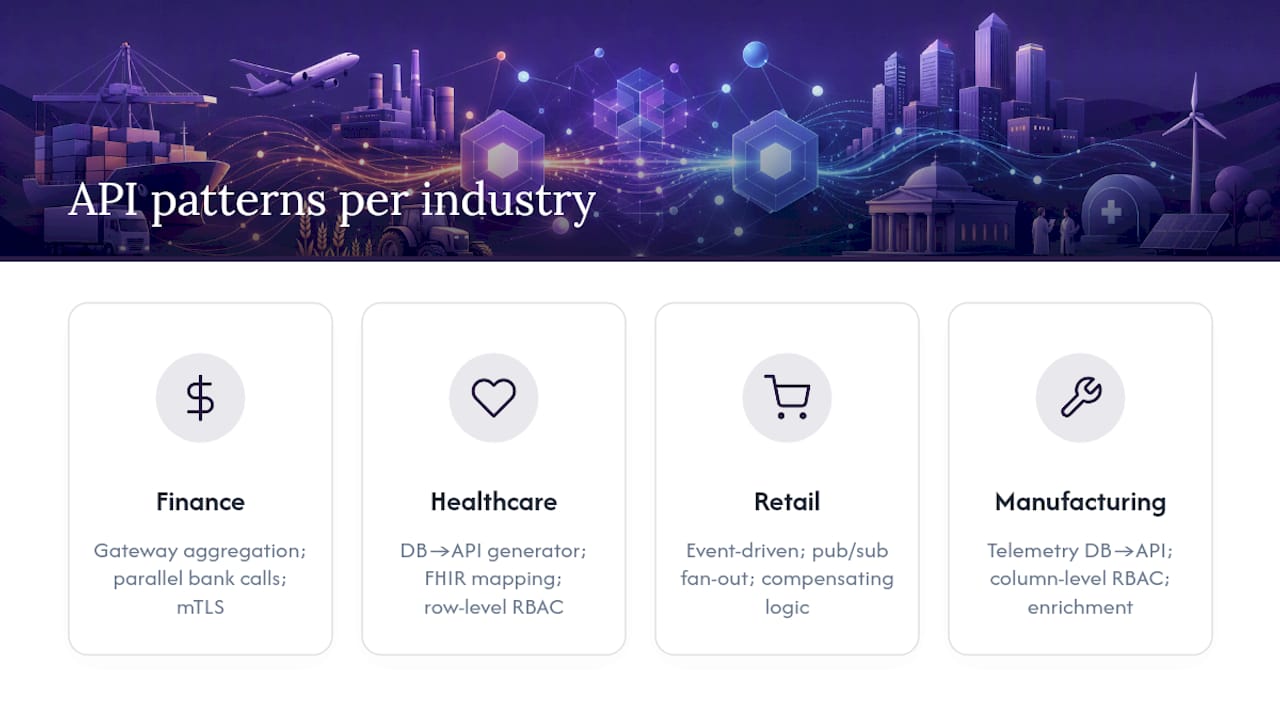
Abstract patterns become concrete when you see them applied to real problems. Here are four industry flows that show which patterns to reach for and why.
Finance: Payment reconciliation and Open Banking fan-outs
A payment platform needs to reconcile transactions across three banking partners and a fraud detection service. The gateway aggregation pattern handles this: the orchestration layer calls each banking API in parallel, waits for all responses, and passes the assembled payload to the fraud service before returning a reconciled result. PCI DSS scoping means mTLS between all services, cardholder data never appears in logs, and the gateway enforces network segmentation between scoped and out-of-scope services.
Healthcare: HL7 FHIR DB→API with HIPAA constraints
A health system stores patient records in a relational database and needs to expose a FHIR-compliant API to a network of care coordinators. A DB→API generator introspects the schema and generates FHIR-mapped endpoints. Row-level RBAC ensures care coordinators see only patients in their assigned panel. Every API call produces a HIPAA-compliant audit log entry. The FHIR mapping layer handles the transformation between the internal schema and the HL7 standard.
Retail: Order-to-fulfillment orchestration
An order placed on the storefront triggers a pub/sub event. A fulfillment orchestrator subscribes to the event and fans out to inventory, shipping, and notification APIs in sequence. If the inventory API returns a backorder status, the orchestrator routes to an alternative fulfillment center before calling shipping. The event-driven pattern decouples the storefront from fulfillment latency; the orchestrator owns the compensating transaction logic if any step fails.
Manufacturing: Telemetry aggregation from SCADA systems
Factory floor sensors write telemetry to a time-series database. A DB→API layer exposes that data as a REST endpoint with column-level RBAC so the maintenance team sees raw sensor values while the executive dashboard sees aggregated KPIs. A gateway orchestration layer combines the telemetry API with an asset registry API to enrich each reading with equipment metadata before forwarding to the analytics platform. IEC 62443 compliance requirements drive network segmentation and audit logging at the gateway.
What does current research say about DB-centric API architectures?
The trend toward database-centric API design is not just a developer preference. It reflects a practical response to the cost of maintaining hand-written controller layers that duplicate logic already expressed in the database schema.
PostgREST’s documentation makes the practitioner case directly: treating the database as the single source of truth for data-heavy systems avoids the leaky abstractions that emerge when the database is treated as an implementation detail. When business rules live in both the application layer and the database, they diverge. The database-centric approach keeps them in one place.
The tooling has matured to match that philosophy. Faucet introspects schemas at runtime, generates CRUD endpoints and OpenAPI docs, and ships a built-in MCP server for governed AI-agent queries. That last feature matters more than it might seem: as AI agents become a real integration consumer (not just a demo), the ability to give an agent governed, auditable access to a database through a typed API surface is a compliance requirement, not a nice-to-have.
NpgsqlRest demonstrates the developer productivity angle: SQL files and functions become the API surface, typed clients are generated automatically, and annotations in SQL handle caching, auth, and rate limits. The iteration cycle shrinks from days to hours.
Decision criteria for adopting DB→API tooling:
- Your data model is stable enough that schema changes go through a review process
- You need a governed API surface quickly and cannot wait for a full controller build
- Your compliance requirements include row/column-level access control
- You want AI agents to query your data through a governed, auditable interface
When to build a custom adapter instead:
- The transformation between your database schema and the required API contract is complex enough that a configuration file cannot express it
- You need business logic in the API layer that goes beyond filtering and field selection
- The downstream consumer requires a protocol (gRPC, SOAP) that your DB→API tool does not support natively
The rise of AI-native tooling that generates endpoints from natural language intent, as demonstrated by platforms like Jundago’s API Studio, extends this trend further: the schema introspection step itself becomes automated, and the time-to-first-request shrinks to minutes rather than days.
What most teams get wrong about API integration (and what to do instead)
The most expensive mistakes in API-to-API integration are not technical failures. They are architectural decisions made under time pressure that look fine in a sprint demo and become liabilities six months later.
Pushing integration logic into clients is the most common one. When a mobile app or a frontend service fans out to five APIs, manages its own auth tokens, and assembles the response, every client becomes a custom integration layer. Adding a new downstream service means updating every client. A mediating layer, whether a gateway or a BFF, centralizes that logic once.
Duplicating security logic across services is the second. When each service implements its own JWT validation, rate limiting, and RBAC, the implementations drift. One service validates the audience claim; another does not. One rotates its signing key; the others keep accepting the old one. Centralize these at the gateway and enforce them as policies, not code.
Ignoring schema contracts until something breaks is the third. A downstream team renames a field, changes a type, or removes an endpoint without a major version bump. Your integration breaks silently in production. Contract testing with Pact and schema locking in your contract registry catches these before deployment, not after.
Under-investing in observability is the fourth, and it compounds all the others. Without distributed tracing, a p99 latency spike in a fan-out integration is nearly impossible to attribute to a specific downstream service. OpenTelemetry instrumentation on every integration hop, tied to a correlation ID that flows from the original request, turns a two-hour debugging session into a two-minute trace lookup.
The corrective actions are not complicated. Centralize policies at the gateway. Adopt contract testing in CI. Enforce schema locking for DB→API surfaces. Automate synthetic tests that run against production every few minutes. These are not heroic engineering efforts. They are the baseline that separates integrations that age well from ones that require a rewrite every 18 months.
Jundago covers the full API-to-API integration lifecycle for regulated enterprises
Regulated enterprises face a specific version of the integration problem: every pattern discussed in this guide needs to work within a compliance boundary, and most tooling forces you to bolt compliance on after the fact.
Jundago is built the other way around. API Studio generates REST, GraphQL, gRPC, and SOAP APIs from natural language intent. DB→API integration is native, with RBAC and ABAC enforced at the row and column level from day one. The integration studio handles ETL and ELT flows alongside API-to-API and EDI integrations, so your data pipelines and your API layer share the same governance model. EndPlex, the native API workbench, handles testing, debugging, and load testing without leaving the platform. Command Center deploys and governs across AWS, Azure, GCP, and Oracle Cloud from a single control plane. Industry modules for HIPAA, PCI DSS, Open Banking, and IEC 62443 ship with the platform, which means compliance controls are configured, not custom-built. Request a demo at Jundago to see how your team can go from database schema to governed, production-ready API in a fraction of the time a traditional build takes.
Sources
The following resources back the recommendations in this guide and are worth bookmarking for deeper dives.
- faucetdb/faucet - GitHub
- NpgsqlRest - Automatic REST API for PostgreSQL
- PostgREST documentation
- Api7
- Manta