API Rate Limiting: Algorithms and Production Patterns
API Rate Limiting: Algorithms and Production Patterns

API rate limiting caps how many requests a client, user, or API key can make in a given window, and it rejects the rest. Exceed the cap and the API returns HTTP 429 Too Many Requests, usually with a Retry-After header telling the client when to come back. For most public, developer-facing APIs, the token bucket algorithm is the right starting point because it tolerates short bursts. If you need a hard, provable ceiling instead, sliding window is the better call.
- 429 status code signals the request was rejected purely for volume, not content
- Retry-After tells the client how many seconds (or a timestamp) to wait
- Token bucket for general use; sliding window when the cap must be strict
Key Takeaways
Rate limiting protects APIs and backend resources by capping calls per identity, and choosing token bucket, sliding window, or GCRA depends on your accuracy and burst tolerance needs.
| Point | Details |
|---|---|
| Default response | Return HTTP 429 with a Retry-After header so clients know exactly when to retry. |
| Pick the right algorithm | Token bucket for general APIs, sliding window counter for strict caps at scale. |
| Atomicity matters | Use Redis with Lua scripts to avoid race conditions in concurrent enforcement. |
| Reduce central load | Add local-chunk leasing at gateways to cut Redis traffic while accepting minor drift. |
| Govern policy centrally | Jundago’s Command Center enforces RBAC/ABAC rate-limit rules consistently across environments and clouds. |
Table of Contents
- Why API Throttling Matters for Security, Cost, and Fairness
- How Rate Limiting Works: Enforcement Points and Response Headers
- Which Rate Limiting Algorithm Should You Use?
- Building Rate Limiting for Distributed Systems
- Where to Place Rate Limiting Checks in Your Stack
- How Do You Test and Monitor Rate Limits?
- How Do You Design a Rate Limit Policy?
- Why Governed Rate Limit Rollout Matters for Regulated Enterprises
- Enforce Rate Limits Consistently Across Every Environment
- Frequently Asked Questions
- Sources
Why API Throttling Matters for Security, Cost, and Fairness
Rate limits exist because unmetered access breaks systems in predictable ways. An attacker running credential stuffing against a login endpoint looks identical to a legitimate user, until volume gives them away. Rate limiting is one of the few controls that catches that pattern without needing to understand intent.
The business case is just as strong as the security one:
- Abuse prevention: throttling slows brute-force attempts and shrinks the practical surface for denial-of-service style abuse.
- Resource protection: backend databases and downstream APIs have finite capacity; limits keep one client from starving everyone else and blowing your SLOs.
- Cost control: every call to a metered third-party service (payment processors, LLM APIs, SMS gateways) costs money, and usage tiers only work if limits are enforced.
- Fair access: a single noisy tenant in a multi-tenant system can otherwise consume capacity meant for hundreds of others.
Teams that skip formal rate limit policies almost always discover the gap during an incident, not during design review, which is the expensive way to learn it.
How Rate Limiting Works: Enforcement Points and Response Headers
Where you enforce a limit matters as much as which algorithm you pick. Checking at the CDN or edge blocks bad traffic before it costs you anything, but the edge often lacks user-level context. Checking at the API gateway is the common middle ground: you know who the caller is, and you haven’t yet touched the database. Checking deep in the service layer gives the most context but wastes the most resources on requests you’re about to reject anyway.
When a client is throttled, the response should do more than just say no:
- Return
429 Too Many Requests, never a generic403or500. - Include
Retry-Afterwith a concrete wait time in seconds or an HTTP date. - Emit rate-limit context so clients can self-throttle before hitting the wall.
Two header conventions coexist right now. The informal X-RateLimit-Limit, X-RateLimit-Remaining, and X-RateLimit-Reset headers are what most APIs still ship. A newer IETF draft standardizes RateLimit and RateLimit-Policy headers, giving clients a structured way to read quota and policy in one field instead of parsing three separate ones. Cloudflare has already adopted the draft while plenty of other services stick with the legacy pattern, so the safest move is emitting both.
Pro Tip: Never let your client code retry immediately after a 429. Read Retry-After and wait at least that long. If the header is missing, treat that as a bug in the API you’re calling, not a green light to hammer it.
Which Rate Limiting Algorithm Should You Use?
The algorithm you choose trades memory footprint against precision and burst tolerance, and there’s no single right answer across every endpoint in your system.
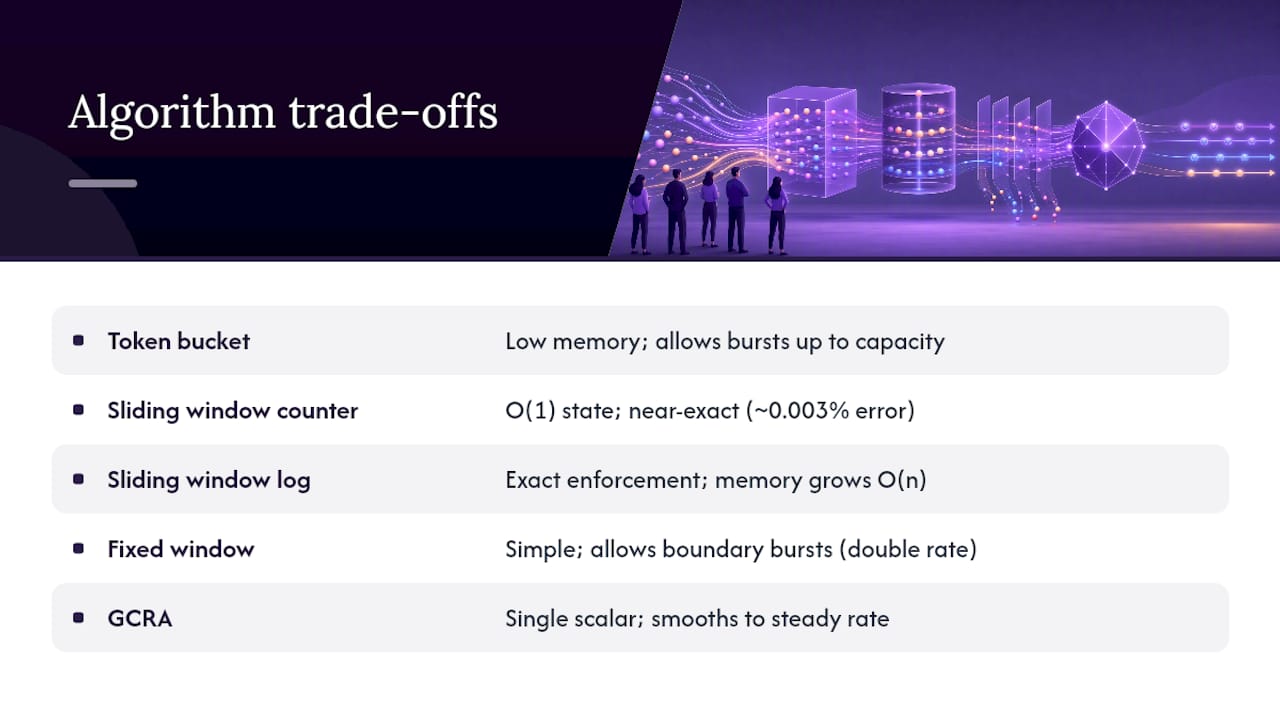
Token bucket is the default for a reason: it stores just two values (current tokens and last refill timestamp), runs in constant time, and lets clients burst up to bucket capacity before throttling kicks in. Most public APIs and gateways use it as their baseline because real traffic is bursty, not smooth.
Sliding window counter blends the current and previous window’s counts, weighted by elapsed time. It needs only O(1) state yet gets remarkably close to exact enforcement. One large-scale analysis found Cloudflare’s implementation held error rates around 0.003%, which is why it’s become the pragmatic choice at global scale.
Sliding window log stores every request timestamp, giving exact enforcement, but memory grows with request volume (O(n)). Reserve it for endpoints where precision genuinely matters, like fraud-sensitive financial transactions.
Fixed window is the simplest to build but allows a burst at the boundary between two windows, effectively doubling the real rate for a brief moment. Fine for internal tooling; risky for anything customer-facing at scale.
Leaky bucket and GCRA smooth output into a steady rate rather than allowing bursts. GCRA in particular stores a single scalar (the theoretical arrival time), making it a strong fit for memory-constrained edge filters.
Building Rate Limiting for Distributed Systems
Enforcing a limit on one server is trivial. Enforcing it across fifty servers, all seeing slices of the same client’s traffic, is where most homegrown implementations fall apart.
- Use Redis with atomic Lua scripts. Lua scripts execute atomically inside Redis, collapsing the read-check-decrement sequence into a single round trip. Without that atomicity, concurrent requests race past a limit that looks correct in isolation.
- Add a local-chunk layer in front of Redis. Instead of hitting the central store on every request, each gateway node borrows a chunk of tokens and depletes it locally. This pattern cuts Redis traffic by roughly 10x at the cost of a 5 to 10 percent accuracy drift, an easy trade for most APIs.
- Decide fail-open versus fail-closed before you need to. A recommendation feed can fail open if Redis goes down. A payment authorization endpoint should fail closed, rejecting requests rather than risk unmetered access during an outage.
- Plan for multi-region deployments explicitly. Route users to their home region where possible, and accept a bounded worst case (roughly 2x the configured limit) rather than paying cross-region latency on every check.
Pro Tip: Tune your local chunk size per tenant tier. Enterprise customers with high, steady volume can take larger leases; free-tier accounts should get small ones so a runaway script gets caught fast.
Where to Place Rate Limiting Checks in Your Stack

Placement decisions come down to how much context you need versus how cheap you want the rejection to be. CDN and edge-level throttling (via Envoy or NGINX filters, often backed by a central limiter service) stops obvious abuse before it reaches your infrastructure. API gateway enforcement is where most teams land: it has caller identity without the overhead of a full service invocation.
If you’re on .NET, the built-in Microsoft.AspNetCore.RateLimiting middleware supports named policies you attach to specific endpoints, with fixed-window, sliding-window, and token-bucket limiters available out of the box. Microsoft’s documentation walks through configuring these policies, but every example there comes with the same caveat: load test before shipping. A policy that looks correct in a unit test can behave very differently under concurrent load.
- Edge/CDN: cheapest rejection, least context
- API gateway: identity aware, moderate cost, most common choice
- Service layer: full context, most expensive rejection
Calling Redis synchronously on every single request adds latency you’ll feel at scale, which is exactly why the local-chunk pattern above exists.
How Do You Test and Monitor Rate Limits?
A rate limiter you haven’t load tested is a policy you’re guessing about. Simulate bursts with API testing tools or load runners that can fire concurrent requests from multiple simulated identities, not just one client hammering sequentially.
- Load test for boundary behavior, especially with fixed window algorithms where the window edge is the failure point.
- Monitor 429 rate as a first-class metric, broken out by endpoint and client tier, not just aggregated across the API.
- Track Retry-After compliance to see whether clients are actually honoring it or retrying blind.
- Alert on sudden spikes in over-limit rejections, which usually means either abuse or a client bug, not normal traffic growth.
On the client side, exponential backoff with full jitter is the standard defense against retry amplification; pair it with idempotency keys so retried writes don’t duplicate. Watch your P99 latency, too. If the limiter itself is adding more than a few milliseconds at the tail, that’s usually a sign the enforcement path needs re-architecting, not more tuning.
How Do You Design a Rate Limit Policy?
Pick your rate-limit key first. Authenticated traffic should be keyed by API key or user ID; IP-based limits should be reserved for unauthenticated endpoints, since IPs behind shared NAT or corporate proxies create false positives that punish innocent users for someone else’s traffic.
- Default to token bucket unless you have a specific reason (financial or security endpoints) to choose sliding window log instead.
- Decide enforcement location up front: gateway for most cases, local chunking once you’re operating at real scale.
- Build tiered limits into the policy from day one, not as a retrofit when your first enterprise customer complains.
- Cap per-endpoint, not just globally. A single expensive search endpoint can starve everything else if it shares a global budget.
- Document headers and expected client behavior in your API reference, not just in internal runbooks.
| Decision | Recommendation |
|---|---|
| Rate-limit key | API key or user ID for authenticated calls; IP only for anonymous traffic |
| Default algorithm | Token bucket; sliding window counter for strict, high-scale caps |
| Enforcement point | API gateway, with local chunking added once QPS demands it |
Why Governed Rate Limit Rollout Matters for Regulated Enterprises
Rate limit policy tends to drift the moment more than one team owns it. One environment gets token bucket with a generous burst, another gets a stricter fixed window nobody documented, and now your compliance audit has to explain two different behaviors for the same endpoint.
An integrated API platform that generates, tests, and governs APIs from a single source of truth closes that gap. When RBAC and ABAC controls sit alongside automated testing, the same rate-limit policy gets validated and enforced consistently across every environment, not hand-copied between config files. For regulated industries where an inconsistent throttling rule can itself become an audit finding, that consistency is the whole point.
Enforce Rate Limits Consistently Across Every Environment
Writing a good rate-limit policy is one problem. Keeping it identical across dev, staging, and three cloud regions is a different one entirely, and it’s usually where teams lose control. Jundago generates APIs from natural language across REST, GraphQL, gRPC, and SOAP, and governs them centrally, so a rate-limiting rule you define once gets applied the same way everywhere the API deploys.
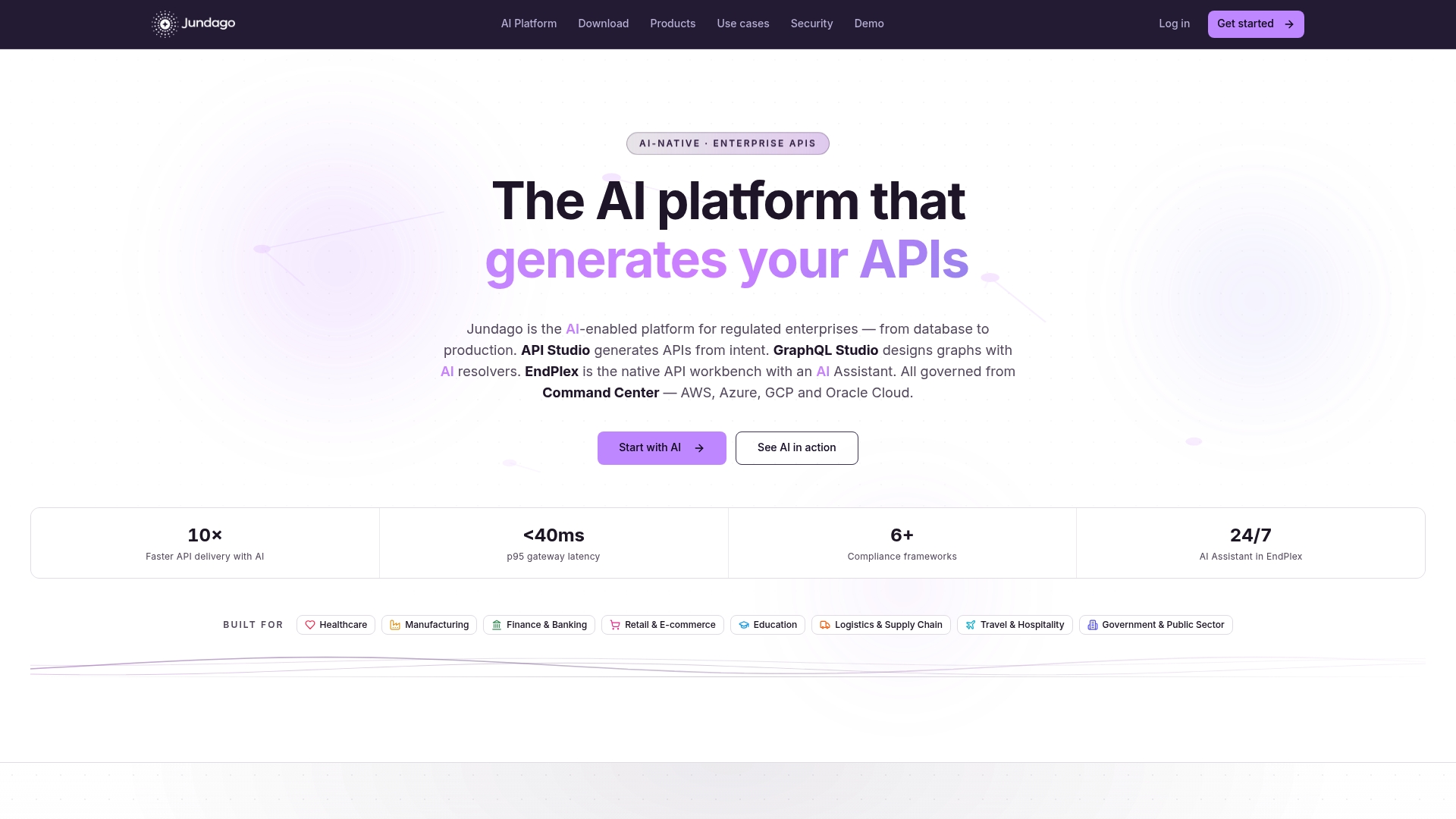
API Studio builds the endpoint and its policies together, EndPlex gives you a native workbench with an AI Assistant for testing throttling behavior under load before it ships, and Command Center governs RBAC and ABAC rules across AWS, Azure, GCP, and Oracle Cloud from one place. For healthcare, finance, and manufacturing teams where compliance documentation matters as much as the code, that means your rate-limit policy is provable, not just implemented. Start a trial at Jundago to see how policy enforcement stays consistent from generation through production.
Frequently Asked Questions
What is the difference between rate limiting and throttling? Rate limiting sets the hard cap on calls allowed in a window; throttling is often used interchangeably but sometimes refers specifically to slowing requests down rather than rejecting them outright. In practice, most API teams use the terms as synonyms.
What HTTP status code indicates a rate limit was hit?
429 Too Many Requests is the standard response, typically paired with a Retry-After header specifying the wait time in seconds or as an HTTP date.
Should I rate limit by IP address or API key? Use API key or user ID for any authenticated endpoint. IP-based limiting should be reserved for unauthenticated traffic, since shared IPs behind corporate NATs can trigger false positives against innocent users.
How do I handle bursts of legitimate traffic without blocking users? Token bucket algorithms are built for this. They allow bursts up to a configured capacity while still enforcing a long-term average rate, which handles legitimate spikes better than fixed window limits do.
Is sliding window always better than token bucket? No. Sliding window counter gives tighter accuracy at similar memory cost, but token bucket’s native burst tolerance makes it the better fit for most developer-facing APIs where occasional spikes are normal, not abusive.
Sources
- Rate Limiting: Protecting Systems from Themselves - The HLD Handbook
- Design a Distributed Rate Limiter - The HLD Handbook
- ArXiv: Design and evaluation of rate limiters (2026)
- What Is Rate Limiting? - Microsoft Learn