API Mocking Guide: Simulate Endpoints Without a Live Backend
API Mocking Guide: Simulate Endpoints Without a Live Backend

API mocking means simulating an API’s behavior with a fake endpoint that returns realistic responses, so you can build and test without a live backend. It works because you can generate mocks straight from an OpenAPI, GraphQL, or gRPC contract instead of waiting for the real service to exist. Seventy-four percent of organizations had adopted an API-first development approach by 2024, up from 66% the year before, and mocking is the practical engine behind that shift. Record-and-replay tools now capture live traffic and turn it into reusable fixtures automatically.
Engineers reach for mocks in three recurring situations:
- Building frontend features while the backend team is still writing the real endpoint.
- Testing failure modes (timeouts, 500s, malformed payloads) that a live service won’t reliably reproduce on demand.
- Isolating tests from flaky, rate-limited, or expensive third-party APIs.
Key Takeaways
Schema-driven mocks generated from OpenAPI, GraphQL, or gRPC contracts reduce drift and keep frontend and backend teams working from the same source of truth.
| Point | Details |
|---|---|
| Start with the contract | Generate mocks from an OpenAPI, GraphQL, or gRPC schema instead of hand-writing responses. |
| Match mock type to task | Use static mocks for prototypes, contract-based mocks for team alignment, record-and-replay for complex integrations. |
| Test failure modes, not just success | Inject latency, timeouts, and malformed responses so negative paths get real coverage. |
| Keep regulated data out of shared mocks | Mask or synthesize payloads and add RBAC/ABAC before opening a mock server to multiple teams. |
| Scale beyond DIY when governance matters | Jundago generates and governs mocks with audit trails and compliance modules across multi-cloud deployments. |
Table of Contents
- Should You Mock This API? A Quick Decision Checklist
- Types of API Mocks and When Each One Fits
- How to Build and Integrate an API Mock
- Which Mocking Tool Fits Your Situation?
- What Regulated Teams Need Beyond a Basic Mock Server
- Best Practices and the Pitfalls That Break Mocks
- When DIY Mocking Stops Scaling
- Frequently Asked Questions
- Sources
Should You Mock This API? A Quick Decision Checklist
Before writing a single stub, ask three questions. Is the real backend unavailable, incomplete, or too slow to hit repeatedly in a test suite? Do you need to simulate stateful workflows, like a cart that updates across requests? Is the dependency a flaky or metered third-party service you’d rather not hammer in CI?
Match the scenario to the approach:
- Frontend prototyping with no backend yet: static stubs get you moving in minutes.
- Contract testing between teams: schema-driven mocks generated from OpenAPI or GraphQL keep both sides honest.
- Testing against an existing but risky integration: record-and-replay captures real traffic once, then replays it forever.
Pro Tip: Never pipe production payloads directly into a shared mock server. Scrub or synthesize any personally identifiable data first, especially if the mock environment is reachable by more than your immediate team.
Types of API Mocks and When Each One Fits
Not every mock deserves the same amount of engineering effort, and picking the wrong type wastes time in both directions.
Static mocks return a fixed, hardcoded response no matter the input. They’re fast to write and perfect for early UI work where you just need something to render on screen.
Dynamic mocks compute the response based on request parameters, headers, or a simple rules engine. Use these when a UI needs to render different states, like an empty cart versus a full one, without hand-writing every case.
Contract-based mocks are generated directly from an OpenAPI, GraphQL, or gRPC schema. They enforce that requests and responses match the agreed contract, which is exactly why schema-driven mocks reduce drift between what the frontend expects and what the backend actually ships.
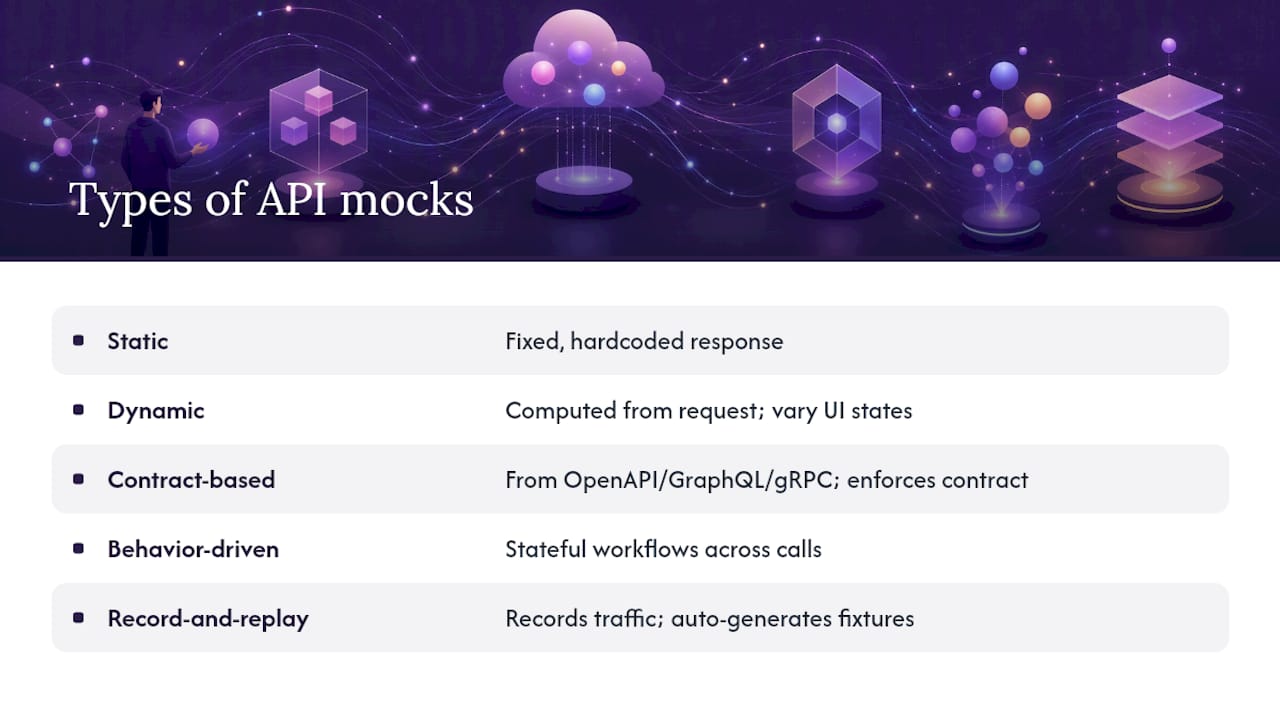
Behavior-driven mocks simulate stateful workflows across multiple calls, like an order that moves from “pending” to “shipped” only after the right sequence of requests. WireMock’s scenario and state features exist precisely for this.

Record-and-replay mocks capture real interactions and turn them into fixtures automatically, which is the model Keploy uses to skip manual mock authoring entirely.
When picking, weigh four things: does the mock need to hold state, does it stay aligned to a schema, can it simulate faults and latency, and does it plug into CI without extra glue code?
How to Build and Integrate an API Mock
The workflow, in one sentence: define the contract, generate or author the mocks, run them locally, then wire everything into your test suite and CI pipeline.
-
Start from the schema, not from memory. Import or author an OpenAPI, GraphQL, or gRPC definition. Generating mocks from a real spec, rather than guessing at shapes by hand, is what keeps contracts consistent as both sides of an integration evolve.
-
Pick your mock flavor. For a frontend team, an in-browser interceptor that reuses request handlers across unit, integration, and end-to-end tests, the pattern Mock Service Worker popularized, cuts out a whole class of “works in dev, breaks in test” bugs. For backend or integration testing, a standalone mock server makes more sense.
-
Run the mock locally. Point your app’s base URL at the mock server or let the interceptor take over network calls in the browser. A minimal handler might just match a route like
GET /api/orders/:idand return a canned JSON body with a 200 status. -
Wire it into your test suite and CI. The mock should spin up automatically in your test runner’s setup step and tear down after. Add a contract verification step that diffs your mock responses against the live schema so drift gets caught before merge, not after a customer reports it.
-
Inject faults and latency for negative tests. Add scenarios that return 429s, 500s, or artificial delays. This is where most teams under-invest, and it’s exactly where production incidents tend to originate.
Pro Tip: Sandbox mock endpoints per environment (local, CI, staging) so a stale mock configuration in one environment can’t silently leak into another and mask a real regression.
Which Mocking Tool Fits Your Situation?
The right tool depends less on brand reputation than on where the mock needs to live and how much state it has to track.
For frontend work, an in-browser interceptor like Mock Service Worker (MSW) shines because the same request handlers run across your unit tests, integration tests, and end-to-end suite without duplicating logic.
For server-side and integration testing, standalone servers like WireMock handle dynamic templating, stateful scenarios, and record-and-playback in one package, while MockServer extends that further with gRPC and GraphQL protocol support alongside its OpenAPI import.

For teams that want mocks generated automatically instead of hand-authored, Keploy’s record-and-replay model captures real application interactions, including database and queue calls, and turns them into reusable test fixtures without a human writing a single stub.
For rapid prototyping or a quick demo endpoint, lightweight no-code mock servers that import an OpenAPI spec and spin up a stateful mock in minutes fill the gap MSW and WireMock aren’t built for.
As a rough guide: local frontend development leans toward in-browser interceptors, CI contract testing leans toward schema-driven standalone servers, and complex multi-service integrations lean toward record-and-replay. Regulated, multi-cloud environments need something more, which the next section covers.
What Regulated Teams Need Beyond a Basic Mock Server
If your mock payloads could ever contain real customer data, healthcare records, or financial details, default to local-first or private-hosted mocking rather than routing that traffic through a third-party cloud service. Privacy-first infrastructure choices matter more once mocks touch anything resembling PII.
Concretely, regulated teams should build in:
- Encryption at rest and in transit for anything stored in the mock server.
- RBAC or ABAC controls on who can create, edit, or view mock configurations and their admin APIs.
- Audit logging on every mock definition change, not just production changes.
- Masked or fully synthesized data instead of copied production payloads.
With 74% of organizations now running API-first workflows, the volume of mock infrastructure sitting inside regulated companies has grown fast, and governance hasn’t always kept pace with that growth.
Best Practices and the Pitfalls That Break Mocks
A mock that isn’t maintained becomes a liability faster than having no mock at all.
Do this:
- Store mocks in source control alongside the code they support, not in a wiki or a teammate’s local folder.
- Generate mocks from OpenAPI or GraphQL schemas so they can’t silently drift from the real contract.
- Include negative scenarios and artificial latency, not just the happy path.
- Automate schema diffing so contract drift fails a build instead of surfacing in production.
- Run contract verification as a required CI check, not an optional one.
Avoid this:
- Over-simplified responses that never test edge cases like pagination, null fields, or partial failures.
- Sensitive or production-derived data sitting unmasked in a shared mock environment.
- Mocks nobody has touched in months while the real API evolved underneath them.
- Skipping periodic runs against the actual live service.
Mocks are excellent for development speed and test isolation, but they are not a substitute for final acceptance testing against live services. A mock can pass every check you wrote for it while the real API has quietly changed underneath. Treat mocking as a fast feedback layer, not the last gate before release.
Where Teams Should Actually Start
I’d tell most teams to start narrower than they think: pick your two or three highest-traffic API flows, generate schema-driven mocks for those first, and add record-and-replay only once you hit a genuinely painful third-party integration. Trying to mock everything on day one burns weeks that could go toward better test coverage.
Regulated teams specifically should decide on local-first versus hosted infrastructure before writing a single mock, not after an audit forces the question.
Pro Tip: If you’re building for a regulated industry, bake RBAC into your mock admin tooling from the first sprint. Retrofitting access controls onto a mock server that’s already in daily use across three teams is far more painful than starting with it.
When DIY Mocking Stops Scaling
Hand-rolled mocks work fine until you’re managing dozens of schemas across five teams, three clouds, and an auditor asking for a change history you don’t have. That’s the point where a governed, enterprise-grade platform earns its keep over a folder of WireMock configs someone wrote two years ago.
Jundago generates mocks and full API implementations directly from natural-language intent, across REST, GraphQL, gRPC, and SOAP, with RBAC and ABAC access controls, audit logging, and industry-specific compliance modules for healthcare, finance, and manufacturing built in from the start. Everything runs through one Command Center across AWS, Azure, GCP, and Oracle Cloud, so mock governance doesn’t fragment across teams the way it does when everyone picks their own tool. If your test infrastructure has outgrown what a single open-source mock server can govern, see how Jundago’s API lifecycle platform handles schema generation, testing, and compliance in one place, or start a trial to run it against your own API contracts. For a look at how sandboxing and testing habits shift in complex integration work, the practical notes on ERP integration testing are worth a read too.
Frequently Asked Questions
What’s the difference between API mocking and API virtualization?
API mocking typically simulates a single endpoint’s responses for development or testing. API virtualization tools go further, modeling entire dependent systems with stateful behavior, making them useful for full-scale performance and load testing rather than just unit-level checks.
Can I use the same mocks for local development and CI?
Yes, and you should. Tools like Mock Service Worker are built so the same request handlers work across unit, integration, and end-to-end tests, which means local dev and CI stay in sync instead of drifting apart.
Do mocks help with API load testing and stress testing?
Mocks are useful for early-stage load testing because they let you simulate high request volumes without hammering a real backend or racking up third-party API costs. For true performance testing under production-like conditions, you’ll eventually need to test against the real service too, since mocks won’t reveal database contention or downstream latency.
How do I keep mocks from going stale?
Generate them from your OpenAPI or GraphQL schema and run automated diffing in CI so any contract change fails the build immediately. Store mock definitions in source control right next to the code, and schedule periodic runs against the live API to catch drift a schema diff might miss.
Is record-and-replay better than hand-authored mocks?
It depends on the use case. Record-and-replay, the approach Keploy uses, saves significant manual effort for complex integrations with many edge cases, since it captures real interactions automatically. Hand-authored, schema-driven mocks still make more sense for new APIs that don’t have live traffic to record yet.
Sources
- mswjs/msw
- WireMock - flexible, open source API mocking | WireMock
- A Developer’s Guide to API Mocking: Benefits, Tools, and Tips | Keploy Blog
- MockServer — Mock any HTTP service. Record traffic. Now with MCP for AI assistants.