API Gateway Security: Developer and SecOps Field Guide
API Gateway Security: Developer and SecOps Field Guide

Secure your API gateway by enforcing strong identity controls, transport encryption, request validation, and runtime protection as your first four moves. That is the short answer. Here is the immediate checklist:
- Enable OAuth 2.0/OIDC or mTLS for every inbound request. API keys alone are not sufficient for anything beyond low-risk machine clients.
- Force TLS 1.2 minimum, TLS 1.3 where possible. Reject plaintext connections at the gateway, not at the service.
- Apply rate limiting per user, per token, and per IP on every endpoint, with tighter windows on login and token-issuance paths.
TL;DR: API gateway security centralizes authentication, TLS, rate limiting, and request validation so your microservices never see unauthenticated or malformed traffic. Start with those four controls, then layer in WAF integration, observability, and governance.
Quick checks you can run in the next 30 minutes: (1) Confirm your gateway rejects HTTP and accepts only HTTPS. (2) Hit a protected endpoint without a token and verify you get a 401, not a 200. (3) Send 200 rapid requests to a login endpoint and confirm throttling kicks in before the 50th request.

Platforms like Jundago automate these controls for regulated enterprises, shipping RBAC/ABAC, compliance mappings for HIPAA and PCI DSS, and multi-cloud governance from a single Command Center.
Table of Contents
- What does an API gateway actually protect?
- How do you choose and configure authentication at the gateway?
- Where should you terminate TLS, and how do you manage certificates?
- How do rate limiting and DDoS mitigation work in practice?
- Stop bad requests before they reach your services
- How does a WAF complement your API gateway?
- What should you log, measure, and alert on?
- How do you secure the gateway in your CI/CD pipeline?
- How do you govern APIs across their full lifecycle?
- How Jundago automates API gateway security for regulated enterprises
- Key Takeaways
- The part most teams get wrong about API gateway security
- Jundago handles the complexity of regulated API security
- Further reading and authoritative references
What does an API gateway actually protect?
The gateway sits at the edge of your architecture: every external request passes through it before touching a single internal service. Think of it as the one place where you can enforce policy once and have it apply everywhere.
What the gateway centralizes:
- Authentication and authorization (OAuth 2.0, OIDC, JWT validation, mTLS, API key verification)
- TLS termination and certificate management
- Rate limiting, throttling, and quota enforcement
- Input validation and schema enforcement
- Request routing and load balancing
- Response filtering (strip internal headers, redact sensitive fields)
- Centralized logging and access auditing
Where the gateway sits in a typical cloud-native architecture:
Client → API Gateway → Internal Services → Data Stores / Downstream APIs
The gateway is the only publicly routable component. Internal services communicate over a private network or service mesh, and the gateway controls what reaches them.
What the gateway does not replace:
- Service-level authorization. If an attacker bypasses or compromises the gateway, services with no internal auth checks are fully exposed. The OWASP Secure API Gateway Blueprint is explicit: implement secondary claim-based ABAC or resource-level checks inside each microservice.
- A dedicated WAF. The gateway manages access; a WAF inspects payloads for application-layer attacks like SQL injection and XSS. They are complementary, not interchangeable.
- Network segmentation. Zero Trust principles require that every request be verified by identity, not network location. The gateway enforces identity at the edge, but micro-segmentation and least-privilege network rules still apply inside.
The practical implication: treat the gateway as your first defense layer, not your only one. Defense in depth means services behind it still validate inputs, enforce their own authorization, and emit their own logs.
How do you choose and configure authentication at the gateway?
Authentication is where most teams make their most consequential mistakes, usually by picking a method that is too weak for the sensitivity of the endpoint or too complex to operate reliably.
Choosing the right auth method
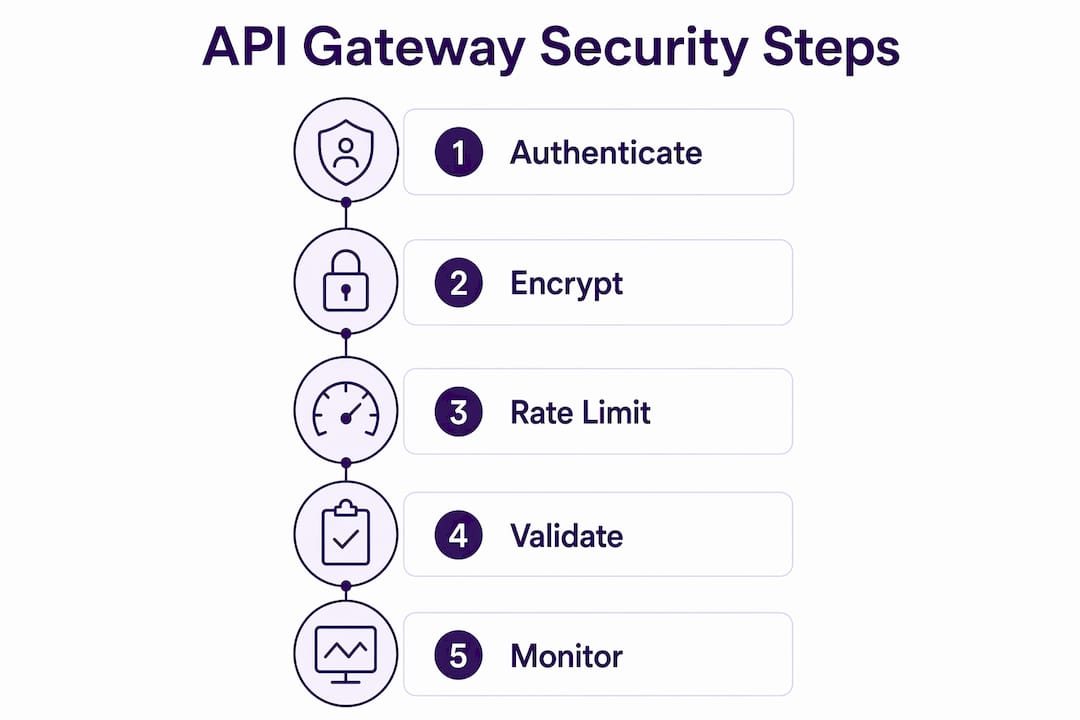
OAuth 2.0 / OIDC with JWT is the right choice for user-delegated flows and any API consumed by third-party clients. The gateway validates the JWT locally (signature, issuer, audience, expiry) on every request without a round-trip to the authorization server. For high-risk operations like payment initiation or account deletion, add token introspection so revoked tokens are caught in real time.
Opaque tokens or HTTP-only cookies belong in browser-facing APIs. JWTs stored in localStorage are a persistent XSS target. Opaque tokens keep the actual claims server-side, and HTTP-only cookies are inaccessible to JavaScript entirely. Curity’s Zero Trust guidance recommends this split explicitly: JWT for backend service calls, opaque tokens or cookies for browser apps.
mTLS is the right choice for service-to-service calls and IoT/device identity. Both sides present certificates, so the gateway can verify the calling service’s identity cryptographically, not just by a shared secret. This matters in regulated environments where you need non-repudiation.

API keys are acceptable only for low-risk, machine-to-machine integrations where the client is a known, controlled system. Never use them as the sole auth mechanism for user-facing endpoints or anything touching PII.
Token validation checklist
Every inbound request should pass these checks at the gateway before routing:
- Signature valid (RS256 or ES256; reject HS256 for multi-party flows)
iss(issuer) matches your authorization serveraud(audience) matches this specific APIexpnot in the past;nbfnot in the future- Required scopes present and not over-broad
- Token not on a revocation list (for high-risk endpoints, use introspection)
RBAC and ABAC at the gateway
Role-based access control (RBAC) maps token claims to allowed operations. Attribute-based access control (ABAC) goes further, evaluating contextual attributes like the requesting IP, time of day, or resource ownership. Apply RBAC at the gateway for coarse-grained routing decisions, and push ABAC into the service layer for fine-grained resource checks.
Pro Tip: Set access token lifetimes to 15 minutes or less for sensitive APIs. Long-lived tokens are the single most common way a compromised credential stays active for hours after detection. Pair short-lived tokens with a refresh flow and store refresh tokens in secure, HttpOnly cookies or a server-side session store.
Where should you terminate TLS, and how do you manage certificates?
TLS termination is a decision with real security and operational tradeoffs. There is no universally correct answer, but there is a right answer for your threat model.
| Pattern | How it works | Pros | Cons |
|---|---|---|---|
| Terminate at edge (gateway) | Gateway decrypts; backend traffic is plaintext or re-encrypted | Simplest cert management; full observability at gateway | Backend traffic unencrypted unless re-encrypted; backend must be trusted network |
| Pass-through | Gateway forwards encrypted traffic to backend | End-to-end encryption; backend holds its own cert | Gateway cannot inspect payloads; harder to enforce policies |
| Re-encrypt | Gateway terminates, then establishes new TLS to backend | Full observability + end-to-end encryption | Higher latency; two cert chains to manage |
For most cloud-native deployments, terminate at the gateway and re-encrypt to backends. This gives you payload visibility for WAF and validation rules while maintaining encryption in transit. SSL/TLS termination patterns affect observability, backend certificate requirements, and mTLS implementation, so document your choice and its rationale in your architecture decision record.
Certificate management hardening
- Automate certificate issuance and renewal. Manual rotation is the primary cause of expired-cert outages.
- Use short-lived certificates (90 days or less) for service-to-service mTLS. ACME-compatible CAs or cloud-managed CAs (AWS ACM, Azure Key Vault) handle rotation automatically.
- Store private keys in an HSM or cloud KMS, never on disk in plaintext.
- Maintain a trust store for client certificates in mTLS flows and rotate it on a defined schedule.
TLS hardening checklist
- Enforce TLS 1.2 minimum; prefer TLS 1.3. AWS API Gateway’s
SecurityPolicy_TLS13_1_3_2025_09policy accepts TLS 1.3 and rejects TLS 1.0 and 1.2 traffic, which is the right posture for regulated workloads. - Disable weak cipher suites (RC4, 3DES, export-grade ciphers).
- Enable HSTS on public-facing endpoints with a
max-ageof at least one year. - Set
STRICTendpoint access mode on AWS API Gateway enhanced security policies when possible.
How do rate limiting and DDoS mitigation work in practice?
Rate limiting is one of the cheapest controls you can add and one of the most neglected to tune properly. A flat global limit is better than nothing, but per-endpoint, per-identity limits are what actually stop abuse without blocking legitimate traffic.
Policy examples:
- Login endpoints: 5 requests per minute per IP, 10 per minute per user. Burst of 2. Anything above that gets a 429 with a
Retry-Afterheader. - Data export endpoints: 10 requests per hour per token. No burst. These are expensive operations; treat them that way.
- Standard API endpoints: 100 requests per minute per token, 500 per minute per IP (to account for NAT). Burst of 20.
- Webhook receivers: Rate-limit by source IP and validate HMAC signatures before processing.
Operational playbook:
- Start with permissive limits and tighten based on observed traffic patterns. Deploying aggressive limits without baseline data causes false positives.
- Monitor 429 response rates by endpoint and by client. A spike in 429s on a login endpoint is either a brute-force attempt or a misconfigured client — both need investigation.
- Use circuit breakers to stop cascading failures when a backend service is degraded. The gateway should return 503 with a
Retry-Afterrather than queuing requests indefinitely. - Integrate with your CDN or cloud DDoS protection (AWS Shield, Azure DDoS Protection) for volumetric attack absorption. The gateway handles application-layer limits; the CDN absorbs volumetric floods before they reach the gateway.
- Apply quotas at the API product level for partner or third-party consumers. A daily quota of 10,000 requests per API key is a business control as much as a security one.
Stop bad requests before they reach your services
Schema validation at the gateway is one of the highest-leverage controls available. A request that fails validation never reaches a service, which means it cannot trigger a bug, an injection vulnerability, or an unexpected code path.
What to enforce
JSON schema validation on every POST, PUT, and PATCH body. Define required fields, allowed types, string formats (email, UUID, date-time), and maximum lengths. Reject anything that does not match with a 400 and a structured error body. A minimal example:
{
  "type": "object",
  "required": ["userId", "amount"],
  "properties": {
    "userId": { "type": "string", "format": "uuid" },
    "amount": { "type": "number", "minimum": 0.01, "maximum": 1000000 }
  },
  "additionalProperties": false
}
The additionalProperties: false line is critical. Without it, clients can inject arbitrary fields that services may process unexpectedly.
Size limits: Set a maximum request body size (typically 1–10 MB depending on the endpoint) and reject oversized payloads with a 413. Unbounded payload sizes are a vector for memory exhaustion attacks.
Header and path validation: Validate that required headers (Content-Type, Authorization) are present and correctly formatted. Reject path traversal patterns (../, %2e%2e) with a 400.
What not to do
- Never rely on client-side validation as your only check. Clients are untrusted by definition.
- Do not use permissive wildcard rules (
.*) in schema definitions. They defeat the purpose. - Do not silently drop invalid fields. Return a structured 400 so legitimate clients can debug their integration.
- Do not accept
Content-Type: application/x-www-form-urlencodedon endpoints that expect JSON unless you explicitly need it. Unexpected content types bypass schema validators.
How does a WAF complement your API gateway?
The gateway and a WAF solve different problems. The gateway manages access, routing, and policy enforcement. The WAF inspects the content of requests for malicious payloads. Running one without the other leaves a gap: a gateway without a WAF cannot reliably block SQL injection or XSS, and a WAF without a gateway has no centralized auth or rate-limiting layer.
WAF integration checklist:
- Place the WAF in front of or inline with the gateway, not behind it. The WAF should inspect traffic before the gateway routes it to services.
- Share request IDs and correlation headers between the WAF and gateway so you can join logs during incident investigation.
- Enable shared logging to a central SIEM so WAF rule hits and gateway auth failures appear in the same timeline.
Rule sets to deploy:
- OWASP Core Rule Set (CRS) for injection, XSS, and path traversal protection.
- API-specific rules: enforce that REST endpoints only accept expected HTTP methods; block undocumented paths.
- Bot detection signatures: challenge or block known scanner user-agents and headless browser fingerprints.
- Rate-based rules at the WAF layer for IP-level volumetric detection, complementing the gateway’s per-token limits.
When to add runtime behavioral protection:
Generic WAF rules catch known attack signatures. Behavioral detection catches anomalies: a token that suddenly starts calling endpoints it has never touched, a client that enumerates sequential IDs, or a service account making requests at 3 AM. Add API-specific runtime protection when your threat model includes insider threats, compromised credentials, or sophisticated automated attacks. This is distinct from WAF rules and typically requires a dedicated API security platform or SIEM correlation logic.
What should you log, measure, and alert on?
Observability is where security teams either catch incidents in minutes or discover them weeks later in a post-mortem. The gateway is the best place to collect a consistent, high-fidelity log stream because every request passes through it.
Suggested log schema
Each gateway log entry should include:
| Field | Purpose |
|---|---|
timestamp |
ISO format, UTC |
request_id |
Unique per request; propagate as trace ID |
source_ip |
For rate-limit correlation and geo-blocking |
token_subject |
sub claim from JWT or client cert CN |
endpoint |
Method + path template (not raw path with IDs) |
response_code |
For error rate dashboards |
latency_ms |
Backend + gateway overhead |
rule_hits |
WAF or validation rules triggered |
auth_method |
OAuth, mTLS, API key |
Strip PII from log fields before shipping to your SIEM. Log the token subject, not the user’s email or SSN. For HIPAA-covered workloads, ensure logs are stored in an encrypted, access-controlled log store with a retention period that meets your audit requirements (typically six years for HIPAA). PCI DSS requires log retention of at least one year, with three months immediately available.
Key metrics to track
- Auth failure rate by endpoint (spike = brute force or misconfigured client)
- 429 rate by endpoint and client (spike = abuse or quota misconfiguration)
- 4xx/5xx error rates (sudden rise = deployment issue or active attack)
- Token validation failure rate (spike = token replay or clock skew issue)
- Latency p99 by endpoint (sudden rise = backend degradation or large payload attack)
Alerting checklist
- Alert on auth failure rate exceeding baseline by 3x over a 5-minute window.
- Alert on any 401/403 from a service account that has not been active in 30 days.
- Alert on WAF rule hits above a defined threshold per hour.
- Integrate gateway logs with your SIEM (Splunk, Elastic SIEM, Microsoft Sentinel) using structured JSON so correlation rules can join gateway events with host and network logs.
- Propagate
request_idas a trace header (X-Request-IDor W3Ctraceparent) so distributed traces in tools like Jaeger or AWS X-Ray link back to the gateway log entry.
How do you secure the gateway in your CI/CD pipeline?
Configuration drift is one of the most common causes of security regressions in API gateways. A policy that worked in staging gets overwritten in production by a hotfix, and nobody notices until an audit or an incident.
Pipeline steps (in order)
- Lint gateway policies against your policy schema on every pull request. Reject configs that disable auth, allow wildcard CORS origins, or set rate limits above defined thresholds.
- Run schema validation on API definitions (OpenAPI 3.x) to catch missing security schemes or undocumented endpoints before deployment.
- Execute automated security tests: contract tests that verify auth is enforced, fuzzing tests that send malformed payloads and confirm 400 responses, and negative tests that confirm unauthenticated requests get 401s.
- Canary rollout for config changes: deploy to 5% of traffic, monitor error rates and auth failure rates for 15 minutes, then promote or roll back.
- Staged promotion: dev → test (with live-like synthetic data) → staging → production. Never promote a config that has not passed automated security tests.
- Post-deployment monitoring: watch the metrics described in the observability section for 30 minutes after every production config change.
Secrets management
- Never hardcode API keys, certificates, or client secrets in gateway configuration files or environment variables checked into source control.
- Use a managed secret store: AWS Secrets Manager, HashiCorp Vault, or Azure Key Vault. Reference secrets by ARN or path in your gateway config.
- Rotate credentials on a defined schedule and automate rotation where the gateway platform supports it. Cloud-native gateways provision security group rules and network controls as part of deployment; audit those rules for least-privilege on every release.
- Scan IaC templates (Terraform, CloudFormation) for hardcoded secrets using tools like truffleHog or git-secrets in your CI pipeline.
How do you govern APIs across their full lifecycle?
Security does not end at deployment. APIs accumulate over time, teams change, and endpoints that were once actively maintained become forgotten. Shadow and zombie APIs — undocumented or abandoned endpoints still reachable through the gateway — are a significant and often overlooked attack surface.
Policy matrix by environment
| Control | Dev | Staging | Production |
|---|---|---|---|
| Auth required | Optional | Required | Required |
| TLS enforced | Recommended | Required | Required |
| Rate limiting | Relaxed | Production-equivalent | Enforced |
| Schema validation | Warn | Enforce | Enforce |
| WAF | Off | On | On |
| Logging | Verbose | Standard | Standard + SIEM |
Governance controls
- API discovery: run continuous discovery to inventory every routable endpoint. Any endpoint not registered in your API catalog should trigger an alert and be blocked by default.
- Access reviews: quarterly review of which clients and service accounts have access to which APIs. Revoke credentials that have not been used in 90 days.
- Deprecation workflow: version APIs explicitly (URI versioning or header versioning), set a sunset date, notify consumers via the
Sunsetresponse header, and remove the old version only after traffic drops to zero. - Policy templates: when a new API is registered, automatically apply a baseline policy template (auth required, TLS enforced, rate limits set, logging enabled). Teams opt out explicitly and with documented justification, not by default.
Compliance mapping
For HIPAA-covered APIs, gateway logs provide the access audit trail required under the Security Rule. Map log fields to the required audit controls: who accessed what data, when, and from where. For PCI DSS, gateway rate limiting and WAF rules map to requirements around protecting cardholder data from automated attacks. Both frameworks require that access controls be reviewed periodically, which maps directly to the access review governance control above.
AWS frames gateway security under the shared responsibility model: the cloud provider secures the infrastructure, but you own the policy configuration, access controls, and compliance mapping. That boundary matters for audit purposes.
How Jundago automates API gateway security for regulated enterprises
Jundago is built specifically for the gap between “we have an API gateway” and “our APIs are actually compliant and governed.” The platform maps the controls described throughout this guide into automated, auditable workflows for regulated enterprises.
Control-to-capability mapping
| Security control | Jundago capability |
|---|---|
| Authentication and authorization | Built-in RBAC and ABAC; OAuth 2.0/OIDC integration; token validation configuration |
| TLS management | Managed certificate handling across AWS, Azure, GCP, and Oracle Cloud |
| Rate limiting and quotas | Per-endpoint, per-token, and per-IP policy configuration from Command Center |
| Schema enforcement | API Studio generates OpenAPI definitions with validation rules from natural language intent |
| WAF integration | Gateway policies configurable for WAF rule alignment and payload inspection |
| Logging and SIEM export | Structured log output with compliance-ready field schemas for HIPAA and PCI DSS audit trails |
| CI/CD automation | Automated security testing, schema validation, and canary rollout support in deployment pipelines |
| Governance and lifecycle | API discovery, deprecation workflows, access reviews, and policy templates in Command Center |
| Compliance modules | Industry-specific modules for healthcare (HIPAA, HL7 FHIR), finance (PCI DSS, KYC/AML), and manufacturing (IEC standard) |
How it works in practice for regulated enterprises
Jundago’s API Studio generates REST, GraphQL, gRPC, and SOAP APIs from natural language intent, with security policies and schema validation rules embedded from the start rather than bolted on later. The EndPlex workbench provides a native environment for testing and debugging with an AI Assistant, so developers catch auth misconfigurations and schema violations before they reach staging.
Command Center provides a single governance plane across AWS, Azure, GCP, and Oracle Cloud. Security teams can enforce baseline policy templates across all registered APIs, run access reviews, and export audit logs in formats that satisfy HIPAA and PCI DSS requirements without manual log transformation. The ETL/ELT integration studio handles DB-to-API and API-to-API integrations with the same security controls applied consistently, so data pipelines do not become a governance blind spot.
For a healthcare organization deploying FHIR APIs, Jundago ships the HIPAA compliance module with pre-configured audit logging, access controls, and data handling policies. For a financial services team building Open Banking APIs, the PCI DSS module maps gateway policies to the relevant requirements out of the box.
Key Takeaways
Effective API gateway security requires layering identity controls, transport encryption, request validation, and continuous observability — none of these controls works in isolation, and skipping any one of them leaves a gap that the others cannot close.
| Point | Details |
|---|---|
| Start with identity and TLS | Enforce OAuth 2.0/OIDC or mTLS and TLS 1.2+ before any other control — these two stop the majority of unauthorized access attempts. |
| Rate limit every endpoint | Apply per-token, per-IP, and per-endpoint limits with tighter windows on login and token-issuance paths to block brute force and abuse. |
| Validate at the gateway, not the service | Schema validation with additionalProperties: false and strict size limits stops malformed payloads before they reach any service. |
| Observability enables fast response | Log token subject, source IP, endpoint, response code, and rule hits on every request; alert on auth failure rate spikes and 429 surges. |
| Jundago automates governance at scale | Jundago’s Command Center enforces baseline policy templates, RBAC/ABAC, compliance mappings, and API lifecycle governance across multi-cloud deployments. |
The part most teams get wrong about API gateway security
The conventional wisdom says: deploy a gateway, enable auth, and you are covered. That framing is wrong in a specific, consequential way. The gateway is a policy enforcement point, not a security perimeter. Treating it as a perimeter leads teams to under-invest in service-level authorization and over-invest in gateway configuration complexity.
The teams that get this right share one habit: they treat the gateway as the first check in a chain, not the only check. Every service behind the gateway still validates the token claims it cares about, still enforces its own resource-level authorization, and still logs its own access events. The gateway catches the obvious attacks. The service layer catches the subtle ones, like a valid token being used to access a resource it was never meant to reach.
The second thing teams consistently underestimate is the operational cost of strict validation. Enforcing JSON schema with additionalProperties: false is the right call for security. It will also break clients that have been sending undocumented fields for years without anyone noticing. The fix is not to loosen the schema. The fix is to canary the validation policy, watch for 400 spikes by client, and work with those clients to clean up their requests. Observability during rollout is not optional; it is what makes strict controls survivable.
The third mistake is governance debt. Teams secure the APIs they know about and forget the ones they do not. Continuous API discovery is not a nice-to-have for large organizations. It is the control that prevents a forgotten internal endpoint from becoming the path of least resistance for an attacker who has already cleared the gateway.
Start with the four immediate controls. Build the observability layer before you tighten anything else. Then tackle governance. That sequence works because it gives you the visibility to tune safely, rather than locking down first and debugging blind.
Jundago handles the complexity of regulated API security
Regulated enterprises face a specific version of this problem: the controls described in this guide need to be consistent, auditable, and mapped to compliance frameworks that auditors actually check. Doing that manually across multiple cloud environments and dozens of APIs is where teams run out of bandwidth.
Jundago is the platform built for exactly that situation. Instead of configuring RBAC, ABAC, schema validation, audit logging, and compliance mappings separately on each gateway deployment, Jundago’s Command Center enforces them from a single governance plane across AWS, Azure, GCP, and Oracle Cloud. API Studio generates compliant APIs from intent, with security policies embedded from the first line. Compliance modules for HIPAA, PCI DSS, and IEC 62443 ship pre-configured, not as a post-deployment checklist.
If your team is building APIs in healthcare, finance, or manufacturing and needs governance that keeps pace with your deployment velocity, see what Jundago covers and request a demo to walk through how the platform maps to your specific compliance requirements.
Further reading and authoritative references
These are the sources worth bookmarking depending on your role.
For developers implementing auth and token flows:
- Why APIs Require Zero Trust Security (Curity) — the clearest practical breakdown of JWT vs opaque token selection and token validation requirements.
- OWASP Secure API Gateway Blueprint — the authoritative reference for service-level authorization and defense-in-depth requirements.
For SecOps and platform engineers:
- Security in Amazon API Gateway (AWS Docs) — shared responsibility model, logging, and compliance configuration for AWS deployments.
- AWS API Gateway Security Policies — TLS version and cipher suite configuration reference for REST APIs.
- Best Practices for API Gateway Security (Snyk) — practical walkthrough of HTTPS, request validation, rate limiting, WAF, and logging configuration.
- What Is API Gateway Security? (Security Compass) — solid overview of centralized controls and the gateway-vs-WAF distinction.
For compliance and governance teams:
- Zero Trust API Security: Key Principles and Challenges (A10 Networks) — Zero Trust principles mapped to API security requirements, including identity-centric models and least-privilege enforcement.
- The Practical Guide to Zero Trust for APIs (Traceable.ai) — covers API discovery, shadow API governance, and continuous verification requirements.
- SSL/TLS Termination in API Gateway Pattern (C# Corner) — decision framework for termination vs pass-through vs re-encrypt patterns.
Start here if you are new to this space: read the OWASP Blueprint first for the mental model, then the Snyk best practices post for implementation specifics. If you are preparing for a HIPAA or PCI DSS audit, the AWS shared responsibility documentation is the reference your auditors will expect you to know.